12.05.2026
 1562
1562
1562
What Is a Smart Sensor for a Water Meter and How Does It Work?
1562
Remote water metering is becoming a standard part of modern utility infrastructure. Conversely, as the number of metering points grows, manual meter reading is seen as increasingly inefficient, with data received late, the risk of errors during data transmission and processing, and a distributed infrastructure that requires significant resources to maintain its operation.
Smart sensors for water meters make it possible to automate this process. These sensors register the operation of the meter, generate consumption data, and transmit it to the metering system. This solution works by connecting a conventional water meter to a digital platform where the data can be used for billing, analytics, water consumption tracking, and detection of abnormal situations.
A smart sensor is a device or functional unit that captures meter readings and converts them into a digital signal. At the same time, the meter itself may remain analog. Used in the latest digital water meter solutions, the sensor is installed on the meter or next to it, detects changes in the state of the metering mechanism, and transmits this data to the radio module.
A radio module is a device that receives data from the metering device and transmits it over a wireless network to a data collection and processing system. In Jooby solutions, this action is used in remote water meters, where the sensor and radio module operate as a unified system: the sensor is responsible for reading the data, while the radio module is responsible for processing and transmitting it.
The advantage of this approach is that the digitalization of a metering system does not always require a complete replacement of the existing infrastructure. In many projects, it’s sufficient to select a compatible sensor and radio module for a specific meter model in order to connect the metering point to a digital system.
There are several technologies for reading water meter data. They differ in operating principle, meter requirements, and operational characteristics, but they all perform the same task, that of reliably determining the volume of water that has passed through the meter.
One of the most common approaches is pulse reading, where the meter or a sensor connected to it generates a pulse when a specified volume of water passes through. For example, one pulse may correspond to a certain number of liters or cubic meters. The radio module counts these pulses and then converts them into an automated meter reading. Pulse-based systems are well suited for large-scale metering because they are simple, energy-efficient, and compatible with many meter models.
Another option is magnetic reading. In some water meters, the movement of the metering mechanism is associated with changes in the magnetic field. The sensor detects this change and determines that the meter has registered a new consumption volume. The advantage of this approach is the absence of direct mechanical contact with the metering mechanism. However, proper installation and protection against external magnetic influence are important for reliable operation.
Optical reading is used when the sensor detects the movement of indicators, marks, or elements of the metering mechanism using an optical principle. This technology can be applied in specific configurations, but it’s more sensitive to contamination, lighting conditions, installation quality, and the condition of the surface from which the data is read.
Digital reading is used in meters where consumption data is already available through an integrated digital interface. In this case, the radio module does not count individual pulses but instead receives ready-made values or structured data directly from the meter. Carrying out utility water monitoring in this way reduces the risk of signal interpretation errors and may allow the transmission of not only current readings but also additional meter status parameters. Its use requires a meter with an appropriate interface and data exchange support.
Ultrasonic reading is used in ultrasonic water meters, where flow is determined by changes in the travel time of an ultrasonic signal through the water flow, rather than the rotation of a mechanical metering mechanism. Such meters do not contain moving parts in the measuring path, which increases wear resistance and helps maintain accuracy during long-term operation. In remote metering systems, an ultrasonic meter typically transmits already processed flow and consumption data through a digital interface or integrated communication module.
A more advanced class of solutions are encoder meters. In these smart water monitoring systems, meter readings are generated digitally inside the meter itself. Such systems can provide high accuracy and extended diagnostic capabilities, but they usually require a specific type of meter and are more expensive than pulse-based or magnetic solutions.
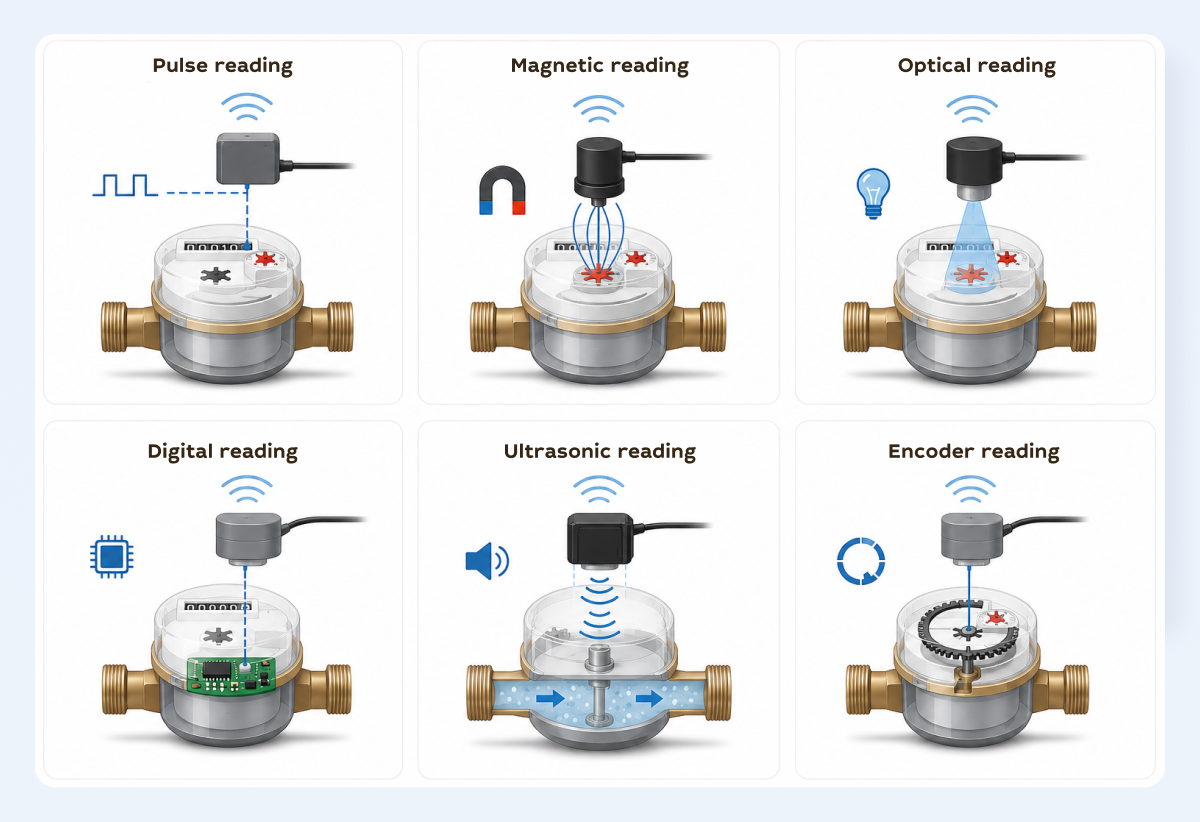
Pulse and magnetic reading principles are most commonly used in water sensors. They are well suited for autonomous devices where low power consumption, stable long-term operation, and the possibility of large-scale deployment are important.
After the readings are collected, the data must be transmitted to the metering system. Wireless communication technologies are used for this purpose, selected according to project scale, object density, available infrastructure, and operational requirements.
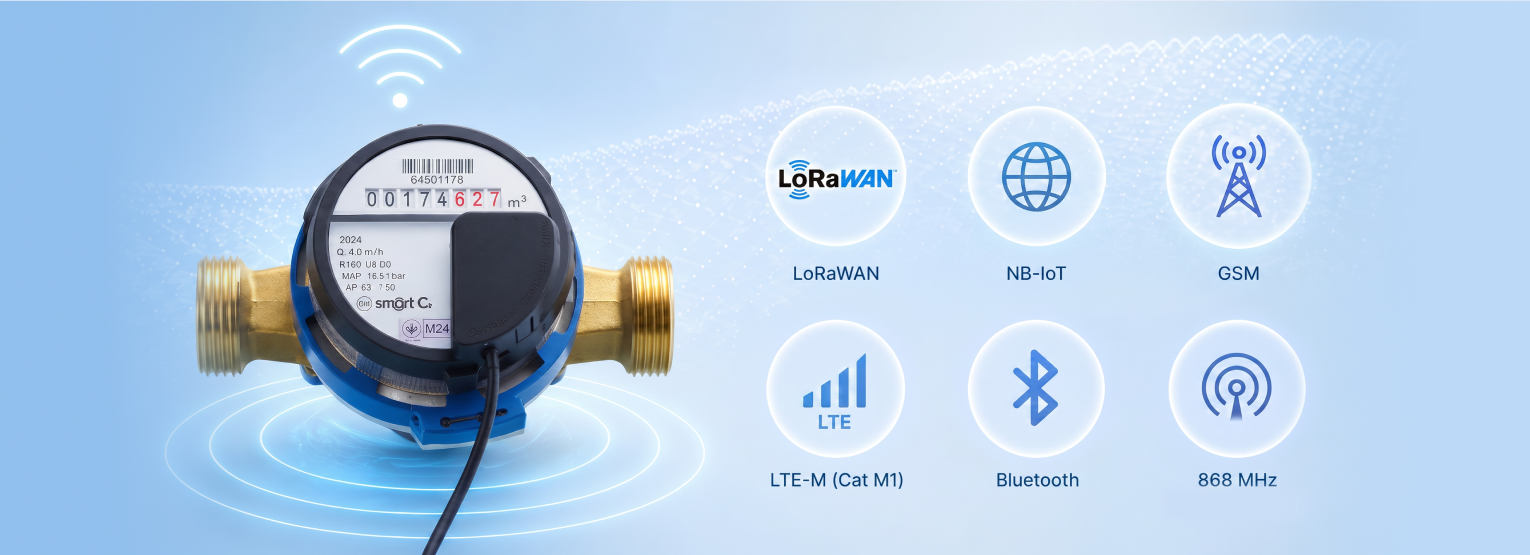
LoRaWAN is frequently used in remote smart water metering projects. This technology is well suited for mass IoT deployments, with LoRaWAN water meters operating on battery power for many years, transmitting small amounts of data over long distances, and connecting to the network through gateways. LoRaWAN is particularly effective where the utility provider or project operator builds its own network for a large number of meters across a city, district, or group of facilities.
NB-IoT works differently: the device transmits data through a mobile operator’s infrastructure. This option is relevant when meters are distributed across a large territory, when deploying a dedicated network is economically impractical, or when new NB-IoT water metering points need to be connected quickly without installing gateways. For the service provider, this means the ability to transmit data directly through the operator’s network and scale the project gradually.
The Jooby product line includes remote metering solutions that use LoRaWAN and NB-IoT technologies, making it possible to select a configuration for a specific project — from a single facility to city-scale metering infrastructure.
To understand how smart IoT water sensors work, it’s necessary to consider not only the device itself but the entire data transmission chain.
At the beginning of this chain is the water meter, which records the consumption of the resource. A sensor is attached to the meter which, depending on the meter model and solution design, can be installed directly on the housing, near the metering mechanism, or connected through a dedicated interface.
The water meter sensor technology detects pulses, changes in the magnetic field, or another signal related to the operation of the meter. The radio module receives this signal, stores it in memory, and transmits the data further.
In modern devices, the radio module not only sends readings but can also maintain consumption logs, monitor battery status, track events, detect tampering attempts, and receive remote configuration settings.
The data is then transmitted through the selected communication network. If LoRaWAN is used, the radio module sends a message to a gateway, which forwards it to the server side. If NB-IoT is used, the device connects to the mobile operator’s network and transmits the data through the operator infrastructure.
On the server, the information is transformed into understandable readings. Pulses or events become consumption data, e.g. current values, historical records, hourly or daily logs, and notifications about abnormal situations.
After processing, this data becomes available to the utility provider, management company, metering system operator, or end user through an administrative panel, billing system, SCADA, or IoT platform.
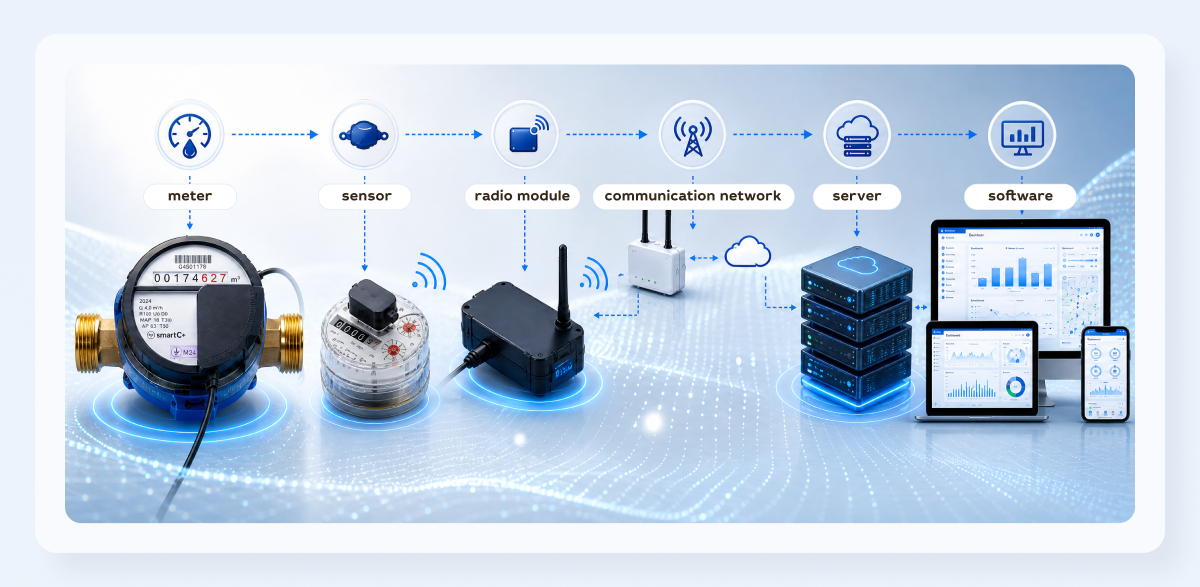
At this level, the main value of remote metering and how smart water meters work becomes visible. The system shows not only individual meter readings but also a broader picture of infrastructure status, including where consumption has changed, an error has occurred, a device has stopped transmitting data, or where leaks or tampering may be possible.
Metering automation changes not only the method of obtaining readings but also the operational model itself. The service provider becomes less dependent on manual data collection and receives a more regular, transparent, and manageable process.
The main advantages of this approach include:
For residential complexes, municipal utility projects, and commercial facilities, this is particularly important because the more metering points there are with water leak detection sensors, the greater the effect of automation.
When selecting a smart sensor for a water meter, it’s essential to consider both the cost of the device and how it will operate within real infrastructure. The sensor must be compatible with a specific meter model, correctly read data, reliably transmit it to the system, and maintain autonomy for a long period of time.
Typical evaluation criteria includes compatibility with specific meter models, reading technology, signal detection accuracy and stability, installation method, sensor enclosure protection rating, operating temperature range, and resistance to external influences.
It’s equally important to determine in advance who will maintain the system, how the data will be transmitted to billing or another platform, and how easily new metering points can be connected.
In this sense, IoT water meter sensors are not an isolated component but part of an ecosystem. Therefore, in remote water metering projects, it’s important to choose not only the device itself but also the data transmission architecture, server side, and monitoring tools.
A smart water meter sensor transforms a conventional metering device into an element of a digital system. It automatically records consumption, transmits data over a wireless network, and helps the service provider obtain accurate readings without manual data collection.
Modern solutions for smart city water systems, such as Jooby sensors and radio modules for remote water meter reading, make it possible to build such infrastructure step by step: starting with individual facilities, connecting new metering points, and then scaling the system without changing the core operating logic.
The result is that the water meter becomes part of a managed IoT network, while resource metering becomes more accurate, transparent, and convenient to operate.
Was it helpful?
 147
147


Stay on top of the latest industry news
Thank you, we have received your message. Our manager will contact you shortly.


Thank you, we have accepted your request. In the near future the responsible manager will contact you and clarify the details of the order.