22.07.2026
 385
385
385
5 Key Use Cases for IoT in Urban Infrastructure
385
With requirements growing for energy efficiency, transparent billing, the quality of utility services, and the speed of response to emergencies, urban infrastructure is becoming more complex.
At the same time, some municipalities, resource providers, developers, and homeowners’ associations still see the implementation of smart city infrastructure – something that could effectively address these issues for them – as some sort of abstract concept. What they know for certain however, is that they have a pressing need to solve very practical issues surrounding where losses occur, why readings are collected with delays, how to reduce maintenance costs, and how to detect problems faster.
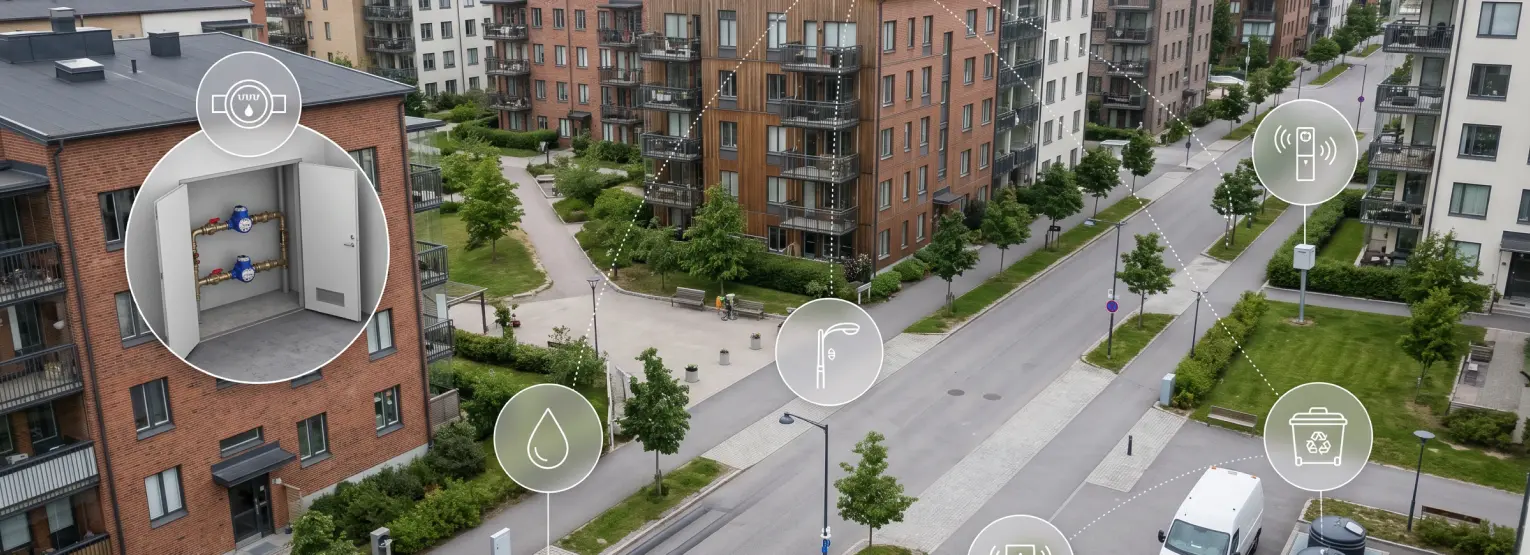
The Internet of Things is valuable in urban infrastructure precisely because of its ability to turn separate assets – meters, pumping stations, waste collection sites, lighting poles, and air quality sensors – into a manageable data system.
For such tasks, communication technologies with low power consumption and long range are especially important, particularly LoRaWAN and NB-IoT. These technologies make it possible to connect and operate thousands of devices without laying cables to each asset and without frequent battery replacement.
According to estimates by IoT Analytics, the number of connected IoT devices worldwide reached 21.1 billion in 2025 and may grow to 39 billion by 2030. This is clearly not just a technology trend or passing fad. For urban infrastructure, it means that remote data collection is gradually becoming the norm rather than an experiment.
Below are five scenarios that demonstrate IoT applications in urban infrastructure, and where such solutions deliver the clearest impact for utilities, developers, property management companies, and homeowners’ associations.
When looking at IoT use cases in smart cities, the most obvious and established scenario is the automatic collection of water, gas, heat, and electricity readings. For a utility provider, this is a matter of billing accuracy, lower operating costs, and loss control. For a homeowners’ association or property management company, it’s a way to move away from apartment-by-apartment inspections, disputed readings, and delays in generating bills.
In the traditional model, data is often collected irregularly: some residents submit readings on time, some forget, and some meters are physically inaccessible. As a result, the provider works with estimated values, while the consumer receives recalculations. However, smart meters and radio modules allow real time data to be transmitted on a schedule that could be once a day, every few hours, or at another specified interval if required by the business process.
For apartment buildings, the network architecture is just as important as the meter itself. LoRaWAN is suitable where data needs to be collected from a large number of devices within a district, residential complex, or city. NB-IoT is convenient where mobile operator coverage is available and devices need to be connected without deploying a private network. In both cases, the key idea is to have readings entering the system automatically, while staff no longer work on manual rounds, but with deviations and discrepancies.
The practical effect appears in several areas. The time required to collect data is reduced, the number of manual input errors decreases, and unusual consumption spikes are detected faster. For a developer, prepared remote metering infrastructure becomes an advantage at the stage of handing over a property for operation. Now, the property management company receives not just a “set of meters,” but a ready-made foundation for further maintenance.
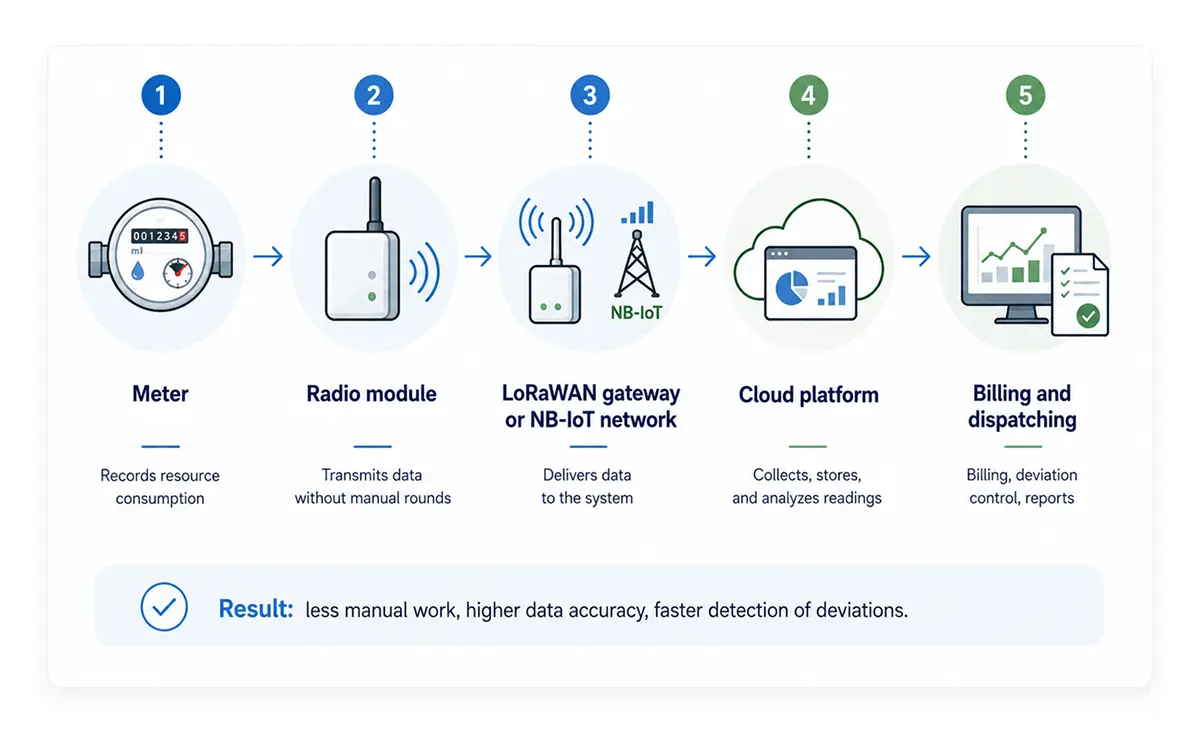
How remote meter reading works
For water utilities and property management companies, metering alone won’t solve the problem if the collected data is not used for analysis. One of the most important use cases is the detection of leaks, hidden losses, and abnormal consumption. In water supply, this is especially critical as water losses directly affect the cost of service, the load on pumping equipment, and the quality of service provided to consumers.
In global practice, such losses are commonly described using the indicator of water that has been produced or supplied to the network but has not generated revenue. The reasons for such losses vary and can include physical leaks, illegal connections, inaccurate meters, and accounting errors. Information published by the World Bank on behalf of the utility sector indicates that reducing such losses is one of the industry’s priorities, with some estimates suggesting that the level of non-revenue water can reach tens of percent.
In the case of non-revenue water, the use of IoT is built not around a single sensor, but around data comparison. If a building-level meter shows one value while the sum of apartment meters shows another, the system records the discrepancy. If consumption remains stable at night, when it should be minimal, this may indicate a leak. If network pressure drops in a specific area, the dispatcher receives an alert before residents start submitting mass complaints.
For resource providers, data analysis changes the approach to maintenance. Instead of scheduled inspections carried out routinely, priorities can be set more precisely, with those areas with the largest deviations being checked first. For homeowners’ associations, this scenario helps detect leaks more quickly in basements, technical rooms, and internal building networks. For developers, it makes it possible to include transparent water balance monitoring by buildings, sections, and technical zones at the design stage.
It’s also important to consider the limitations. The system won’t be able to “see” the pipe directly unless pressure, flow, or leakage sensors are installed. It works with indicators of a potential problem. Therefore, in a well-designed project, remote metering is complemented by flood, pressure, water level, or pump equipment monitoring sensors. The more precisely the task is defined, the higher the practical value of the data.
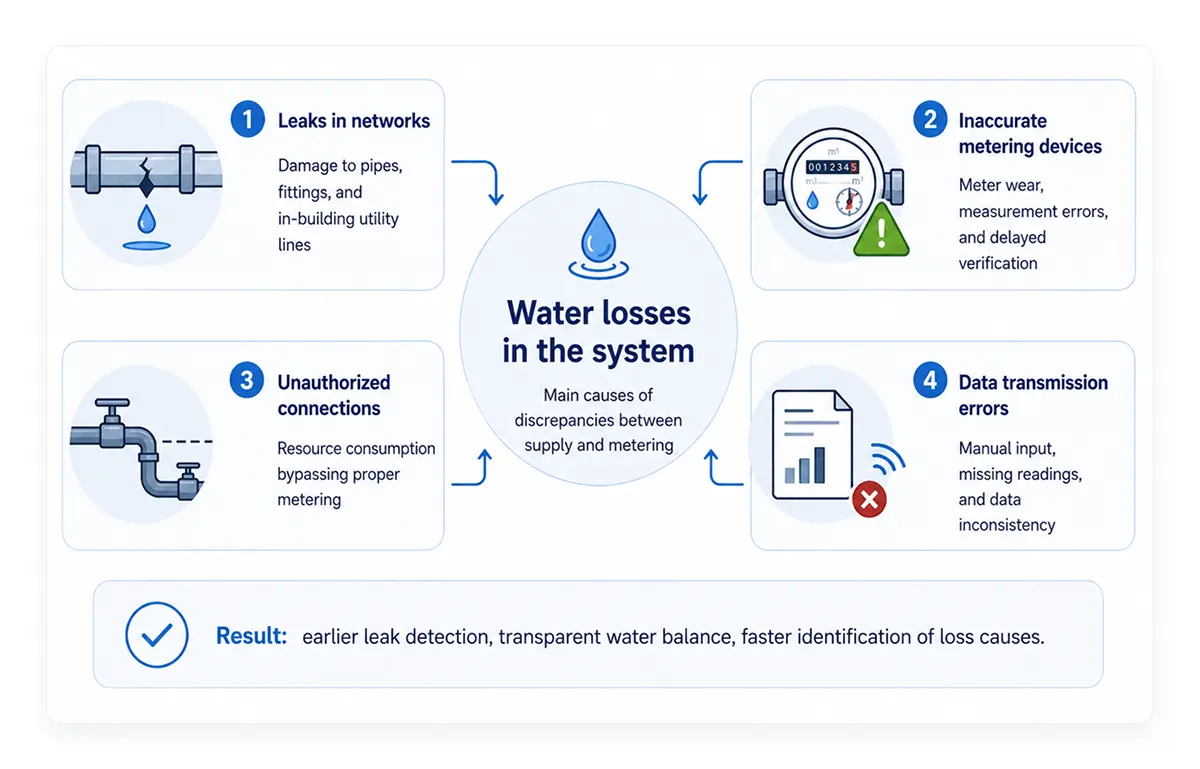
Where water losses occur
Lighting is one area where the effect is clear even without a high level of digital maturity. A municipality or property management company has a network of luminaires, electricity costs, and regular requests from residents: somewhere it’s dark, somewhere a lamp is not working, and somewhere the lights are on during the day. IoT makes it possible to move this infrastructure from manual inspection to centralized monitoring.
According to the International Energy Agency, in 2024 lighting in buildings and on streets (excluding industry and agriculture), accounted for about 8% of global electricity demand, or approximately 2,200 TWh. For cities, this is an important opportunity for savings, especially when modernization includes not only replacing luminaires with LED ones, but also managing operating modes.
In a basic version, the system includes controllers installed on lighting lines or on individual luminaires. They transmit data on status, consumption, and faults. In a more advanced version, lighting is adjusted according to schedule, natural light level, movement, or type of area. For example, in the courtyard of a residential complex, the lights can operate more brightly in the evening and reduce power late at night when there is no movement.
For a municipality, the value of this scenario lies in reducing costs and improving controllability. The dispatcher can see where a failure has occurred and send a crew to a specific address. For homeowners’ associations and property management companies, it’s a matter of safety and comfort, with well-lit courtyards, parking areas, entrances, and technical zones reducing the number of complaints and unplanned call-outs.
When evaluating the use of IoT solutions for urban infrastructure, it’s important not to reduce such a project to savings alone. Smart lighting can become supporting infrastructure for other sensors such as air quality, noise, movement, and parking occupancy. Lighting poles already have power and are distributed across the urban area, so they often become convenient points for installing additional devices.
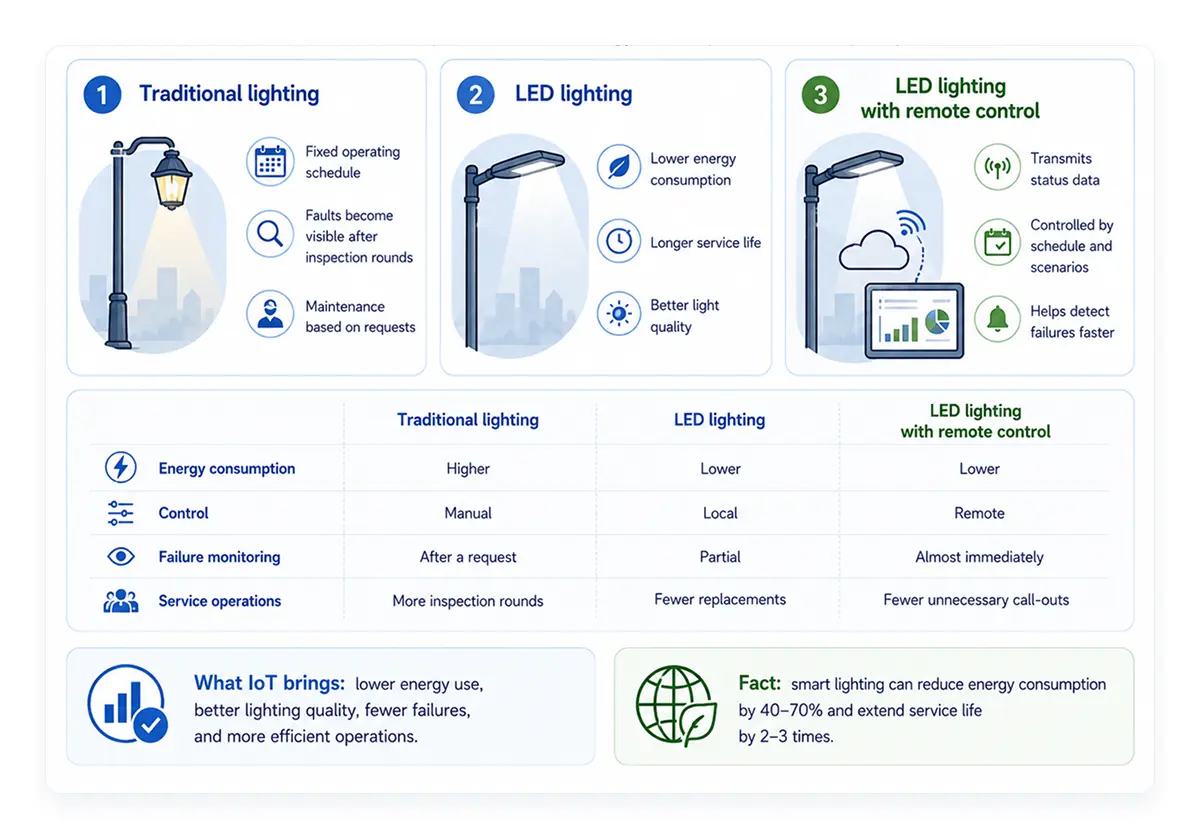
Traditional and smart lighting
Air quality, noise, temperature, humidity, and water level after heavy rainfall are data points that used to be collected locally and irregularly. But for a modern city, isolated measurements are not enough. Pollution can vary from one street to another, noise levels change throughout the day, and local flooding can occur before the first reports from residents arrive.
According to the World Health Organization (WHO), outdoor air pollution remains a serious health risk factor and is associated with millions of premature deaths every year. The European Environment Agency also states in its 2025 report that a significant share of the EU’s urban population continues to be exposed to PM2.5 levels above the level recommended by the WHO. This makes local monitoring not a decorative feature, but a tool for actively managing the urban environment.
IoT sensors do not replace certified environmental monitoring stations, they complement them. Urban IoT deployment examples include helping to show how pollution is distributed across districts, near roads, industrial zones, schools, hospitals, and residential neighborhoods. Such data is useful for planning green spaces, changing traffic schemes, assessing construction work, and informing residents.
For developers, environmental and air quality monitoring can be part of residential complex operation, using sensors to help objectively assess the state of the environment instead of relying only on complaints. For municipalities, it’s a way to identify problem areas faster. For homeowners’ associations, it’s a tool for monitoring basements, technical rooms, parking areas, and roofs, where smoke, flood, temperature, and humidity sensors are important.
A separate scenario is early detection of emergency situations. Water level sensors in storm drains, manhole opening sensors, and monitoring of vibration or structural tilt do not make a city “smart” by themselves, but give the dispatcher a signal before the problem becomes visible to a large number of people.
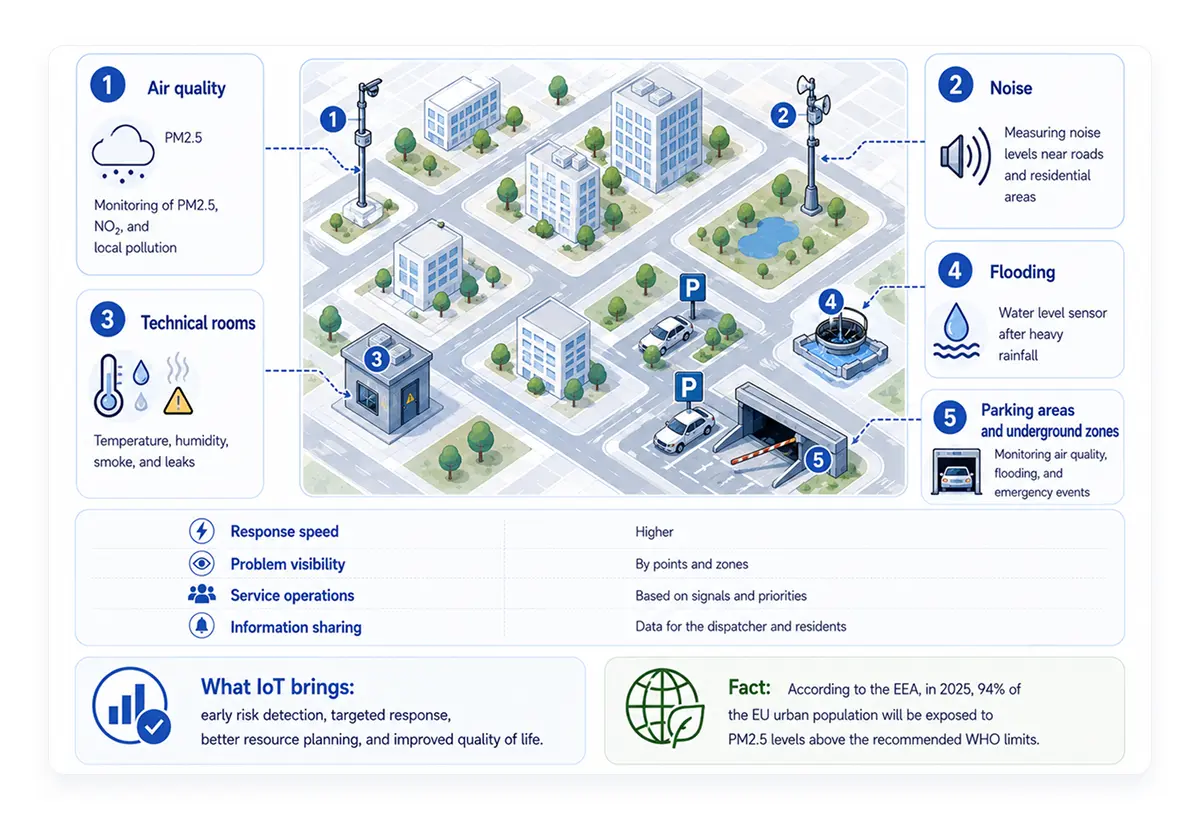
IoT in monitoring urban environment and security
Waste collection is often perceived as a simple service: the container is full, and the truck arrives. In practice, it’s complex logistics. Containers fill up unevenly, routes are planned according to a schedule rather than actual need, some sites overflow, while others are serviced too early. This leads to unnecessary trips, fuel consumption, resident complaints, and overloaded contractors.
The use of IoT in a waste management system begins with container fill-level sensors. They transmit the fill level, temperature, and sometimes the fact of movement or tipping. Based on this data, collection routes can be planned according to real need, not a fixed schedule.
For the city, this means cleaner collection sites and fewer unnecessary trips. For the contractor, it means a more predictable workload for vehicles and staff.
According to the UNEP Global Waste Management Outlook 2024, waste management remains one of the key challenges for cities, and without changes in approach, both costs and environmental impact will continue to grow. Technology itself does not solve the problem of sorting or recycling but helps make the system more transparent. It quickly identifies where containers are overflowing, where collection frequency needs to be changed, and where a site is being used incorrectly.
For homeowners’ associations and residential complexes, this is especially useful when there are several waste collection sites, commercial premises on the ground floors, or seasonal fluctuations in fill levels. For a municipality, waste data can become part of a general district management dashboard alongside lighting, water metering and supply, and resident requests.
It’s important not to overload the project with excessive sensors. In most cases, it’s enough to start with the most problematic sites and a few measurable indicators, such as fill level, collection frequency, number of overflows, and contractor response time. After that, it becomes possible to assess whether scaling is justified.
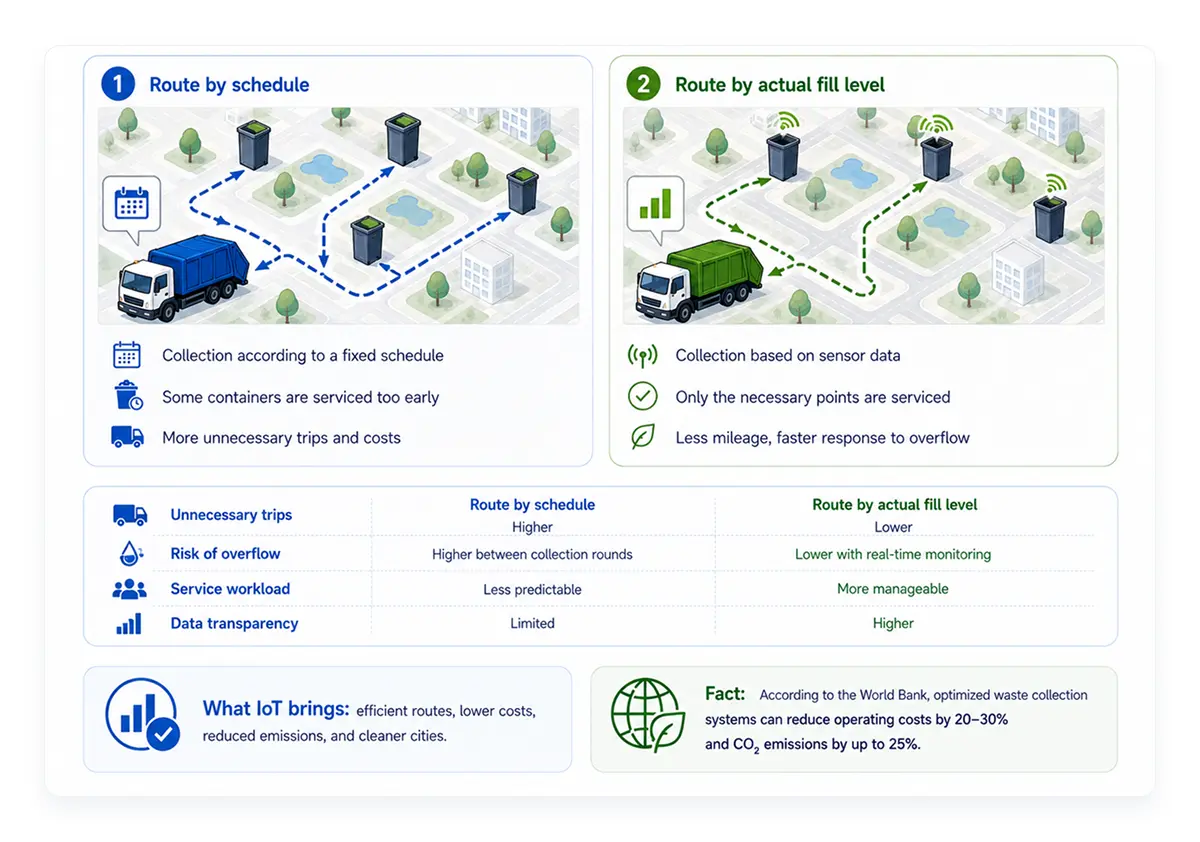
Managing waste collection by schedule and actual need
The main mistake when implementing IoT in urban infrastructure is starting with the technology rather than the task. LoRaWAN, NB-IoT, sensors, meters, and platforms are important, but first and foremost they must answer the specific questions of what data is currently missing, who will use it, and what decision will be made based on it.
For a resource provider, remote metering and loss analysis often become the logical first step. For a developer, it’s preparing a residential complex for transparent operation using meters, building-level metering units, emergency sensors, and dispatching. For a municipality, it may be lighting, environmental monitoring, or waste management, depending on the budget and the urgency of the problem. For a homeowners’ association, it may be resource metering, leak detection, technical rooms, and the outdoor residential area.
There is also no universal answer when choosing a network for city automation. LoRaWAN can be cost-effective when it’s necessary to monitor a large number of devices on one’s own territory and manage the network independently. NB-IoT is convenient when it’s easier to use the infrastructure of a mobile operator and connect devices without deploying a private base station. What matters is not only tariffs and coverage, but also battery life, data transmission frequency, installation depth of the device, security requirements, and integration with metering systems.
Before scaling, it’s worth running a small pilot. The pilot should not be a demonstration for the sake of demonstration, but used to test measurable indicators for urban analytics, including how many manual operations were eliminated, how much faster emergencies are detected, how data accuracy changed, and how many requests were closed without a repeat visit. This is how IoT stops being a buzzword and becomes a tool for infrastructure management.
In practice, the value of an IoT project depends not only on sensors or meters, but on measurement at the site, data transmission, storage, analysis, and work with deviations. In other words, the entire chain. In this way, Jooby RDC solutions can be used as an infrastructure layer for remote metering and monitoring using sensors, radio modules, gateways, and smart meters to help collect data from water, gas, heat, and electricity metering devices in LoRaWAN and NB-IoT networks.
Jooby RDC Dashboard complements this layer with a working panel for viewing readings, monitoring device status, and analyzing deviations. For a resource provider, property management company, or homeowners’ association, this is a way to see the connected infrastructure in a single interface and be fully aware of any missed data transmissions, disputed readings, signs of leaks, and abnormal equipment behavior at all times.
The five scenarios detailed as the top IoT use cases in cities – namely remote resource metering, water loss control, smart lighting, urban environment monitoring, and waste management – show that IoT in a city is not a nice to have “digital showcase”, but the means to make more informed, actionable, and accurate decisions.
The more clearly the problem is defined and the better the data is integrated into the work of the dispatcher, resource provider, property management company, or municipality, the higher the practical value of the project.
IoT applications for utilities and cities are extensive, and for 2026–2027, the key question is no longer whether urban assets can be connected, but which processes should be connected first and which decisions will be made based on the data received.
Was it helpful?
 77
77


Stay on top of the latest industry news
Thank you, we have received your message. Our manager will contact you shortly.


Thank you, we have accepted your request. In the near future the responsible manager will contact you and clarify the details of the order.