12.10.2026
 20
20
20
From Manual to Digital Metering: The Stages of Utility Transformation
20
At the end of each month, a utility provider or building manager collects meter readings. Some readings arrive on time, others require follow-up requests, and some values need verification. The data is then entered into the accounting system, compared with the previous period, and used for billing.
Traditional utility metering using this process can work when there are relatively few metering points. However, as the number of properties grows it takes more time, and the causes of discrepancies become harder to identify.
Remote meter reading changes this process, because the information arrives automatically, is stored as historical data, and then becomes available for analysis. But installing radio modules to meters does not solve every problem. The meters still need to be checked, connectivity established, devices linked to customer accounts, and responsibility assigned for responding to anomalies.
The transition to digital metering is therefore best approached as a phased modernisation programme. Each stage should deliver a verifiable result, from an accurate meter inventory to the routine use of data in billing and network maintenance.
With manual collection, readings show consumption between two dates but reveal little about what happened during that period. If consumption increases, it’s difficult to determine when the change began and whether it resulted from a leak, seasonal demand, or a data entry error. Readings taken on different days also make it harder to compare whole-building consumption with that of individual apartments.
Data published by the Environment Agency in November 2025 illustrates the difference between having meters and digitalising the metering process. In England, during the 2024–2025 reporting period, more than 62% of households paid for water based on consumption, but only around 12% of homes had smart water meters.
These figures relate to a specific market, but they clearly demonstrate that installing a meter and establishing an automated data collection system are separate stages.
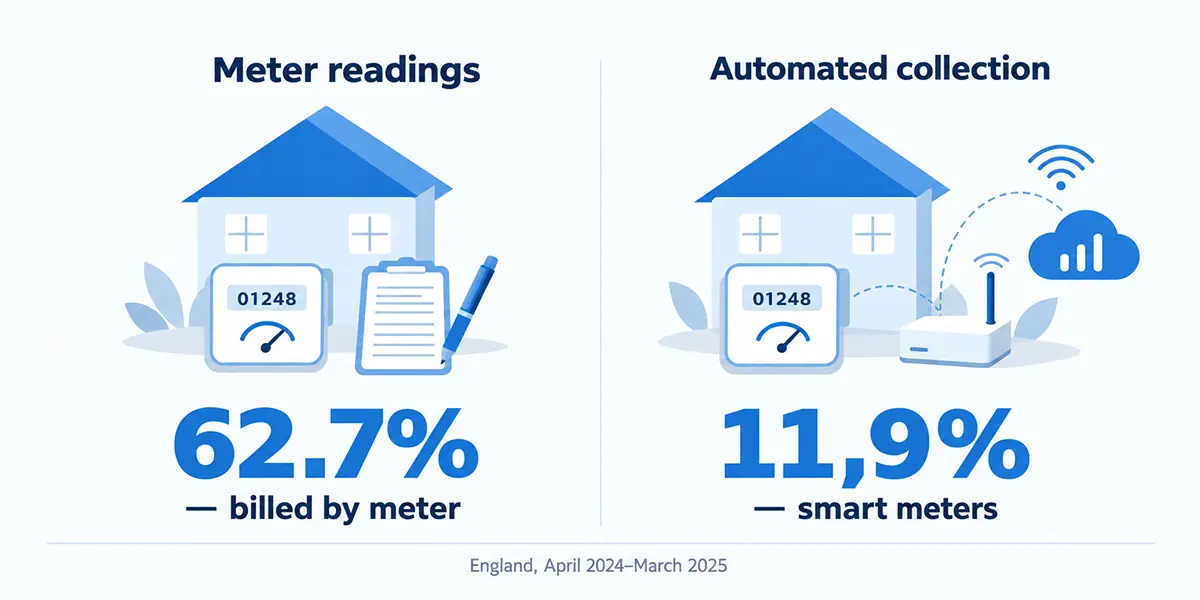
Water Metering: Two Levels of Digitalisation
For utility providers, digitalisation can mean fewer repeat visits and more complete data by the billing date. For homeowners’ associations, it offers a way to investigate discrepancies in a building’s consumption balance. Developers need to hand over a functioning system to the maintenance organisation, while municipalities need to compare consumption across buildings and make informed decisions about which properties to modernise.
Start with a specific question: what is preventing effective metering today? Do readings arrive late? Are meter-reading visits too expensive? Are leaks discovered only after complaints? Do employees spend too much time correcting data? The answer determines the equipment required, the data transmission frequency, and the criteria for project success.
Before purchasing equipment, it’s useful to measure the time currently spent on the process, the proportion of readings received by the billing date, and the number of repeat visits and corrections. These figures will provide a basis for comparison later. Without baseline measurements, it’s easy to confirm that devices work but difficult to demonstrate that the process has become more efficient.
A meter survey is carried out at the same time. The register should record each meter’s model and serial number, installation location, condition, next verification due date, available reading method, and link to a property or customer account. Installation conditions also matter: a dry plant room, a metal cabinet, and a chamber subject to flooding require different solutions.
This stage produces a clear map of metering points and a list of tasks. It also reveals which meters can be connected, which need replacing, and where additional work will be required.
Replacing every meter is not always necessary. If a meter is in good working order and compatible with an external reading device, it can be fitted with a sensor or radio module. Depending on its design, data can be obtained through a pulse output, a digital interface, or a sensor specifically designed for that model.
With this approach, the meter continues to measure consumption while the additional equipment reads and transmits the result. A radio module doesn’t improve the meter’s own accuracy or reverse wear. The decision to retain a meter should therefore consider both its connectivity options and its remaining service life.
Smart meters with built-in connectivity are worth considering for new properties, scheduled replacements, or locations where existing meters can’t be connected reliably. The comparison should cover the total cost of each option: equipment, installation, configuration, any interruption to the utility supply, and ongoing maintenance.
For example, if compatible water meters have recently been installed in a building, adding radio modules may reduce the amount of work required. If a large-scale meter replacement is due soon, however, two separate installation cycles may cost more than one. These decisions for utility metering modernization should be based on survey results, not the age of the building.
LoRaWAN and NB-IoT are designed to transmit small amounts of data and are used in remote metering. The choice between them depends on meter locations, available infrastructure, maintenance requirements, and operating costs.
In a LoRaWAN network, devices transmit messages through gateways, which forward them to a server. The technology supports both private and operator-managed networks. The LoRa Alliance provides for both deployment models, allowing organisations to choose between managing the smart utility infrastructure themselves and having an external provider maintain it.
A private network requires suitable gateway locations, power, a data connection, and clearly assigned maintenance responsibilities. The number of gateways is calculated based on meter locations, obstacles, message volumes, and reliability requirements.
A promise of “one gateway for the entire district” without a site survey is no substitute for network planning.
In a typical NB-IoT solution, devices connect to a mobile operator’s network, so the customer doesn’t need to install dedicated radio gateways. However, NB-IoT availability, equipment compatibility, and connection terms must all be checked.
Ordinary mobile coverage at a property does not confirm that the selected meter will work at its installation point. Compatibility between devices and operator networks is one of the key issues addressed in GSMA guidance on NB-IoT deployment.
The final decision should follow on-site testing, with cabinet doors or chamber covers closed and the meter in its normal installed position. A geographically distributed project may require both technologies if the data collection system supports their combined use for wireless meter reading.
Jooby RDC equipment can support a phased transition, using sensors and radio modules for compatible meters already in service, alongside smart meters for new installations or scheduled replacements.
Depending on the meter model and connection method, the device either reads data or registers pulses. This makes it possible to connect existing metering points without necessarily replacing the entire meter fleet. Equipment compatibility is checked separately for each model.
The Jooby RDC range includes devices that transmit data via LoRaWAN and NB-IoT. Gateways are available for building a LoRaWAN metering network, receiving messages from radio modules, and forwarding them to a server. NB-IoT models use the corresponding mobile operator network. The solution is configured according to meter locations, coverage test results, and operating conditions.
Jooby RDC Dashboard software is designed to collect and process consumption and device status information, and to display historical data and reports. Software interfaces and documentation are available for connecting equipment to existing monitoring and control systems.
During deployment, it’s important to verify the entire data path, from an individual meter to the report or accounting system where employees will use its readings.
Measurement, storage, and transmission frequencies should not be treated as a single parameter. A device for utility monitoring may create an hourly data archive but transmit the accumulated readings only a few times a day. In that case, the consumption history will be detailed, but new information will reach the server with a delay.
Monthly billing and leak detection require different operating modes. For billing, reliable readings at an agreed point in time are essential. For leak detection, the priority is a sufficiently detailed history that makes unusual consumption visible. Where prompt alerts are required, it’s also necessary to check whether the device supports event-triggered transmissions and how quickly they are delivered.
Communication settings affect battery life, and life estimates must account for message frequency, signal quality, retransmissions, and temperature. Because a datasheet figure can’t automatically be applied to every site, the stated operating life should be assessed against the conditions used to calculate it.
Meter behaviour during a loss of connectivity should be checked separately. Does the device retain readings? How long does it store the archive? Does it transmit missing records after the connection is restored? These functions must be confirmed for the specific model. A battery-powered meter doesn’t make the entire system independent of mains electricity and communications and server infrastructure have their own backup requirements.
A pilot project should reflect the conditions of the future rollout. If all devices are installed close to a gateway in an easily accessible room, the results will reveal little about performance in basements, meter chambers, or remote buildings. Testing should include different meter types and the most challenging installation locations.
Acceptance criteria should be agreed before the pilot begins. For billing, for example, a key measure is the proportion of metering points that deliver a reliable reading by the required deadline. For consumption analysis, its archive completeness, and for maintenance, its alert latency and the number of site visits caused by faults.
Assessment should cover data usability as well as message delivery. A message may arrive on time but be linked to the wrong customer account, contain an incorrect unit of measurement, or use an incorrectly configured pulse conversion factor. System readings should therefore be compared with the actual values displayed on the meters.
Manual checks of utility data collection should remain in place during the transition. The trial must run long enough to assess connection stability, the preparation of billing data, and recovery after failures. Large-scale procurement should be justified by the results of these checks and a list of any improvements required.
If data arrives in a separate portal and an employee then copies it manually into the accounting software, some of the previous costs remain. The next step is to establish data exchange with the billing system, the operations team’s systems, and other software in use.
Each record should clearly identify the meter, property, measurement time, unit, and origin of the value. An automated meter reading must be distinguishable from an estimated value used in its place. Rules are also needed for meter data management, including the handling of duplicate messages, late records, and meter replacements so that the historical record remains consistent.
In apartment buildings, data comparability is particularly important. A difference between the whole-building volume and the sum of individual apartment readings does not, by itself, prove there is a leak. First, check that the periods match, the data is complete, and communal consumption and measurement characteristics have been accounted for. Otherwise, automation will simply produce an incorrect conclusion faster.
Before scaling up AMR systems, define access rights, backup procedures, and options for exporting historical data. Customers need to understand whether they can retain their data and connected equipment if they change maintenance providers or software platforms.
The next level of digital metering is using the information obtained from utility data automation to guide maintenance. An alert is useful only when it’s clear who receives it, what they should check, and how quickly they must respond. If this isn’t done properly, manual meter reading is simply being replaced by the manual review of hundreds of unprocessed events.
For example, continuous low water consumption at night may warrant an inspection. It’s a sign of a possible problem, not a definitive diagnosis: the building’s purpose, operating hours, and users’ habits must be considered. Similarly, an absence of new readings may indicate a communication problem rather than a stop in consumption.
Yorkshire Water provides a practical example in a publication dated 23 July 2026. According to the company, over the previous 12 months, smart meter information enabled it to contact 12,800 customers about possible leaks. It recorded 9,387 instances of customers fixing problems themselves after receiving information based on meter readings. This is the outcome of a specific programme, not a guaranteed result for every deployment.
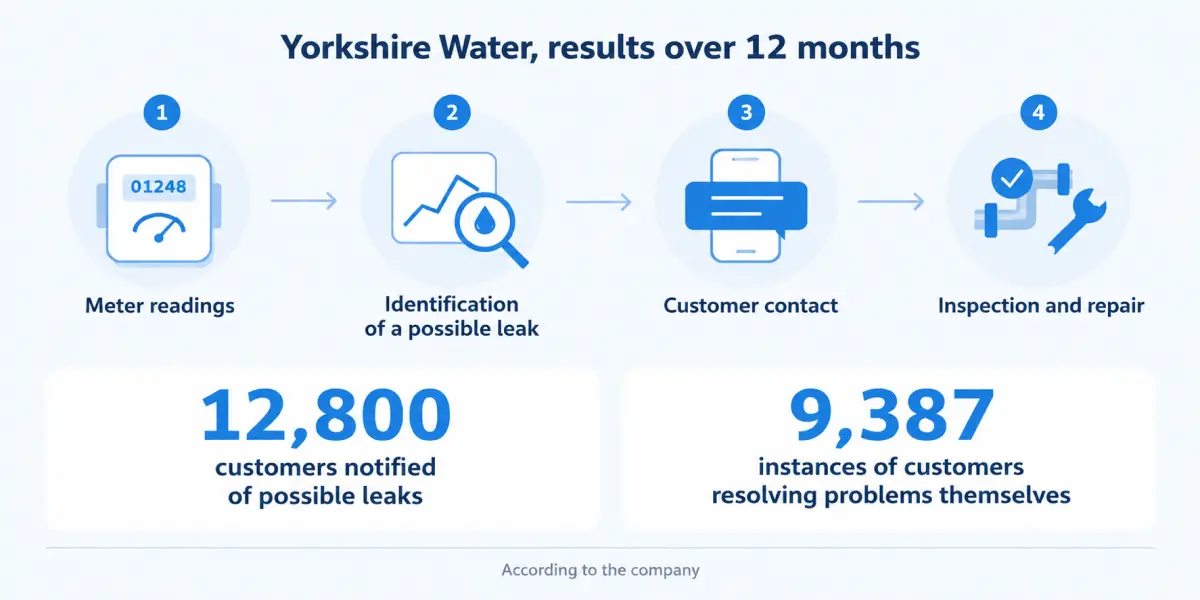
From Meter Readings to Leak Repair
The same logic applies to other utilities, but the analysis rules differ. Heat consumption is assessed in relation to weather and building operating patterns, while electricity consumption is considered alongside equipment schedules. Remote gas metering helps analyse consumption, but it doesn’t replace dedicated leak detection and safety systems.
After a successful pilot, smart metering can be rolled out by building, district, or group of meters. Each phase should follow the same installation, registration, and acceptance procedures. This reduces the risk of equipment being installed while some metering points fail to transmit data or are linked to the wrong properties.
The budget for digital utilities management should include more than meters and radio modules. It must also cover surveys, installation, gateways or connectivity services, software, integration, support, site visits, and the replacement of batteries or devices. Supplier proposals should be compared against the same requirements for this work.
Financial results are assessed against the baseline. Has the time needed to prepare billing data decreased? Are there fewer repeat visits and corrections? Are problems being identified earlier? Reductions in utility losses should not automatically be attributed to digital metering alone: repairs, network condition, and consumer behaviour also affect the outcome.
For developers, project completion should include the handover of equipment, documentation, access credentials, and maintenance responsibilities. For homeowners’ associations, it should mean a clear process for handling readings and residents’ enquiries. For utility providers and municipalities, utility infrastructure modernization should deliver a stable process that can expand without a proportional increase in manual work.
The transition from manual to digital metering begins with understanding the problems and ends with the effective use of data. Compatible meters, proven connectivity, correct integration, and clearly defined staff responsibilities make it possible to move forward in stages while retaining serviceable equipment and controlling costs.
The main result of this transformation to remote utility monitoring is not the number of connected meters, but the ability to obtain reliable real-time meter data and use it to make informed decisions.
Was it helpful?
 4
4


Stay on top of the latest industry news
Thank you, we have received your message. Our manager will contact you shortly.


Thank you, we have accepted your request. In the near future the responsible manager will contact you and clarify the details of the order.