21.08.2026
 325
325
325
How to Assess Whether a Building or District Is Ready for IoT Implementation Before Purchasing Equipment
325
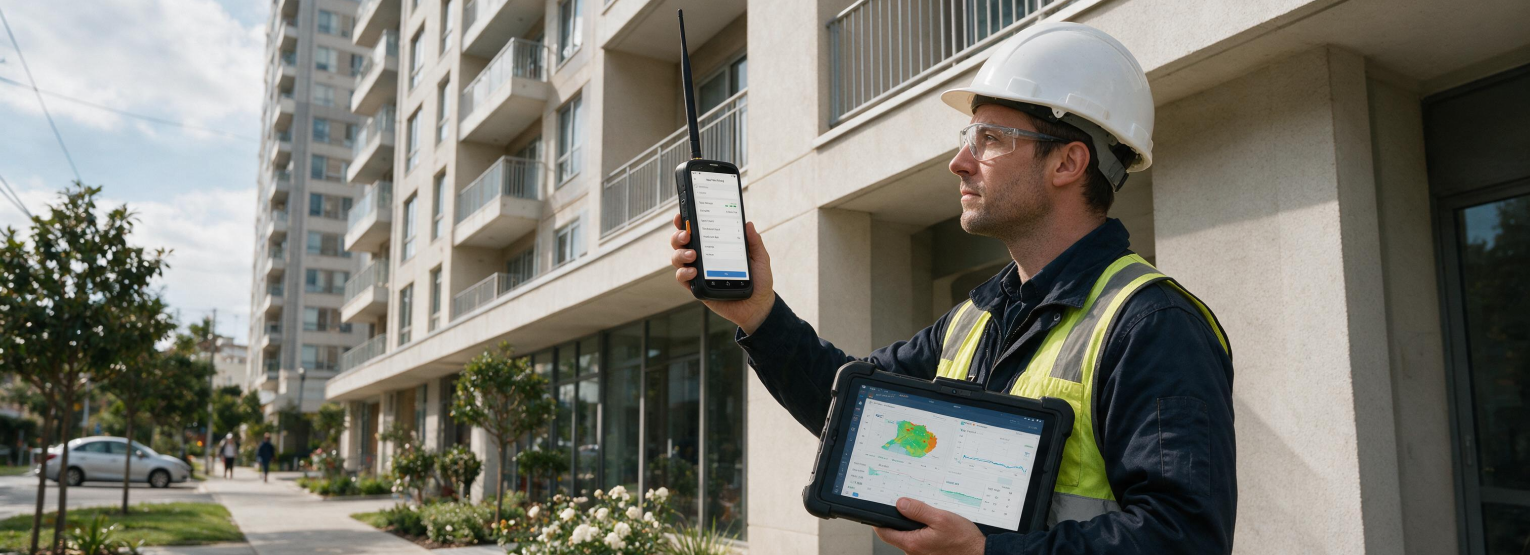
IoT implementation in a building, residential complex, district, or municipal infrastructure should never begin with the purchase of meters, sensors, or base stations. Instead, the first step is to establish that the facility is actually ready for digital monitoring: whether connectivity is available, where equipment can be installed, what data is actually needed, who will maintain the system, and how it will scale.
Preliminary analysis of a project’s IoT infrastructure requirements helps avoid typical mistakes, such as weak coverage in basements, incompatibility between meters and sensors, unrealistic expectations for battery life, lack of integration with billing, or manual data processing after launch.
For an integrator, developer, management company, or utility provider, this is not a formality, but a technical and economic justification for an IoT project. A comprehensive assessment will allow you to make informed decisions regarding both its feasibility and the IoT implementation cost before any equipment is purchased.
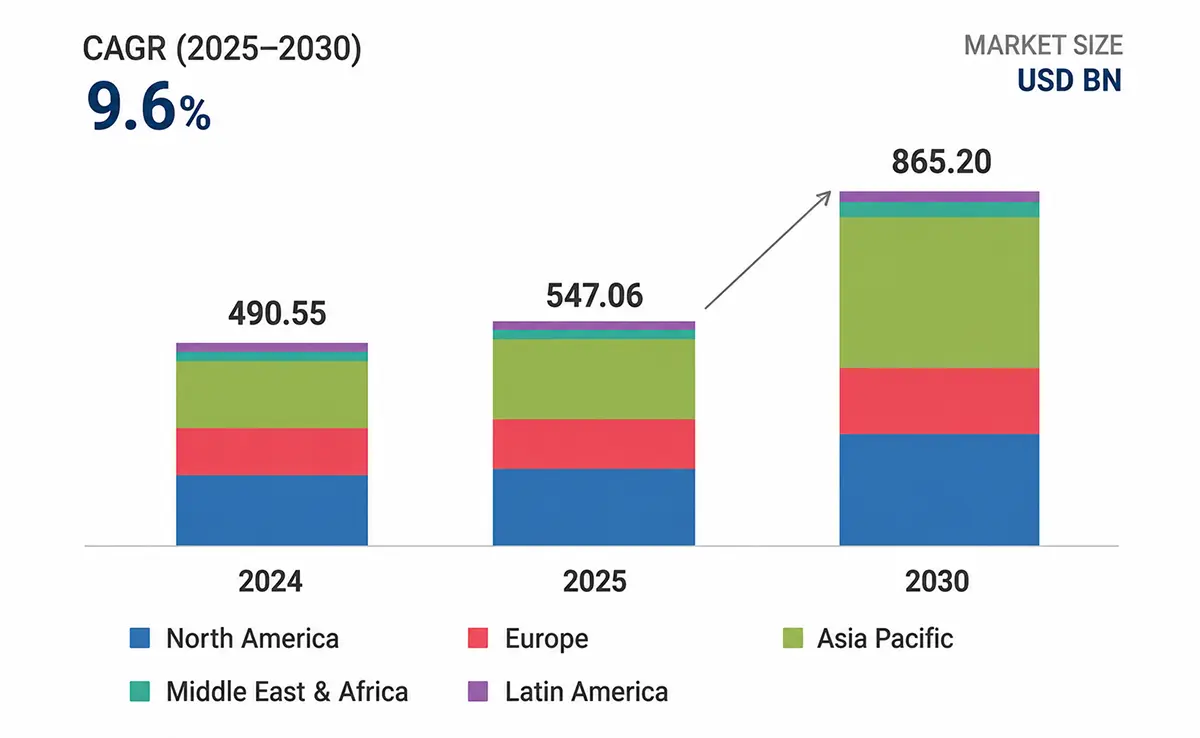
The relevance of such preparation is becoming increasingly important, together with the market for smart buildings and digital infrastructure. According to MarketsandMarkets, the global IoT market may grow from $547.06 billion in 2025 to $865.20 billion by 2030, with smart buildings, energy, and utility services highlighted among the areas of growth.
The European Commission has also noted the practical value of smart metering. In the EU, the average installation cost of a smart meter is estimated at €180–200, while the average savings are €230 for gas and €270 for electricity per metering point.
Below, we provide a detailed plan for conducting an IoT feasibility study, to assess whether a building or district is ready for IoT implementation and explain what to focus on.
The first stage of readiness assessment is to understand what problem the IoT project should solve. The same building or district can be equipped in different ways, e.g., for remote meter reading, alarm control, flood monitoring, consumption analysis, dispatching of technical rooms, or integration with a building management system.
Before selecting equipment, several questions need to be answered. These include which resources need to be metered (water, gas, heat, electricity)? Are only readings required, or also events, such as opening, magnetic influence, low battery notification, loss of connectivity, flooding, temperature exceedance? Should data be transmitted once a day, once an hour, by event, or more frequently? And will it be the utility provider, management company, dispatcher, service team, resident, or several parties at once using the data
For example, for smart gas metering, the main goal may be regular remote reading collection and fewer inspector rounds. For basements and technical rooms, emergency events are more important: leaks, flooding, temperature, and access to the room. For a district or municipal infrastructure, the key task may be a unified network to which different services can be gradually connected.
After defining the task, a map of facilities should be created when beginning IoT deployment planning. For a single building, this is a list of entrances, floors, technical rooms, basements, metering units, cabinets, and meter installation locations. For a district, this includes residential buildings, heating points, pumping stations, wells, transformer substations, commercial premises, municipal buildings, and other distributed points.
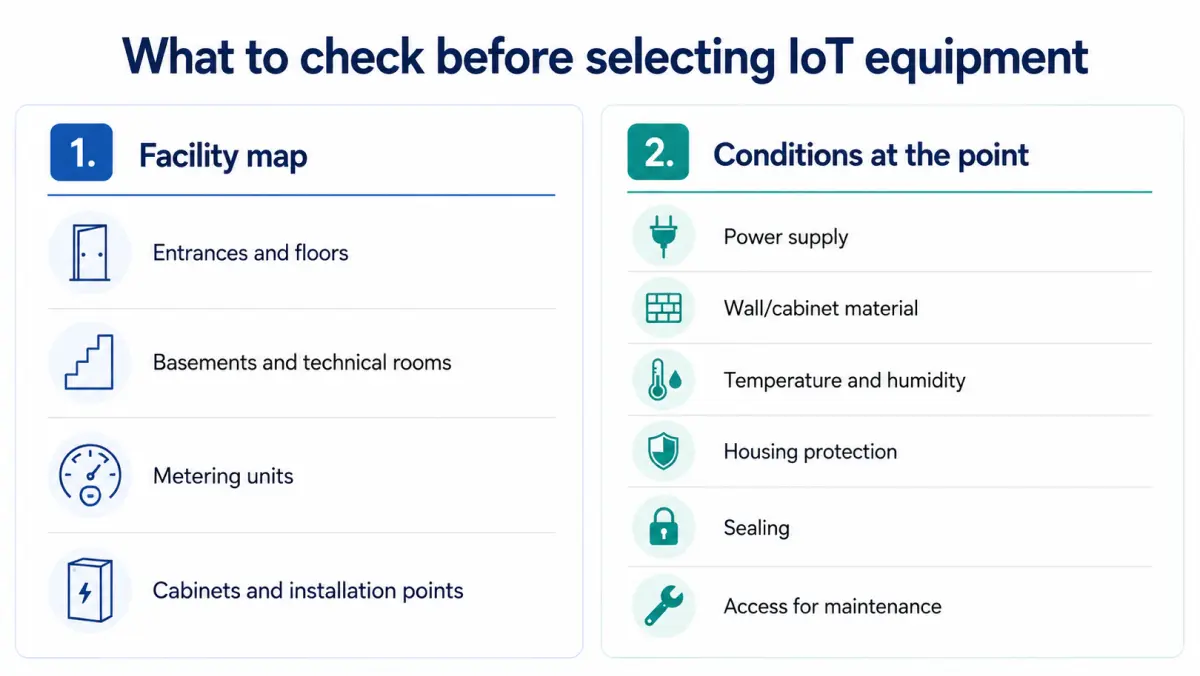
For each point, it’s necessary to record the facility type, installation accessibility, availability of power, wall and cabinet material, installation depth, distance to a potential base station, temperature and humidity conditions, housing protection requirements, need for sealing, and maintenance accessibility.
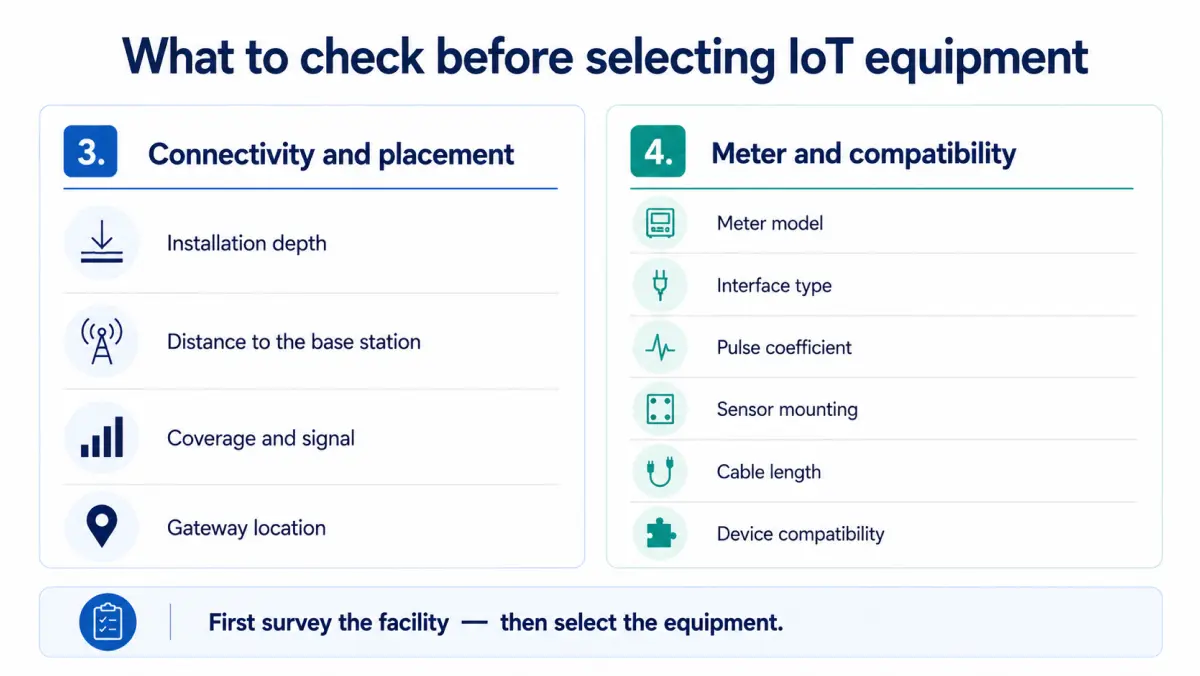
Existing meters should be checked separately. In smart metering projects, it’s not only the meter model that matters, but also the possibility of connecting an external sensor or radio module. It’s necessary to define the interface type, pulse coefficient, sensor mounting method, cable length, sealing conditions, and compatibility with specific devices.
Jooby products allow such solutions to be built step by step: using radio modules for meters, sensors, smart meters, LoRaWAN base stations, and the Jooby RDC Dashboard platform for collecting, displaying, and further transmitting data. However, the selection of a specific device should still begin with checking the facility and meter model, not with a universal equipment list.
Connectivity assessment is one of the main stages of preparation. On paper, a facility may look simple, but in practice the signal is often weakened by basements, reinforced concrete, metal cabinets, shafts, dense development, height differences, and poor equipment placement.
For LoRaWAN, it’s necessary to check possible base station installation locations, height, antenna direction, radio horizon, distance to devices, and the presence of problematic zones. For NB-IoT, mobile operator coverage should be assessed exactly at the device installation locations, not only outdoors or according to a general coverage map. It’s especially important to check basements, technical rooms, closed cabinets, and rooms with metal structures.
A practical approach is to carry out signal strength testing and divide points into three groups: normal, borderline, and problematic. Normal points transmit data reliably with a signal quality margin. Borderline points work, but require monitoring, an external antenna, a change in installation location, or adjustment of the transmission interval. Problematic points require a separate solution, involving an additional LoRaWAN gateway, antenna relocation, another connectivity technology, or a change in the installation scenario.
For LoRaWAN projects, it’s important to measure not only whether reception is present, but also quality parameters: RSSI, SNR, percentage of successful transmissions, retransmissions, and coverage margin. For NB-IoT, it’s necessary to consider signal level, stable device registration in the network, behavior indoors, and energy consumption under poor connectivity conditions.
If the project is based on LoRaWAN, facility readiness largely depends on base station placement. It’s not enough to simply place a gateway “where it’s convenient” and expect stable operation across the entire building or district.
For a residential complex, suitable locations may include the roof, upper technical floor, a room with network coverage and power access, a façade area, or a separate infrastructure point. For a district, these may be buildings with sufficient height, utility facilities, masts, dispatching points, or technical rooms of the utility provider.
For each location, it’s necessary to check power supply, internet connection, antenna installation feasibility, weather protection, access for maintenance, building owner requirements, and equipment security. In large projects, redundancy should be planned from the start: if one gateway becomes unavailable, some devices should remain within reception range of another base station.
NB-IoT reduces the need for a proprietary radio network, but does not eliminate infrastructure checks. Make sure that the operator network is available in the required rooms, that SIM profiles or tariffs are suitable for the project duration, and that service conditions do not create risks during scaling.
An IoT project is valuable not when a sensor sends a message, but when the data reaches the right system and becomes useful for work. Therefore, before purchasing equipment, the entire data path needs to be described – from the meter or sensor to the platform, billing, dispatching system, SCADA, ERP, CRM, BI system, or personal account.
At this stage, it’s necessary to define which data is needed in raw form, which data needs to be transformed, how often it should be transmitted, where history is stored, who sees events, how notifications are generated, and what is considered an alarm. For example, a utility provider may need readings for billing, a management company may need events and statuses, a technical service may need connection quality and battery data, and management may need analytics by facility and consumption dynamics.
If integrations are not designed in advance, a common problem often arises after the pilot, where data exists in the IoT platform but is not used in the customer’s workflows. To avoid this, agree in advance on APIs, exchange formats, facility directories, meter identifiers, user roles, and responsibility for transmission errors.
An IoT system adds new devices, radio channels, gateways, servers, platforms, user accounts, and integrations to the infrastructure. Therefore, facility readiness should also be assessed from a security perspective.
The minimum set of questions includes: who has access to the platform, how roles are separated, how data transmission is protected, where keys are stored, who can change device settings, how user actions are logged, how updates are performed, and whether there is separation between the IoT infrastructure and the critical systems of the building or utility provider.
For residential complexes and districts, it’s especially important not to mix all services into one unmanaged system. From a data security perspective, smart metering, dispatching, access rights, emergency notifications, and analytics may use shared infrastructure, but rights, data, and responsibility must be separated.
Before purchasing equipment, calculate the device price. The full cost of an IoT project also includes survey, pilot, installation, base stations or NB-IoT connectivity, platform, integrations, maintenance, battery replacement, site visits, user support, and scaling.
For LoRaWAN, the cost and placement of gateways, internet connection, power supply, antenna installation, and infrastructure maintenance need to be considered as part of an IoT network assessment. For NB-IoT, it’s the cost of connectivity, operator terms, coverage availability, and device behavior under weak signal that should be taken into account. And for both technologies, battery life, transmission frequency, point access complexity, and the cost of service team visits are also vital considerations.
A good readiness assessment should show several scenarios: a minimum pilot, basic deployment, and scaling. For example, building automation can first be completed in one property or several typical facilities can be connected. Then, the project can be expanded to the entire complex, and after that new scenarios can be added, such as flooding, temperature, technical rooms, commercial zones, or additional types of metering.
A pilot is needed not for a formal demonstration, but to test real conditions. It should include both the most convenient points and any difficult locations, e.g., basements, distant entrances, metal cabinets, rooms with poor signal, different meter models, and different usage scenarios.
During the pilot, it’s necessary to check connection stability, data correctness, installation convenience, platform operation, notifications, exports, integrations, staff response, and actual labor costs. After that, the equipment specification, installation rules, gateway placement locations, data transmission interval, and maintenance regulations can be refined.
For Jooby-based projects, the pilot may include radio modules or smart meters, compatible sensors, LoRaWAN base stations, and Jooby RDC Dashboard. This approach makes it possible not only to test data transmission, but also to evaluate the entire workflow: device connectivity, status monitoring, reading view, event control, and data preparation for further integration.
Before equipment is purchased, the project should have a document with survey results. The number of points, types of meters and sensors, installation locations, housing and protection requirements, connectivity test results, problematic zones, gateway placement diagram, platform requirements, list of integrations, access rules, maintenance model, and preliminary economics should be recorded as part of any IoT readiness checklist.
Risks should be listed separately: weak coverage, difficult access to points, incompatibility of some meters, lack of power supply, need for external antennas, installation restrictions, unprepared IT infrastructure, or lack of customer regulations.
A checklist helps make a decision before equipment is purchased: whether the project can be launched in the selected architecture, which points require improvements, where a pilot deployment is needed, network scalability and associated costs, and what conditions must be met before mass deployment.
Readiness of a building or district for IoT implementation is determined not only by the presence of meters and the desire to automate metering. What’s also required is to check the task, facility, connectivity, equipment compatibility, gateway placement, data requirements, security, operating costs, and scaling plan.
The more accurately an IoT readiness assessment is performed before purchase, the lower the risk that the project will stop after the pilot or require expensive rework.
Was it helpful?
 77
77


Stay on top of the latest industry news
Thank you, we have received your message. Our manager will contact you shortly.


Thank you, we have accepted your request. In the near future the responsible manager will contact you and clarify the details of the order.