02.04.2026
 189
189

189
End-to-end smart metering architecture: from sensor to analytics platform
189
Remote meter reading is often first discussed in terms of a specific device, such as a water, gas, heat, or electricity meter, a radio module, pulse adapter, LoRaWAN gateway, or an NB-IoT module.
But in a real project, value is created not by an individual device, but by its end-to-end architecture. That architecture will range from the physical measurement of utility usage at the site, to verified data in billing, a dispatching system, or an analytics platform.
For a utility provider, remote meter reading is a matter of billing accuracy, loss reduction, and control of emergency situations. For a developer, it’s about the building’s operating model after commissioning. For a municipality, it means manageable infrastructure and transparency of consumption, and for a condominium association, it results in less manual work, fewer disputes over readings, and reduced “blind spots” in metering.
Not surprisingly, the market is moving precisely in this direction. According to IoT Analytics, in 2025 the number of IoT connections reached 4.7 billion, while NB-IoT was the leading cellular IoT technology. This is important for smart metering because meters and IoT sensors require mass-scale, energy-efficient, and low-cost connectivity rather than a high-speed channel.
End-to-end IoT architecture for utilities is a set of technical and organizational layers that ensure the flow of data from the measurement point to a business decision. In simple terms, it consists of five layers: measurement, transmission, device management, data processing, and applied analytics.
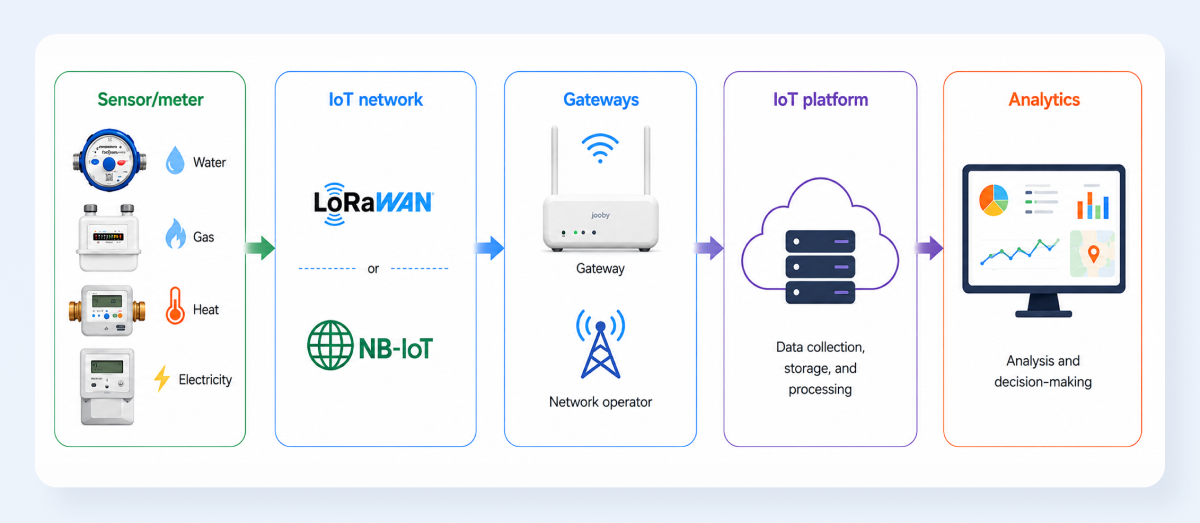
End-to-end smart metering architecture: from sensor to analytics platform
At the measurement level, smart metering system components include the meters themselves, as well as tamper, temperature, pressure, leakage, and reverse-flow sensors. At the transmission level, there are radio modules, antennas, gateways, SIM/eSIM, a LoRaWAN network, or an operator’s NB-IoT network. At the platform level, there’s device registration, packet decryption, data quality control, storage, and integrations.
The biggest mistake is to treat these levels separately. For example, you could choose an accurate meter but end up with unstable data collection because of poor antenna placement. You could build a radio network but fail to define validation rules for readings. You could even end up collecting millions of records but fail to link them to customer accounts, tariffs, and the address structure.
That’s why a project to create smart metering platform architecture should be planned not as an equipment purchase, but as a chain of trust in data that measures correctly, transmits without loss, verifies, stores, matches with the subscriber, and uses in the process.
The first level of IoT smart metering system architecture is physical measurement. This is where it’s determined which parameters will be collected, with what accuracy, how often, and under what conditions. For water, these may include volume, flow direction, attempted magnetic interference, leakage, or absence of consumption. For gas, they may include volume, pressure, temperature, and casing opening. For electricity, active and reactive energy, load profile, power quality, and outage events.
Modernization projects often use not only new smart meters, but also radio modules for already installed devices. This is especially relevant for condominium associations, municipal facilities, and developers, where the infrastructure is heterogeneous: some devices are new, while others are already installed in apartments, basements, wells, or technical rooms.
The key question here is not “does the device transmit data,” but “can this data be trusted?” This requires accuracy class, calibration interval, tamper protection, energy efficiency, enclosure quality, temperature range, and resistance to humidity. If the device is installed in a well, basement, or metal cabinet, the requirements for the radio part and antenna become no less important than metrology.
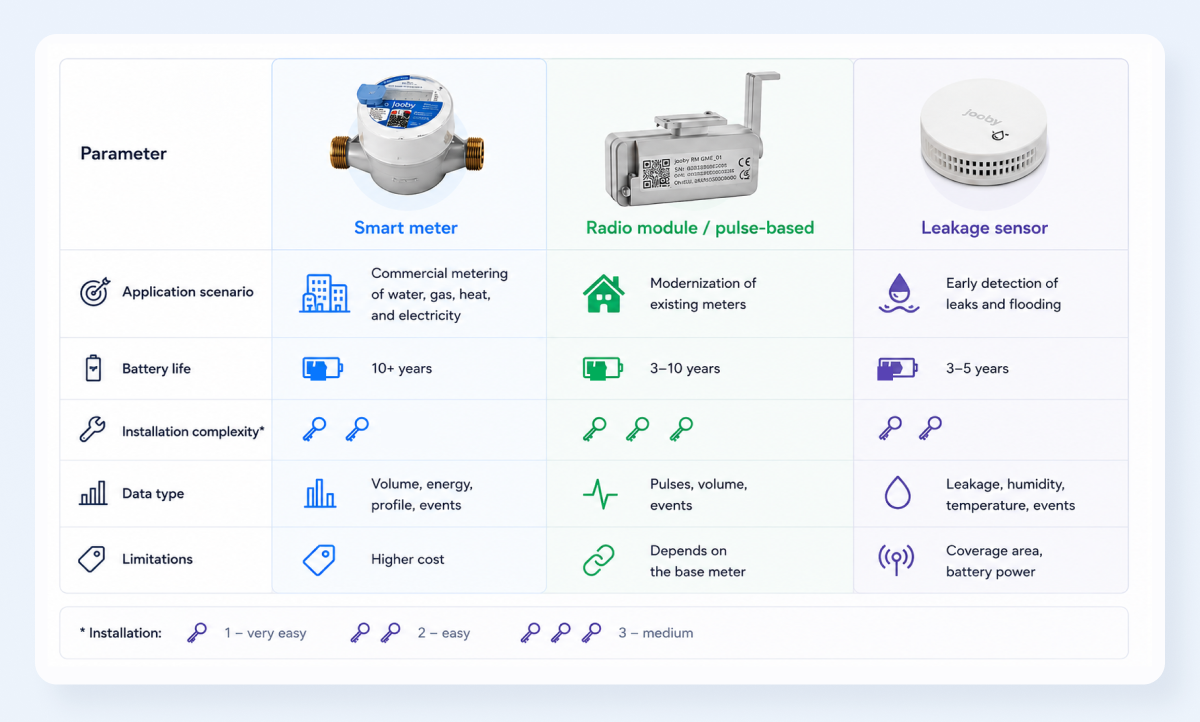
Comparison of device types
For remote meter reading, LPWAN technologies are often considered most suitable – long-range networks with low power consumption. In the smart metering segment, LoRaWAN and NB-IoT are the most common, but they address the task in different ways.
LoRaWAN is usually chosen where the customer wants to control their own radio network, such as a residential complex, district, industrial zone, municipal infrastructure, or distributed water metering units. A gateway receives packets from a large number of devices and forwards them to the network via Ethernet, LTE, or another backhaul channel.
In 2025, the LoRa Alliance specifically emphasized the role of LoRaWAN in the digitalization of Europe’s utility infrastructure and the modernization of smart utilities.
NB-IoT operates in licensed mobile operator networks and is convenient where coverage already exists, where there is no desire to build a dedicated radio network, or where sites are geographically distributed. The GSM Association (GSMA) describes NB-IoT as a standardized 3GPP LPWA technology for energy-efficient IoT devices and services. In 2026, GSMA also reported that by the end of 2025 the mobile ecosystem had reached 1 billion active NB-IoT and LTE-M connections.
The choice between LoRaWAN and NB-IoT should not be ideological. For basements, wells, and dense urban development, actual signal penetration needs to be tested. For sites in different settlements, operator coverage and the cost of SIM/eSIM are important. For municipal projects, infrastructure ownership and independence from an operator matter. For a developer, scalability for subsequent construction phases is key.
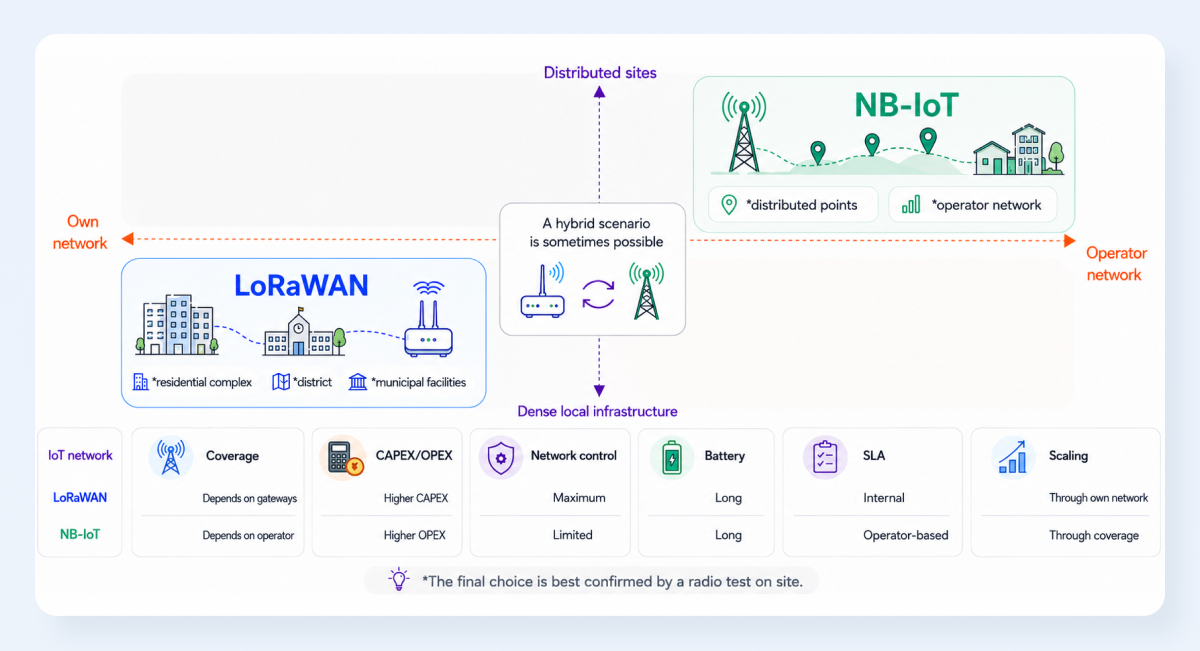
LoRaWAN or NB-IoT: A Selection Matrix for Smart Metering
If LoRaWAN is used, the architecture includes gateways. They are not the “brain” of the system, but the stability of data collection depends on their placement. A single gateway can serve many devices, however, its actual capacity depends on data transmission frequency, packet size, interference, installation height, antenna, building materials, and the topology of the site.
For an apartment building, a typical risk is installing the gateway where it’s convenient to connect power, rather than where it actually covers basements, shafts, technical rooms, and apartments. For a water utility or municipality, the risk is different due to some nodes being located in wells, where the signal is significantly weakened by the cover, depth, and humidity.
In NB-IoT connectivity projects, no gateway layer is required, but there is a dependency on the operator’s network. This is neither good nor bad – it is an architectural decision. It needs to be verified through field tests: RSSI/RSRP, stability of network registration, device behavior under weak signal conditions, and battery consumption during repeated transmission attempts.
In practice, a high-quality project begins with radio planning and a pilot zone. The pilot should check not only whether “the packet got through,” but also the regularity of transmission over several weeks: in the morning, at night, when humidity changes, after manhole covers are closed, in flooded or fully occupied basements, and under real building operating conditions.
After the radio channel, data reaches the network layer. For LoRaWAN, this is the network server, which manages device registration, keys, packet reception, duplicate removal, adaptive data rate, and further data routing. For NB-IoT, some network functions reside on the operator’s side and within the SIM platform, while data is delivered to the IoT platform via IP, MQTT, HTTPS, or other protocols.
At this level, it’s important not to lose control over the device fleet. In a small system, dozens of devices can be tracked manually, but in a network with thousands or tens of thousands of points, problems quickly arise without proper device management. The end result could be that it becomes unclear which devices are silent, where the battery has run down, which devices are transmitting anomalous values, and which ones have been replaced by installers.
A good architecture should store not only readings, but also device lifecycle data, including serial number, address, device type, installation date, installer, firmware version, keys, communication status, latest events, and replacement history. This is especially important for utility providers, where an error in linking a meter to a customer account can lead to incorrect billing and conflicts with subscribers.
This is also where cybersecurity becomes an issue. Metering data is not just technical telemetry, it’s linked to addresses, consumption, payments, and sometimes household behavior. Therefore, encryption, access control, action logging, secure key management, and a clear data retention policy are required.
Meter Data Management, or MDM, is the layer that turns raw readings into business-ready data. A meter may transmit values once an hour, once a day, or upon an event, but billing needs verified readings as of the calculation date, a dispatcher needs emergency events, an engineer needs the consumption profile, and a manager needs summary indicators on losses.
MDM performs data validation, estimation, and correction. For example, the system can check that the new reading is not lower than the previous one, that consumption does not exceed what is physically possible, that the device has not been silent longer than allowed, and that consumption has not dropped to zero at an active site.
If data is missing, MDM can mark the gap, request retransmission, or calculate an estimated value according to predefined rules.
Without MDM, smart metering often turns into simply a large table of readings. While such a table is useful during a pilot, it performs poorly in industrial operation. That’s because the more devices there are, the more exceptions arise. These exceptions could be meter replacements, communication failures, incorrect addresses, seasonal peaks, emergencies, reverse flow, and human errors during installation.
For a condominium association, MDM may be simpler than for an energy company, but the logic is the same: the system must explain which data is reliable, which requires verification, where there is a suspected leak or tampering, and where the problem is only related to communication.
An analytics platform is the level at which data begins to influence management decisions.
For a water utility, this means identifying imbalances between supply and consumption, analyzing minimum night flow, detecting leaks, and prioritizing repair crews. For district heating, it means monitoring temperature schedules, consumption anomalies, and the efficiency of individual heat substations. For a developer, it means transparent building operation and reduced workload for the property management company.
For a municipality, analytics can combine telemetry data from schools, hospitals, administrative buildings, lighting, pumping stations, and other facilities. In this case, smart metering becomes part of the city’s digital infrastructure rather than a separate system just for meters.
The European Commission links smart meters with smart grids and notes that investment in smart metering in the EU could reach €47 billion by 2030, with 266 million meters installed and 92% penetration. This shows that smart metering is viewed not as local automation, but as an element of the energy transition and demand-side management.
In a practical smart metering architecture, it’s important not only to collect data from devices, but also to have a convenient layer for processing, real-time monitoring, and passing it on into workflows.
Jooby RDC Dashboard can be used as such a layer – a service for collecting and processing data on resource consumption and device status. It supports different types of metering – electricity, water, gas, and heat – and helps automate meter reading for utility companies, developers, condominium associations, property management companies, and industrial enterprises.
The system provides consumption reports, data on the status of devices in the network, reading history, metering point cards, and CSV report export for further work in external systems.
Operational control adds separate value, with the platform allowing users to track the network status of devices, battery charge level, and events that affect data reliability. These include magnetic interference, unauthorized removal, disconnection, and communication errors.
For installation and device commissioning, the Jooby Android application is available: radio modules are activated on site, while data is automatically sent to the server and imported into Jooby RDC Dashboard. This approach covers an important part of the end-to-end architecture – from a field device in the IoT network to a platform where data becomes available for analysis, reporting, and further integration.
Even a good analytics platform should not exist separately from other systems. In an industrial architecture, smart metering data is integrated with billing, CRM, ERP, GIS, a dispatching system, the installer’s mobile application, and the consumer’s personal account.
Integration with billing makes it possible to automate charges and reduce manual data entry. Integration with GIS helps visualize problem areas on a map. A connection with CRM is useful for handling subscriber requests, as the operator sees not only the complaint, but also the history of readings, communication events, device replacement, and possible anomalies. The installer’s mobile application reduces the risk of errors during installation and device binding.
For sales and procurement, it’s important to define in advance which integrations are mandatory at the first stage and which can be postponed. A common mistake is trying to create an “ideal” platform immediately. A more realistic approach is to first ensure reliable data collection and correct device binding, then connect billing, and after that develop analytics and automated scenarios.
For a utility provider, smart metering is needed primarily to obtain regular and reliable data. Water, gas, heat, and electricity differ in the physics of measurement, but the business questions, which include where losses occur, where there is no communication, where tampering is suspected, and where consumption does not match the site profile, are similar.
For a developer, it’s important to design the architecture before the building is commissioned. If gateway locations, power supply, cabinets, antennas, access to technical rooms, and the data structure for apartments are not planned at the design stage, correcting mistakes after occupancy will be more expensive and more difficult.
For a municipality, scalability is important. A single pilot across several buildings may be successful, but a citywide system requires unified directories, access rules, cybersecurity, maintenance, reporting, and a clear data ownership model.
Condominium associations most often need a practical solution to collecting readings without manual rounds, reducing disputes, and quickly detecting leaks and anomalies. A complex corporate architecture is not always necessary here, but reliable devices, a clear interface, data export, and minimal workload for the building’s board are essential.
The first mistake is starting with the price of the device rather than the total cost of ownership. A cheap module can turn out to be expensive if it’s difficult to install, drains the battery quickly, performs poorly in a basement, or requires manual data processing.
The second mistake is failing to conduct radio tests under real conditions. A “tabletop” demonstration does not show how the device will operate in a metal cabinet, well, shaft, or technical room. For LoRaWAN and NB-IoT, the actual installation environment is critical.
The third mistake is not defining maintenance processes. Who responds to a meter that has gone silent? Who replaces the battery? Who confirms device replacement? Who corrects an erroneous address binding? Without answers to these questions, the system quickly loses data quality.
The fourth mistake is not thinking through access rights. The supplier, property management company, installer, dispatcher, accounting department, and resident should not see and modify the same things. Role separation must be designed in advance.
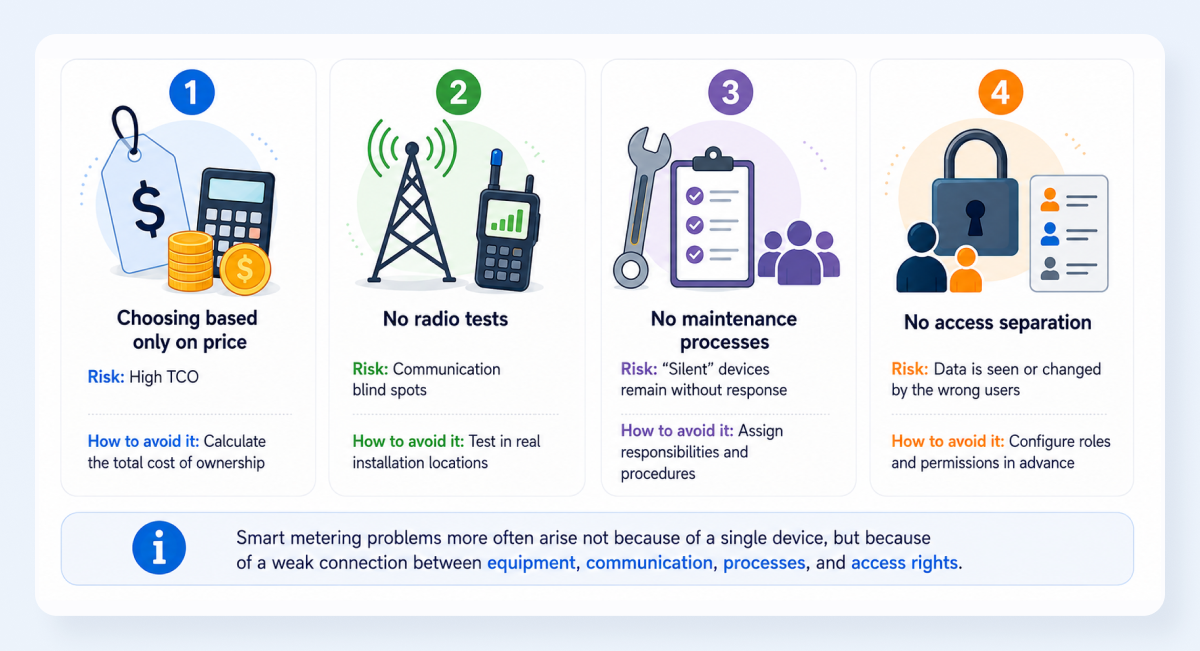
Common Mistakes in Smart Metering Implementation and How to Avoid Them
After implementation, it’s important to look at more than just the number of connected devices. Other useful metrics include the share of devices that transmitted data within a day, the share of valid readings, average communication downtime, the number of emergency events, the number of manual corrections, and the percentage of sites with anomalous consumption.
For a utility provider, imbalances and the dynamics of commercial losses are important. For a condominium association, the number of disputed charges and the time required to prepare reports matter. For a municipality, consumption by facility and deviations from the standard profile are important. For a developer, it is the readiness of the infrastructure to be handed over to the operating organization.
In Europe, smart metering remains a relevant topic precisely because deployment is uneven. In 2025, ACER and CEER noted that the rollout of smart meters and data availability are progressing unevenly across EU countries, while standardized and secure access to data remains an important condition for demand flexibility.
Now that we know how smart metering systems work, a rational approach to their creation is to move step by step. First, define the goals: billing automation, loss control, emergency alerts, eliminating manual rounds, consumption analytics, or preparing a facility for operation. Then conduct an audit of the sites, including meter types, installation locations, power availability, coverage, basements, wells, cabinets, and existing IT systems.
After that, it’s worth selecting a pilot zone that reflects real challenges rather than the most convenient site. A good pilot includes different conditions: apartments, basements, technical rooms, remote points, weak signal, and different types of meters. Its outcome should not be limited to “data is being collected,” but also provide clear conclusions, such as where a gateway is needed, where NB-IoT is better, which devices are suitable, and which maintenance processes will be required.
Next, the target architecture – devices, network, platform, MDM, integrations, user roles, security requirements, and reporting requirements – is defined. Only after that does it make sense to scale the project.
An end-to-end smart metering architecture begins not with the cloud platform or the meter, but with the connection between all layers: correct measurement, reliable transmission, a managed device fleet, data verification, integrations, and analytics. If even one layer of a smart metering network design is substandard, the entire system loses its practical value.
For a utility provider, this is a path to reducing losses and improving billing accuracy. For a developer, it’s a way to hand over a facility for operation with a ready-made digital infrastructure. For a municipality, it’s a tool for consumption control and planning. And for a condominium association, it means transparency, less manual work, and faster problem detection.
The main criterion of a good smart metering project is the system’s ability to regularly provide reliable data on which decisions can be based, not the number of installed devices.
The focus shouldn’t be on a specific sensor, radio module, gateway, or smart meter, but on the architecture and its ability to withstand real-world operation challenges – basements, wells, weak signal, device replacements, installation errors, and network growth, in addition to meeting user requirements.
Was it helpful?
 23
23


Stay on top of the latest industry news
Thank you, we have received your message. Our manager will contact you shortly.


Our experts are always happy to help and promptly answer your questions. Please fill out the form to discuss your project and develop a tailored action plan.
Thank you, we have received your message. Our manager will contact you shortly.
Thank you, we have accepted your request. In the near future the responsible manager will contact you and clarify the details of the order.
Our experts are always happy to help and promptly answer your questions. Please fill out the form to discuss your project and develop a tailored action plan.
Thank you, we have received your message. Our manager will contact you shortly.