25.09.2026
 31
31
31
How to Choose a Gateway for an IoT Network: Key Parameters and Common Mistakes
31
Remote metering seems like a simple chain: a meter transmits readings, software receives them, and the utility provider sees consumption data. But between the meter and the metering system lies a communications infrastructure. Mistakes in choosing what infrastructure to use can lead to delayed readings, lost device connectivity, and additional technician visits.
Finding the right gateway for utility monitoring in an IoT network should start with site conditions and data collection requirements. The gateway range stated in a catalogue and the advertised number of supported devices are not enough on their own. You need to establish how the equipment will operate in a particular building, communicate with the server, and recover from failures.
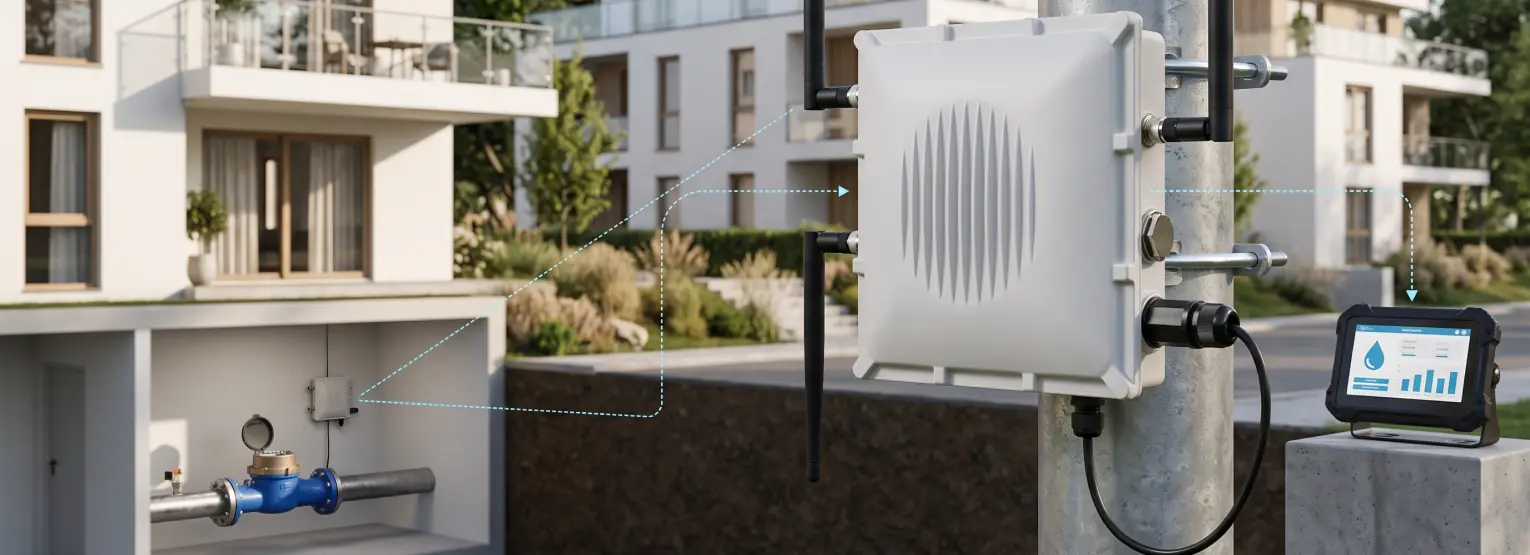
In a LoRaWAN network, the gateway receives radio messages from meters and sensors and forwards them to a network server. The server manages network communications and removes duplicate copies of packets received by multiple gateways. The application layer converts the data into consumption values, temperature readings, or equipment status information.
The network server can run in the cloud, on the customer’s local infrastructure, or on the IoT gateway itself if the model supports this function. The architecture determines which operations remain available when the external internet connection goes down.
In a typical NB-IoT solution, the device communicates directly with a mobile operator’s base station. A separate local gateway for a group of these meters is generally unnecessary. NB-IoT uses licensed cellular spectrum, while LoRaWAN allows users to deploy their own network or use a specialist operator’s IoT infrastructure.
A LoRaWAN gateway with a 4G modem receives messages from LoRaWAN devices and uses the cellular network to communicate with the server. Having a SIM card does not make it a gateway for NB-IoT meters. If a project uses both technologies, their readings can be combined at the software platform level, provided the appropriate integrations are available.
Before comparing models, determine the number of meters at the initial stage and after expansion, their locations, transmission frequency, and acceptable latency. Daily readings for billing and a leak alert serve different purposes. Timely emergency notifications depend on the sensor, the network, and the processing software working together.
It helps to distinguish between measurement frequency and transmission frequency. A radio module may store hourly values and transmit them several times a day if its design supports it. This helps balance metering detail, network load, and battery consumption.
Mark basements, service shafts, utility chambers, metal cabinets, potential antenna mounting points, power supplies, and internet access on the site plan. Developers should repeat the checks before handover: doors, building services, and finishes can change reception conditions.
Future network expansion and gateway scalability also need to be considered in advance. Connecting neighbouring buildings, heat meters, and leak sensors changes coverage and capacity requirements. The ability to add gateways and devices to a shared server system as part of the remote meter reading infrastructure should therefore be checked when selecting the equipment.
The communication range in a product advertisement cannot be applied to every residential development. Reinforced concrete, soil, metal covers, and neighbouring buildings affect signal propagation. A rooftop gateway may receive signals well from devices in open areas but struggle to reach a meter almost directly below it, behind several floors. The number of gateways must therefore be determined by coverage at specific metering points.
Before purchasing, conduct a radio survey using the selected meters or radio modules. Check signal strength, signal-to-noise ratio, and actual message delivery from difficult locations. A single successful reception is not enough: monitoring should cover several operating cycles with doors, cabinets, and hatches closed.
In a 2026 study on IoT gateway deployment and placement in a digital model of Sunway City, the authors assessed eight potential rooftop locations. The study shows how building geometry affects coverage and the selection of additional nodes. It’s important to mention that the study models a specific area, so its findings shouldn’t be used as a universal rule for the number of gateways required per city block.
Compare receiver sensitivity under identical radio settings. Select the antenna together with its installation location and cable: the cable introduces losses, while higher gain changes the radiation pattern and does not improve reception equally in every direction. Sometimes relocating the antenna is more effective than replacing the gateway.
An operational network needs a multichannel LoRaWAN gateway that supports the selected regional frequency plan. Models with eight receive channels are common, with their specific capabilities depending on the radio hardware and configuration. A simplified single-channel receiver cannot be considered an equivalent substitute for a full-featured gateway in utility metering.
However, eight channels do not mean that only eight meters can connect. Devices share the radio spectrum by sending short messages. Network load depends on the number of meters, transmission frequency, packet length, data rate, retransmissions, and server responses. At lower data rates, each packet occupies the airwaves for longer.
For example, a hypothetical network of 1,000 radio modules sending one packet every four hours generates 6,000 messages per day. Hourly transmissions would produce 24,000 messages. This calculation excludes retransmissions and control traffic. It illustrates the change in transmission count but does not establish the gateway’s maximum capacity or exact airtime utilisation.
Peak load also matters: evenly distributed transmissions and simultaneous transmissions at the start of the hour create different conditions. Acknowledging every message also consumes network resources. Half-duplex gateways pause reception while transmitting; full-duplex solutions are also available. Check this capability for the specific model and regional version.
The first level of compatibility is the equipment’s regional version. The gateway, meters, and network settings must support a consistent frequency plan permitted in the country of operation. A LoRaWAN label alone is not enough.
The second level is connectivity to the network server. Check the communication method, whether you can specify your own server, licence restrictions, and the ability to move the equipment to another system. Establish separately which functions are available without a manufacturer subscription.
LoRaWAN support does not guarantee that the system can interpret every meter’s data format, as this requires a software decoder at the application layer. Before purchasing, test the entire path, from the radio message to the correct meter ID, measurement units, timestamp, and consumption value in the metering system.
Compatibility is best checked across the entire transmission chain. Successful packet reception by the gateway confirms only the first stage, after which the data must pass through network processing and become valid readings.
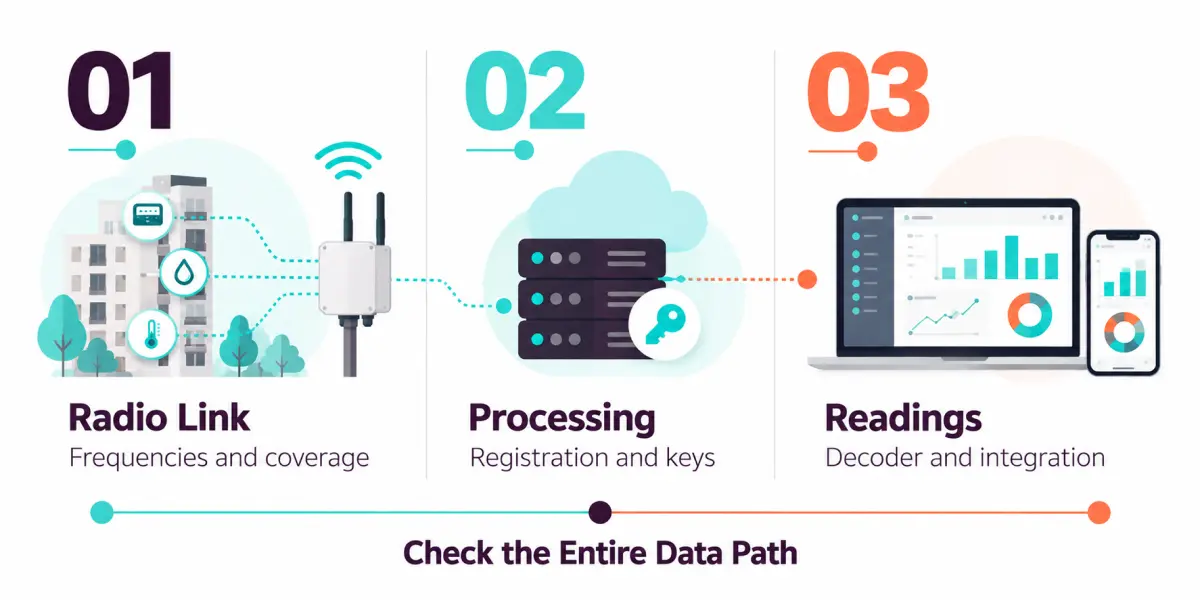
From Signal to Readings
Assess wired and cellular connectivity to the server, along with failover options. Having both Ethernet and 4G listed in the specifications does not confirm automatic switching between them. Testing should include a loss of the primary connection and recovery without a technician visit.
Buffering also needs to be checked. Not every IoT gateway for smart metering stores received packets when connectivity is lost. If the function is available, establish its storage capacity, retention period, whether data survives a restart, and how it is subsequently forwarded. The server must correctly accept the stored messages; delayed delivery does not replace a timely emergency alert.
Similarly, buffering does not replace network server availability. If a remote server is unreachable, storing packets alone does not ensure timely acknowledgements or commands to devices. For Class A devices, a response must arrive within the designated receive window after a message is sent.
A meter’s internal archive and a gateway’s buffer serve different purposes. The gateway can store only what it’s already received. A radio module’s archive may help restore historical data if the device and platform support its subsequent retrieval. Archive recovery should be tested.
Backup power must be sized for the entire chain, i.e., the gateway, modem, router, and equipment supplying power over the network cable. A second gateway helps when the first fails only where reception from the same meters has been confirmed. Two gateways sharing a power source and a single communication link retain a common point of failure.
Choose gateway redundancy measures for specific failures. A battery helps during a power outage, an additional connection helps when connectivity is lost, and another IoT network gateway helps if the equipment fails. Test each scenario separately.
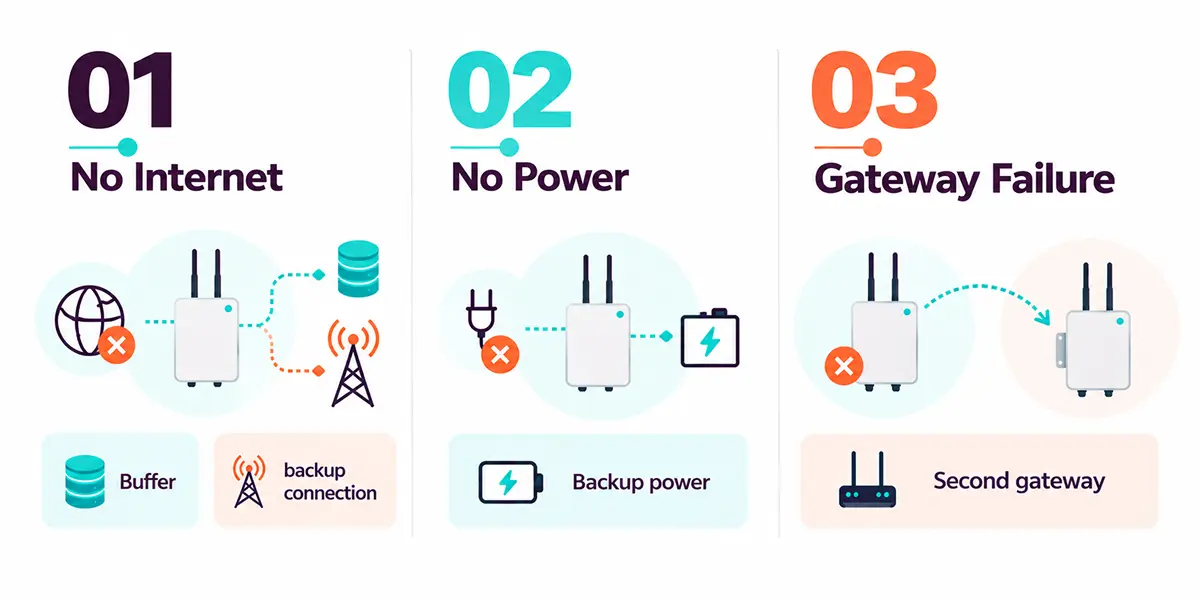
Three Failures — Three Solutions
An indoor model is suitable for a protected room if coverage has been confirmed there. For a rooftop, façade, or damp service area, assess the enclosure’s ingress protection rating, operating temperatures, resistance to sunlight, and installation requirements. An IP rating alone is not enough: connectors, cable glands, and the installed antenna must also be suitable for the operating environment.
Outdoor installations require appropriate mounting, surge protection, and maintenance access. Remote diagnostics should help distinguish radio reception problems from a lost server connection, a device restart, or a power failure.
Security requires individual credentials, access controls, and ongoing update support. LoRa Basics Station supports a secure server connection using TLS, centralized configuration, and updates.
During selection, check whether connection security is enabled, how credentials are managed, and which functions the manufacturer has implemented.
The differences between installation options can be illustrated by Jooby RDC gateways. Jooby Indoor Gateway models are designed for indoor use: the 501 EU version supports Ethernet, LTE, and Power over Ethernet (PoE), while the 502 EU supports Ethernet and PoE without LTE. The choice depends on the available connection and whether an additional cellular link is needed; switching behaviour should be checked during configuration.
In the outdoor range, the Jooby Gateway LoRaWAN 400 EU supports up to eight channels and comes without a backup battery, while the 401 EU includes one. This allows conditions for the gateway power supply to be considered when selecting the equipment.
The chosen indoor or outdoor IoT gateway model is included in the project alongside compatible meters or radio modules and a data collection server, followed by on-site checks of coverage and operation during failures.
Compare the cost of an operational system over an agreed period, such as five years. The calculation should include gateways, antennas, installation, surveys, backup power, connectivity, server licences, and maintenance. Compare proposals with the same scope of work and support.
For homeowners’ associations, recurring payments and clear maintenance responsibility are important. Developers need to hand over access credentials and documentation to the property management organisation. Municipalities and utility providers need to retain control as the network expands and be able to change contractors without losing data.
Before making a final choice, check for five common mistakes:
The pilot deployment should include the most challenging conditions, rather than only a convenient room near the wireless IoT gateway. Agree on acceptance criteria in advance: the proportion of meters delivering up-to-date readings within the required timeframe, acceptable delays, recovery after a failure, and archive completeness.
The right IoT gateway selection is one that enables the network to deliver the required completeness and timeliness of data under actual site conditions.
Selection starts with the LoRaWAN or NB-IoT network architecture, requirements for readings, and a site survey, then moves on to gateway network capacity, compatibility, and resilience.
Testing these conditions in a pilot deployment helps justify the purchase and establish in advance what reliable remote metering will cost after launch.
Was it helpful?
 7
7


Stay on top of the latest industry news
Thank you, we have received your message. Our manager will contact you shortly.


Thank you, we have accepted your request. In the near future the responsible manager will contact you and clarify the details of the order.