05.08.2025
 3246
3246
3246
Satellite LoRaWAN (NTN) + Terrestrial Gateways: How to Ensure Coverage in Every Corner of the Country
3246
When data needs to be collected both in cities and across remote areas, traditional communication solutions often fall short. Forests, agricultural fields, mountainous regions, and sparsely populated areas lack stable cellular coverage, and laying cable infrastructure is economically unfeasible. For utility providers, developers, and municipalities, IoT network redundancy means downtime and the risk of losses due to the absence of accurate information about asset conditions.
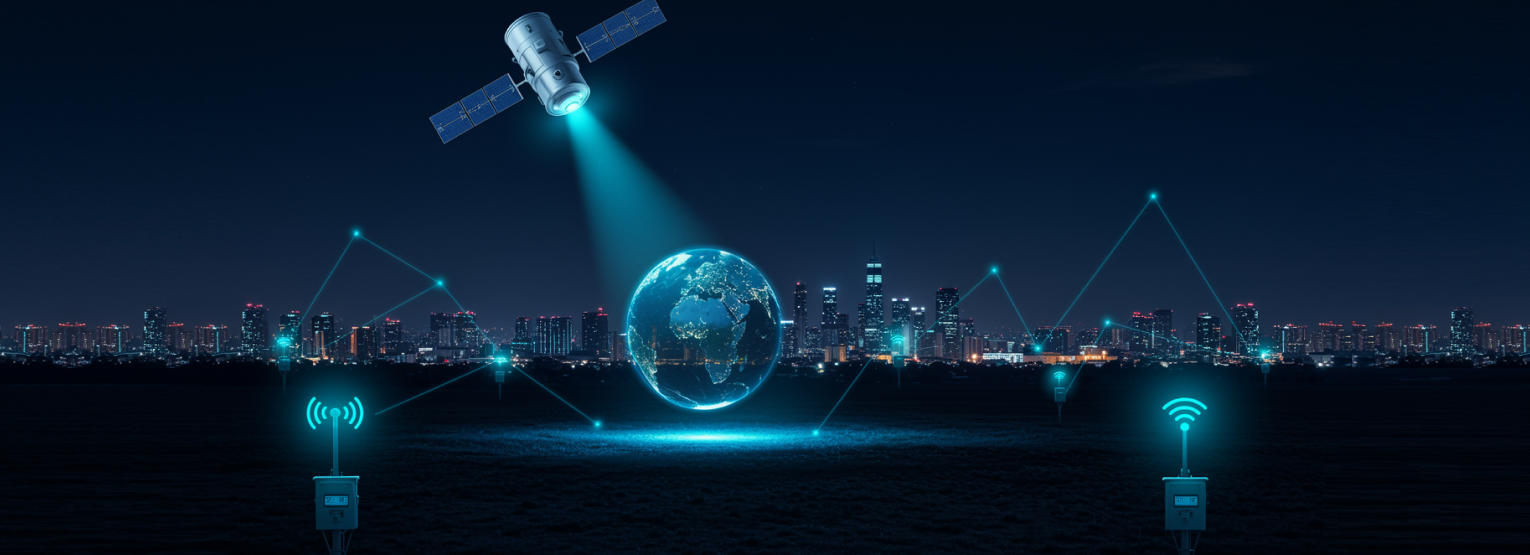
Against this backdrop, LoRaWAN technology—an energy-efficient network for long-range data transmission—comes to the fore. However, until now, its traditional terrestrial architecture hasn’t always managed to provide blanket coverage. The solution? Integrating LoRaWAN terrestrial gateways with satellite LoRaWAN based on the NTN (Non-Terrestrial Networks) standard. This combination allows reliable data collection even where there are no towers or cables—literally in any corner of the country.
The NTN standard in the LoRaWAN ecosystem enables building a network where data is transmitted not only through terrestrial stations but also directly via low-orbit satellites. Connecting IoT devices without terrestrial network access eliminates the main limitation of classic LoRaWAN coverage planning—its dependence on geography and the density of base stations.
From a technical standpoint, satellite LoRaWAN gateways perform the same function as conventional ones but are located in orbit. This means that sensors installed, for example, in a water meter well in a remote village or at a pumping station in the steppe can send data directly to a satellite, bypassing hundreds of kilometers of empty space.
For businesses, ensuring LoRaWAN coverage in rural and hard-to-reach areas means that they achieve continuous infrastructure monitoring but without the cost of building additional ground nodes.
Providing remote IoT connectivity with a satellite link solves the problem of “white spots” on the coverage map, but it’s not always optimal for handling large volumes of traffic. This is where terrestrial LoRaWAN gateways continue to play a key role, processing data in areas with dense device deployment, such as cities, industrial zones, and residential complexes.
The advantage of hybrid LoRaWAN infrastructure is that the architecture is designed so devices automatically choose the best communication channel—terrestrial or satellite. At the same time, the network management system can optimize traffic, reduce the load on satellite links, and minimize latency. As a result, the customer receives unified coverage without needing to worry about where and how the data travels.
While the use of LoRaWAN for utilities is not new, it is becoming increasingly popular, and for companies involved in water supply, heating, or electricity, the main task is to ensure uninterrupted data collection. With that in mind, satellite LoRaWAN for smart meters is especially valuable in suburban settlements, remote boiler houses, or pumping stations where stable cellular connectivity is unavailable, as well as for extending IoT networks to remote communities.
Municipalities can use this type of network to monitor street lighting, manage irrigation of green areas, or oversee the condition of remote infrastructure facilities. Homeowners’ associations and developers can employ it for remote reading of apartment and building-level meters in new housing projects on the outskirts—even before fiber optics or LTE coverage reaches them.
One of the main reasons for interest in nationwide LoRaWAN coverage with NTN support is its minimal operating costs. Devices can run on batteries for 5–10 years, and the hybrid network makes it possible to scale coverage without investing in mass construction of base stations.
Moreover, satellite IoT connectivity can be enabled selectively, where communication is truly needed, making the project economically flexible. This is particularly relevant for large countries with uneven population density as resources are spent only on necessary areas rather than “painting” the entire map with towers.
The global market is already actively developing LoRaWAN NTN, and manufacturers of sensors, radio modules, and smart meters are offering equipment with hybrid connectivity support. For companies that want to stay ahead, now is the perfect time to consider the use of hybrid LoRaWAN networks and incorporate satellite channel support into projects.
This technology doesn’t just provide “everywhere, always” data transmission—satellite and terrestrial LoRaWAN integration creates the foundation for smart cities, autonomous residential complexes, and digital infrastructure management across the country. Using potentially nationwide IoT deployment strategies, in just a few years, satellite-based LoRaWAN may well be as common as Wi-Fi is in every home today.
Was it helpful?
 493
493


Stay on top of the latest industry news
Thank you, we have received your message. Our manager will contact you shortly.


Thank you, we have accepted your request. In the near future the responsible manager will contact you and clarify the details of the order.