09.10.2026
 40
40
40
LoRaWAN Sensors: Types, Applications, and Selection Guidelines
40
Collecting meter readings becomes far more challenging as the number of sites grows.
Utility providers need data from thousands of apartments, homeowners’ associations need to monitor consumption and detect leaks, and municipalities need to oversee their infrastructure.
In short, manual meter-reading rounds take time, while running cables to every installed device in a building is often inconvenient, expensive, or both.
In its place, industrial LoRaWAN sensors and radio modules are increasingly being used in low-power wireless metering networks to transmit small amounts of data. However, having the technological support for LoRaWAN does not mean a device will automatically suit a particular meter, basement, or metering system.
Making an informed choice requires understanding exactly what the equipment measures, how it transmits information, and what conditions it needs to operate.
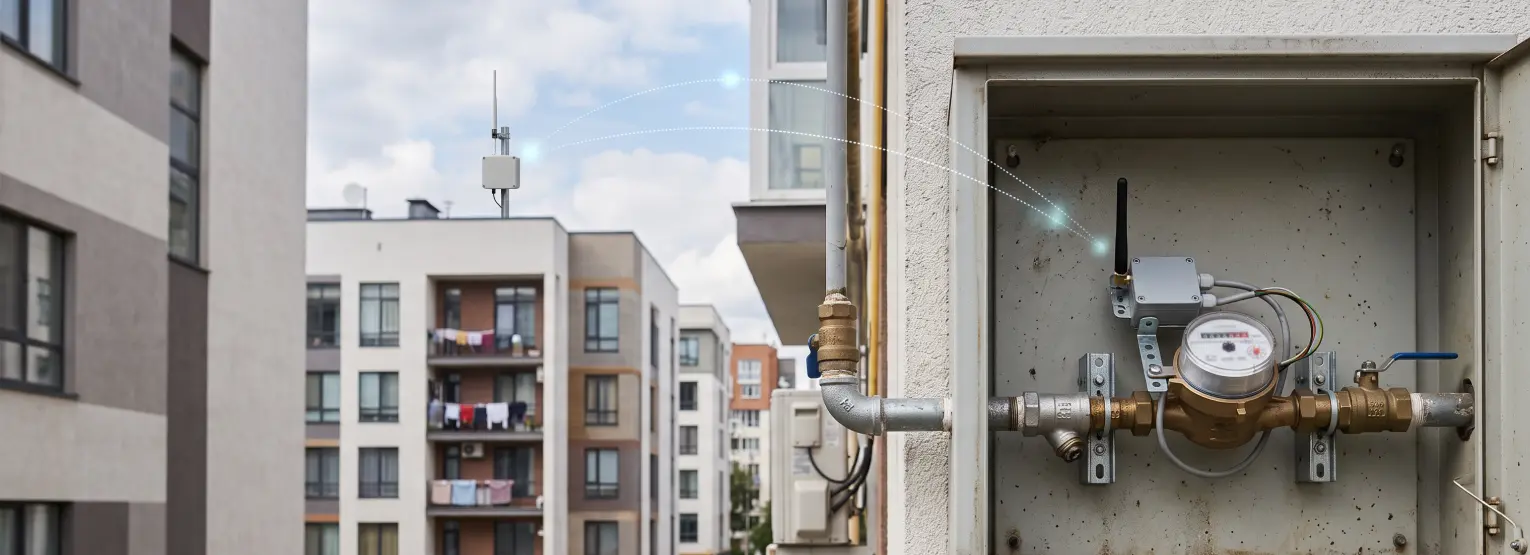
In broad terms, a LoRaWAN sensor is a device that measures a specific parameter or detects an event and uses a radio module to transmit the result over a LoRaWAN network. This might be information about air temperature, pipeline pressure, water on the floor, or meter readings.
LoRa and LoRaWAN are different concepts. LoRa handles radio transmission, while LoRaWAN defines how devices interact within the network. A “LoRa” label alone is therefore insufficient to confirm compatibility with LoRaWAN infrastructure. The technology is primarily designed for short messages, rather than continuous transmission of large volumes of information.
A gateway receives the message sent by the sensor’s radio module and forwards it to a network server through a wired or cellular connection. The data then reaches an application system, where it’s converted into readings, charts, and notifications.
Several gateways may receive the same packet and the network server removes any duplicates. The sensor and its radio module do not need a separate SIM card for LoRaWAN connectivity.
This means that buying wireless sensors alone is not enough for remote monitoring. The system also needs network coverage, server-side processing, and software that staff can use to work with the information.
The infrastructure for LoRaWAN smart metering may belong to the customer or be provided by an operator as a service.
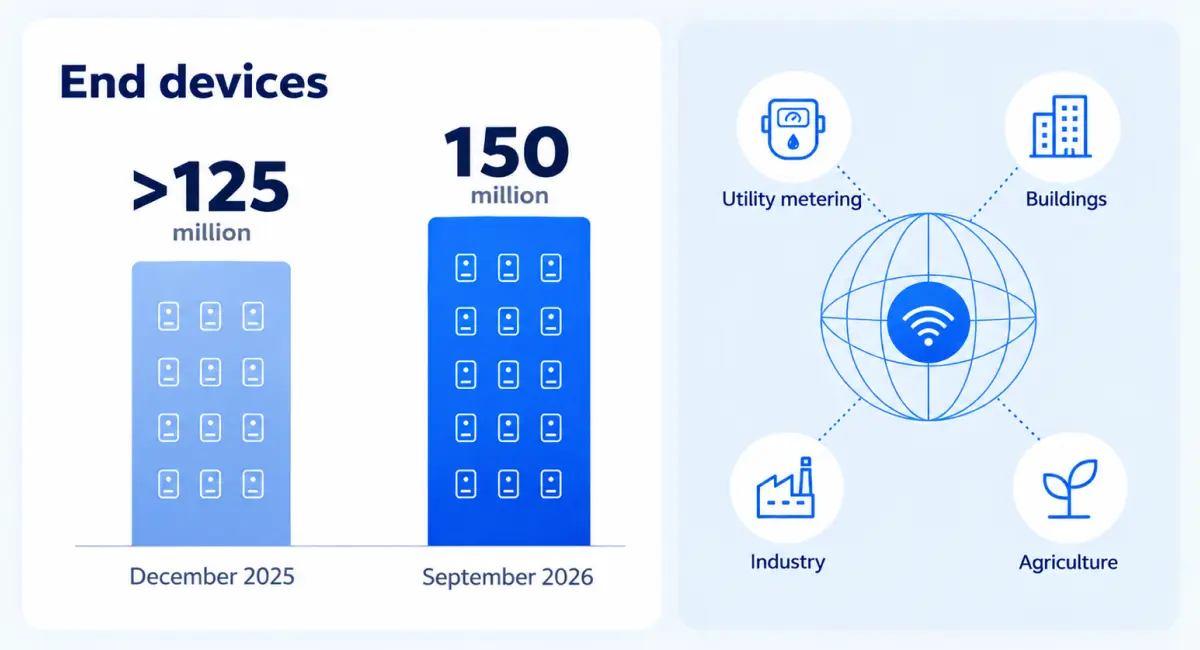
According to the LoRa Alliance, the number of LoRaWAN end devices deployed worldwide exceeded 125 million in December 2025. In September 2026, the organization reported the milestone of reaching 150 million devices.
There are many LoRaWAN applications and these figures cover multiple sectors, including utility infrastructure, buildings, industry, and agriculture—not just meters.
For customers, these figures demonstrate the scale of the technology’s adoption, but they don’t guarantee the quality of an individual project. Reliable meter reading still depends on equipment, LoRaWAN gateway compatibility and subsequent placement, reception conditions, and system maintenance.
Global LoRaWAN Adoption in 2025–2026
From a practical perspective, LoRaWAN sensor selection is best grouped by its purpose. Some devices collect readings, others help detect faults, and others monitor operating conditions in buildings and their engineering systems. The range of devices available includes pressure sensors, water metering sensors, and gas monitoring sensors.
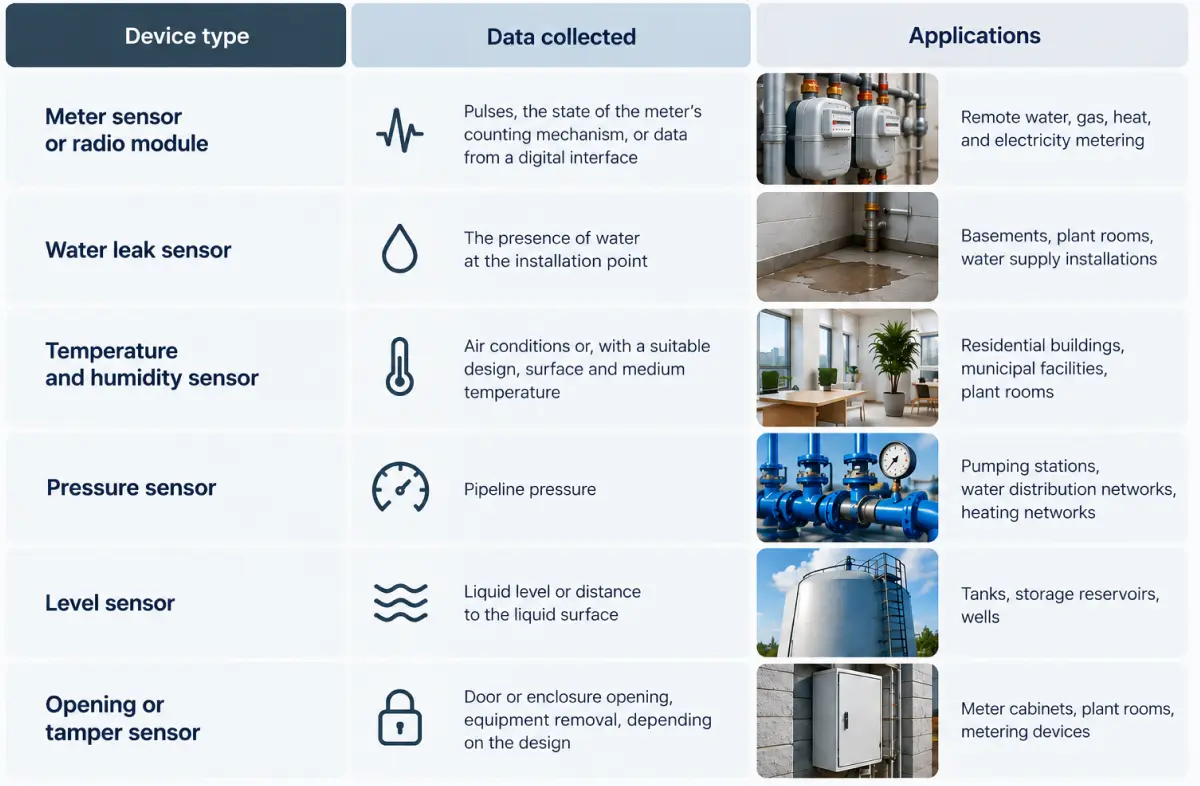
LoRaWAN support determines the communication method, not the measurement capabilities. For example, air temperature sensors cannot automatically be used to monitor hot water inside a pipe, as this requires a suitable sensing element, temperature range, and installation method.
It’s also important to distinguish between detecting water and identifying abnormal consumption. Water leak sensors respond to water near their sensing element. Meter data analysis can identify continuous consumption, including at night, but doesn’t by itself pinpoint the exact location of a leak. In other words, these methods complement each other.
These LoRaWAN devices perform different functions. A sensor detects a physical parameter or event. A radio module receives information from a meter or sensor and transmits it over the network. A smart meter with built-in connectivity combines consumption measurement and data transmission in a single device.
If existing meters are in good working order and compatible with external reading devices, they can be integrated into a remote metering system without full replacement. Options include add-on modules with sensors, pulse-input radio modules, and digital interface converters. The appropriate method depends on the meter’s design.
For example, Jooby’s documentation for add-on radio modules includes separate lists of compatible gas and water meters, highlighting that a module needs to be selected for the exact meter model, rather than simply because it’s labeled “for water” or “for gas.”
For a new site or a scheduled equipment replacement, this approach should be compared with a meter that has built-in LoRaWAN connectivity. The assessment should cover the cost of the entire installation, i.e., the meter, additional modules, installation, configuration, and ongoing maintenance.
Adding connectivity does not improve an old meter’s accuracy or eliminate mechanical wear.
Before purchasing equipment, compile an inventory of the installed meters, including the manufacturer, exact model, variant, available output, and installation conditions. Even meters that look similar may have different counting mechanisms and reading methods.
For pulse connections, check the output type, electrical characteristics, permissible pulse frequency, and pulse value (the volume or amount of energy represented by each pulse). For example, if one pulse represents 10 liters but the software is configured for 1 liter, the system will receive messages correctly but calculate consumption incorrectly by a factor of ten.
During commissioning, also record the meter’s initial reading and the time at which it’s linked to the system. The accumulated pulse count doesn’t necessarily match the number on the mechanical display, as the system needs a correct starting point to reconstruct the full reading.
For digital connections, check both the interface and the communication protocol. A connector or an RS-485 label is not confirmation that the radio module can read the required registers of a particular meter.
Before purchasing equipment in bulk, it’s useful to obtain a verified example of the selected pair of LoRaWAN network devices working together.
Advertised sensor range and coverage in open terrain says little about connectivity inside an enclosed plant room. Reinforced concrete, metal cabinets, installation depth, water, and antenna position all affect signal propagation. Coverage should therefore be tested at the actual installation location.
Testing LoRaWAN sensor deployment should take place with doors, well covers, and cabinets closed. Assess not only whether a message is received, but also how consistently messages are delivered over a chosen period. A single successful transmission doesn’t prove that the system will receive data regularly.
If reception is unstable, consider relocating the gateway, installing an additional gateway, or using a device with an external antenna. Choose the solution after surveying the site: an antenna only helps when correctly positioned, while a long cable introduces additional losses.
The frequency plans of the sensor, gateway, and network must match the region of operation. In addition to frequencies, account for transmission power and airtime restrictions.
The LoRa Alliance publishes regional parameters separately from the main protocol because radio spectrum usage conditions vary.
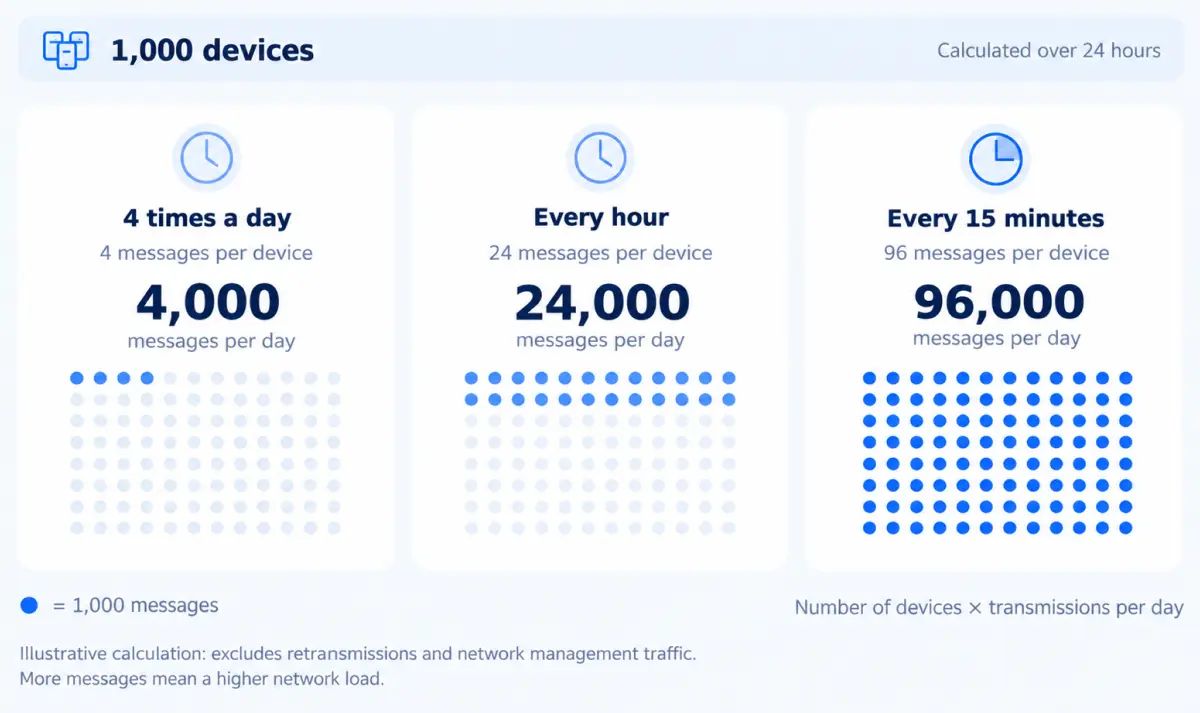
Measurement frequency, historical data retention, and transmission frequency are different characteristics. A device may record hourly consumption, store it in memory, and transmit the accumulated values several times a day. However, the specific model must support this capability.
For utility billing, data completeness and receipt of readings by a specified deadline are usually the priorities. For fault detection, the priorities are how quickly an event is detected and a notification is delivered. The communication interval should therefore be chosen according to the task, rather than on the assumption that more frequent transmission is always better.
A claim of “up to ten years of battery life” must be considered alongside the conditions used to calculate it. Battery life depends on transmission frequency and duration, sensing element operation, temperature, and retransmissions. Longer radio transmissions consume more energy.
One illustrative example is a Jooby pulse-input module for which the manufacturer specifies at least ten years of battery life with four transmissions per day. This is a characteristic of a particular product operating in a defined mode, not a universal property of all LoRaWAN radio modules.
Transmission Frequency and Network Load
LoRaWAN classes primarily determine how a device receives commands. Class A is generally suitable for battery-powered sensors: after transmitting, the device briefly opens receive windows. This saves energy, but the server can’t deliver a command to a sleeping device at any arbitrary moment.
Class B adds schмeduled receive windows. Class C keeps the receiver active almost continuously, allowing commands to arrive sooner but increasing power consumption. Class C devices therefore typically use an external power supply.
For routine meter reading, the difference may be unnoticeable, but it becomes significant when a valve needs to be controlled remotely or settings need to be changed promptly. However, Class A does not prevent a sensor from initiating an event message: that capability depends on its design and firmware.
LoRaWAN should not be treated as a communication channel with guaranteed instantaneous delivery. If the application requires an emergency shutoff, the project must separately define the acceptable delay, local automation, and behavior if connectivity is lost. Periodic monitoring and time-sensitive control have different capabilities.
Choose the enclosure based on actual conditions, such as humidity, the risk of flooding, temperature, sunlight exposure, and mechanical loads. For installation in a well, request the permissible immersion depth and duration, as well as cable entry requirements. An IP68 rating alone does not explain all the operating conditions of a particular product.
Compatibility with the software system is equally important. LoRaWAN certification confirms compliance with protocol requirements, but it doesn’t mean that every application will automatically recognize the device’s readings. Processing the payload may require a decoder—a specification or program that converts the message into consumption, temperature, and other values.
Before purchasing, request a description of the message format, the method for transferring data into the metering system, and the device registration procedure. In addition, check whether historical values are available after a communication outage: receiving the latest cumulative reading makes it possible to recover total consumption, but not necessarily a detailed hourly history.
Long-term operation also depends on connection key management, access permissions, and the ability to move equipment to another network. OTAA activation support allows devices to join the network with session keys established during the process. Secure storage of the root keys remains part of the system owner’s responsibilities.
For a group of buildings or a large number of points within a limited area, a private LoRaWAN network is worth considering. The customer can choose gateway locations and expand coverage as the project grows. However, in addition to smart building sensors, the budget must also include power, gateway connectivity, server infrastructure, and maintenance.
For individual remote sites, NB-IoT may be more convenient. This is because the device connects to a mobile operator’s network, so private LoRaWAN gateways are not required. NB-IoT operates in licensed spectrum and is used, among other applications, for remote utility metering.
The choice depends on verified coverage at the installation points, service charges, the number of devices, and responsibility for the infrastructure. Across a large area, both technologies can be combined if the shared system can receive and correctly process data from each.
A pilot deployment should include difficult locations as well as easy installation points: basements, wells, metal cabinets, and different meter models. Its purpose is to test the entire chain, from measurement to the appearance of a correct reading in the operational system.
Before launch, it’s useful to agree on several criteria:
Next, calculate the system’s cost over the selected period, including equipment, installation, infrastructure, software, connectivity, and technician visits. Savings from fewer manual meter-reading rounds can be assessed using actual labor requirements.
Reductions in water or energy losses should be calculated separately, as these depend not only on detecting a problem, but also on how quickly it’s resolved.
Choosing LoRaWAN sensors starts with establishing what data is needed, how quickly it’s required, and the conditions in which the equipment will operate. A suitable solution combines meter compatibility, verified connectivity, sufficient battery life, and straightforward integration into the metering system. Testing low-power IoT devices at real sites and calculating the total cost of ownership make it possible to move beyond comparing specifications and select a system the organization can reliably operate and maintain.
Was it helpful?
 6
6


Stay on top of the latest industry news
Thank you, we have received your message. Our manager will contact you shortly.


Thank you, we have accepted your request. In the near future the responsible manager will contact you and clarify the details of the order.