29.09.2026
 50
50
What to Do with “Problem” Metering Points: Basements, Shafts, Metal Cabinets, and Weak Signal
50
In smart metering projects, the most difficult points are often identified not at the design stage, but subsequently on site.
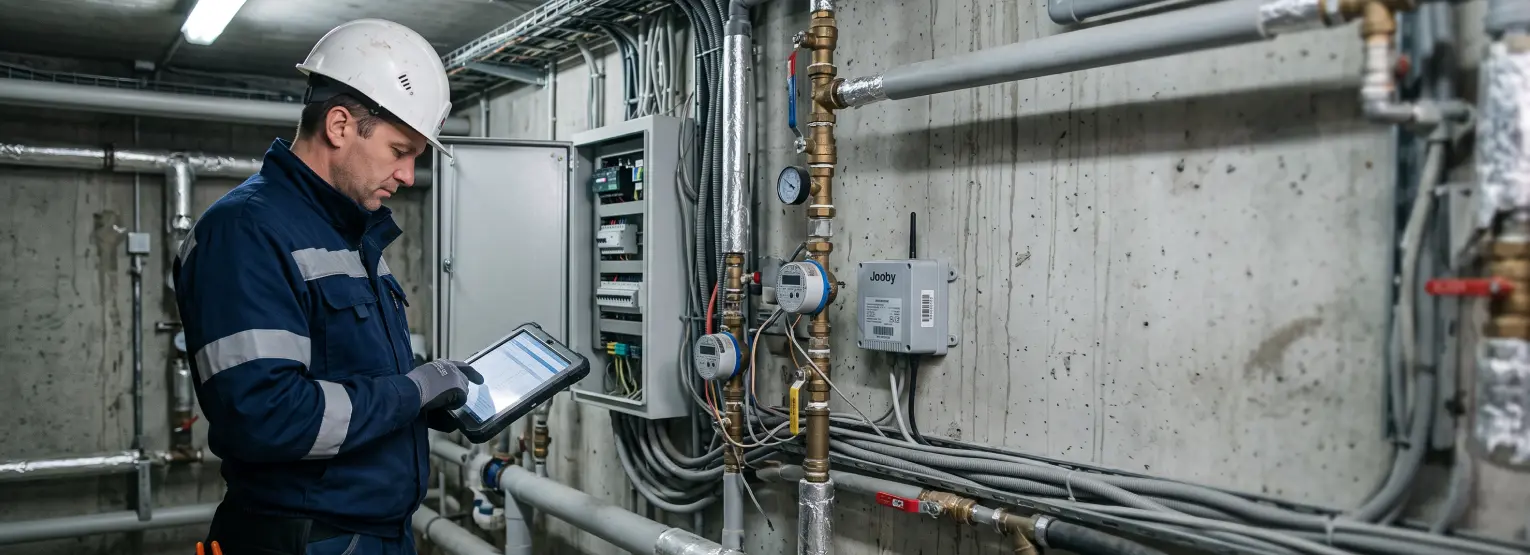
On a plan, all meters, whether in a building, entrance, basement, technical room, or metering cabinet will appear the same. But in reality, things may be very different. One device may be installed in a dry room near a window, another behind a metal door, a third in a deep basement, a fourth in a shaft or manhole, and a fifth in a meter cabinet that additionally shields the radio signal.
For resource providers, municipalities, developers, and homeowners associations, such points become a regular source of problems: data arrives inconsistently, the battery drains faster, the device performs retransmissions more often, and the service team has to frequently visit the site.
That’s why difficult areas should not be treated as exceptions, but as a separate part of the project from the outset, requiring a technical and operational plan prepared in advance.
Radio signals pass less effectively through concrete, metal, soil, thick floors, engineering structures, and enclosed technical rooms. As a result, smart meters lose signal in basements or utility shafts, manholes, and metal cabinets, causing the device to operate at the edge of coverage.
In this situation, data may sometimes be transmitted successfully, but the connection remains unstable, with some messages being lost, the number of retransmissions increasing, and the device consuming more energy.
Signal loss is not always related to equipment quality. Even a reliable radio module will perform worse if installed in a heavily shielded area or at the edge of the network. With that being the case, before large-scale deployment it’s important to check the real conditions on site rather than relying only on an NB-IoT coverage map or theoretical calculation.
The first step is a site survey. The team needs to determine where the meters are located, what materials the walls and cabinets are made of, whether there is access to the device, whether the antenna can be moved outside the shielded area, and where possible locations for a base station or signal relay may be.
For LoRaWAN projects, it’s important to measure not only the fact of data transmission, but also radio communication parameters: RSSI, SNR, the percentage of successful transmissions, the number of retransmissions, and coverage margin.
RSSI shows the level of the received signal, SNR shows the signal-to-noise ratio, and the percentage of successful transmissions helps determine how reliably the device will be able to operate after launch.
If a point transmits data only under ideal conditions, the connection may become unstable when the environment changes.
For NB-IoT projects, it’s necessary to check the availability of the operator’s network exactly at the device installation point, not only on the general coverage map. This is especially important for a basement, enclosed technical room, and metal enclosure.
The device must register reliably in the network, transmit data at the required interval, and avoid excessive battery consumption caused by repeated connection attempts.
A practical approach is to divide metering points into groups: standard, borderline, and problematic.
Standard points operate reliably without additional measures. Borderline points require monitoring and, possibly, installation adjustments. Problematic points, such as an underground meter, require a separate solution: an external antenna, a different installation location, an additional base station, another data transmission scenario, or a different communication technology.
Improving connectivity doesn’t always mean installing more powerful equipment. In most cases, the task is solved through a combination of several measures.
The first solution is correct device placement. Sometimes it’s enough to change the position of the radio module, install it higher, rotate the housing, move the device out of a metal cabinet, or place the antenna closer to a signal path. In metering projects, choosing the right antenna placement for smart meters is vital because even a few dozen centimeters can noticeably affect communication quality.
The second solution is an external antenna. If the meter is located in a metal cabinet, shaft, or deep technical room, an external antenna can help move the radio signal out of the shielded area. This approach needs to be planned in advance, with cable length, mounting location, moisture protection, mechanical risks, and service accessibility all being taken into consideration.
The third solution is an additional base station or a change in its location. For LoRaWAN networks, base station placement is critical. One well-positioned base station can improve network coverage for a large number of devices at once, but its location, installation height, antenna, and surrounding buildings must be tested in practice.
The fourth solution is changing the data transmission mode. If a point is located in difficult conditions, it’s not always reasonable to require frequent transmission. For some scenarios, transmitting data several times per day is sufficient, while emergency or service events can be sent separately. This helps reduce battery load and improve system stability.
The fifth solution is choosing another communication technology for some of the points. Different approaches can be used within a single project. For example, LoRaWAN may be convenient where the customer builds a private network and wants to control the infrastructure, while NB-IoT may be better where it’s preferable to use a mobile operator’s coverage and avoid installing private base stations.
LoRaWAN is well suited for distributed smart metering projects where many devices need to be connected across a large area and the customer needs to manage a private network. This technology is useful for residential complexes, districts, municipal infrastructure, industrial zones, and sites where the customer wants to control base station placement and coverage quality.
The main advantage of LoRaWAN in difficult areas is flexibility. The team can choose a location for the base station, replace the antenna, add another coverage point, check signal parameters, and gradually improve the network based on the real conditions of the site. This is convenient for municipalities, developers, and homeowners associations that manage many metering points within a building, block, or district.
In addition, LoRaWAN is suitable for autonomous battery-powered devices. If the transmission interval is configured correctly and communication quality is checked, radio modules can operate for a long time without battery replacement. But for this to work, the project should not be launched blindly — difficult zones need to be identified during the survey and pilot stages.
NB-IoT uses the mobile operator’s network and can be convenient where there is no desire or possibility to deploy a private radio network. For a resource provider, this can reduce infrastructure requirements as there is no need to install and maintain base stations if operator coverage is stable at the device installation points.
NB-IoT is often considered for distributed sites where metering points are located far from one another, such as private houses, separate commercial premises, small municipal facilities, and remote metering units. In such scenarios, deploying a private LoRaWAN infrastructure may be less convenient, and connection via the operator’s network more practical.
However, any possible NB-IoT coverage issues need to be tested for on site, because having everything appear suitable on a map doesn’t guarantee stable device operation in a basement, cabinet, or shaft. Therefore, before scaling, it’s essential to check device registration in the network, data transmission stability, signal quality, energy consumption, and SIM profile management conditions.
There is no universal solution for all problematic points. Even within one residential complex, conditions may vary, with some meters located in apartments, some in corridor cabinets, others in basements, and some in technical rooms. That’s why the project should begin not with mass device procurement, but with a survey and classification of metering points.
Signal attenuation in smart metering networks requires individual plans. These should include an asset map, a list of meter types, installation conditions, communication requirements, a list of problem areas, selected technologies, installation rules, service scenarios, and success criteria.
For each group of points, it’s necessary to define which solution will be used: a standard radio module, a device with an external antenna, an additional base station, an NB-IoT connection, or another installation method.
Such a plan helps avoid a situation where the project is formally launched, but a significant share of devices operates unstably. It also simplifies budgeting because the customer understands in advance where standard installation will be sufficient and where additional signal attenuation, equipment, or site visits will be required.
In Jooby projects, devices and the software platform can be combined based on the real conditions of the site. The Jooby RDC ecosystem includes LoRaWAN and NB-IoT radio modules, sensors for analog meters, smart meters, LoRaWAN base stations, and Jooby RDC Dashboard for data collection, visualization, and analysis.
This is especially important for difficult metering points:
This approach to smart meter communication challenges makes it possible to build the project not around a single technology, but the task itself. This ensures stable data collection from real sites, including basements, shafts, metal cabinets, and other difficult locations.
Before scaling a smart meter communication network, several steps should be completed. First, the team should collect information about sites and metering points, including where the meters are located, which models are used, and what installation conditions exist on site. Then, a radio survey or connectivity testing should be carried out at both typical and difficult points. After that, a pilot should be launched which includes both convenient locations and problematic zones.
During the pilot, it’s necessary to measure communication quality, not just signal strength but the percentage of successful transmissions, the number of retransmissions, battery consumption, and data delivery stability. The team should then divide the points into categories and select a dedicated solution for each one.
Only after this should the installation standard, budget, and scaling plan be approved.
It’s also important to define operational rules: who checks missing data, analyzes weak signal, decides on a site visit, maintains base stations, replaces batteries, and updates the asset map. Without clearly defined responsibilities, even a technically correct solution can fail during operation.
Problematic metering points should be treated as a normal part of a smart metering project: basements, shafts, metal cabinets, manholes, and weak-signal areas should all be surveyed, tested, and included in an individual deployment plan in advance.
LoRaWAN coverage provides flexibility and control over a private network, while NB-IoT coverage helps connect distributed sites through a mobile operator’s network.
Jooby solutions make it possible to combine devices, sensors, base stations, communication technologies, and the platform into a unified smart metering system.
The earlier the team identifies difficult zones and selects dedicated solutions for smart meter communication, the more stable data collection will be, the lower the operating costs, and the higher the value of the project.
Was it helpful?
 1


Stay on top of the latest industry news
Thank you, we have received your message. Our manager will contact you shortly.


Thank you, we have accepted your request. In the near future the responsible manager will contact you and clarify the details of the order.