17.10.2025
 735
735
735
Rural and Cottage Settlements: Why Autonomous LoRaWAN Networks Win on Cost
735
Modern cottage communities and rural settlements are increasingly seeking access to smart infrastructure, including the remote metering of water, electricity, and gas, control of lighting and road conditions, and even air quality monitoring.
The problem for many of these areas is that traditional communication solutions such as mobile networks, Wi-Fi, or wired channels often prove too expensive and maintenance-intensive, especially when facilities are scattered or apart with poor coverage.
However, there is a technology that enables the creation of autonomous and cost-effective IoT networks, and it’s called LoRaWAN. LoRaWAN is able to transmit data from sensors and meters over long distances while only requiring minimal energy and infrastructure. Crucially, its use in rural IoT connectivity and remote meter reading not only conserves resources but also provides complete independence from telecom operators.
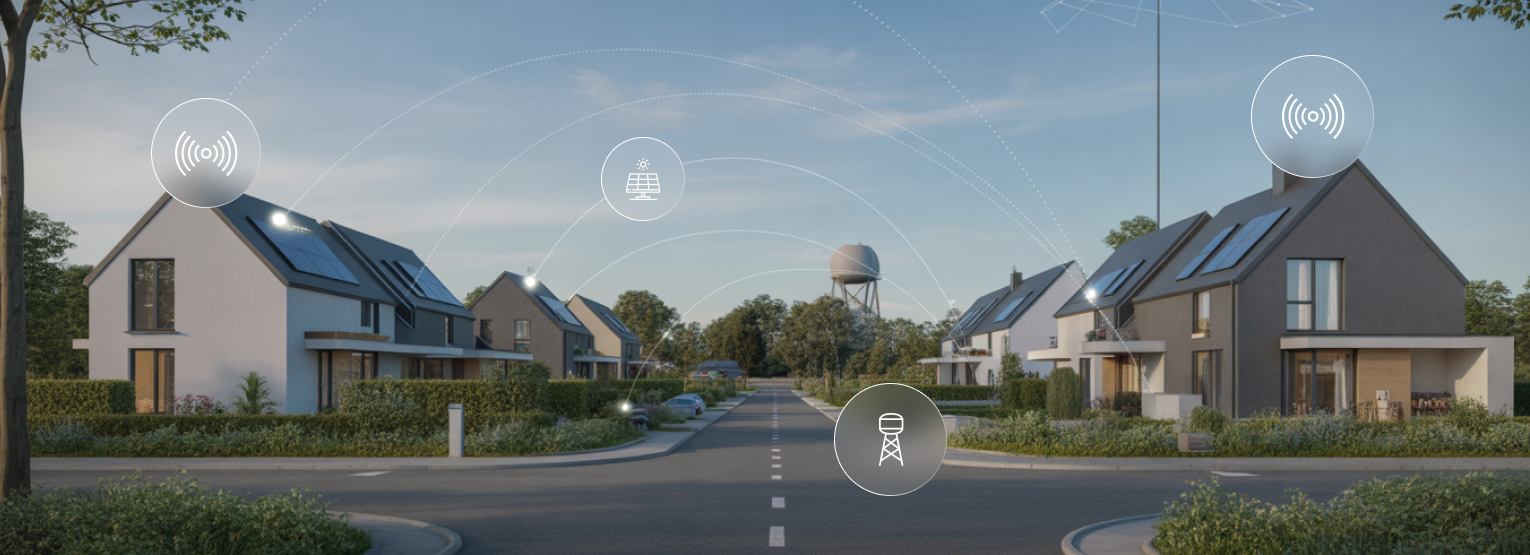
LoRaWAN is a low-power, long-range wireless communication protocol, making it ideal for smart metering for rural areas. A single LoRaWAN gateway can cover several kilometers — a crucial advantage for distributed assets such as water towers, wells, heat substations, and individual homes.
Unlike GSM modems that require SIM cards, subscription fees, and stable cellular coverage, LoRaWAN devices operate autonomously to create decentralized IoT networks and can transmit data even in weak signal conditions. A sensor installed in a hard-to-reach location for wireless resource monitoring can run on a single battery for up to 10 years — with virtually no maintenance.
One of LoRaWAN’s key advantages compared to other wireless metering solutions, lies in its exceptionally low total cost of ownership. For a small village or cottage settlement, just a few base stations are enough to create a rural smart grid and cover the entire area, making deployment several times cheaper than building GSM or Wi-Fi networks.
A further benefit is that LoRaWAN network ownership remains with the developer or municipality and is under their full control: the network belongs to them, not to an operator. There are no subscription fees, no dependence on changing tariffs, and no risk of connectivity loss due to provider limitations. For utility suppliers, these community-based networks mean transparent, continuous, and autonomous collection of meter readings from all devices.
Municipal utilities responsible for water supply, lighting, and heating have long struggled with fragmented systems and the labor-intensive process of manual data collection. Using LoRaWAN infrastructure for energy and water metering in villages enables them to unite all systems into a single network — from smart water meters to pressure and leakage sensors.
For housing associations and property management companies, LoRaWAN networks are an opportunity to automate resource accounting, reduce losses, and respond to incidents more quickly. In the case of cottage communities or homeowners’ associations, an autonomous network becomes a true competitive advantage: residents enjoy modern infrastructure, while management significantly reduces operational costs for local utility data collection and communication.
Building an autonomous LoRaWAN network for affordable smart metering is far less expensive than many expect. For a settlement of about 200 houses, two or three autonomous IoT gateways are enough to ensure complete coverage, with each one supporting hundreds of devices. For those looking at reducing operational costs with LoRaWAN, the cost of one gateway is comparable to just a few months of mobile network payments for several dozen GSM modems.
Add to this the savings on maintenance-free IoT solutions, the absence of subscription fees, and the long lifespan of sensors — and the payback period for this type of network typically comes within one to two years. Moreover, LoRaWAN range and scalability allows new devices to be integrated without redesigning the existing infrastructure, supporting organic growth as the settlement expands.
In an era of decentralization and energy efficiency, LoRaWAN deployment is becoming a cornerstone technology for building smart territories. Autonomous networks not only cut costs but also improve management quality — a vital factor for small municipalities and developers aiming for sustainable growth.
Implementing LoRaWAN solutions means taking a decisive step toward digitalized utilities, accurate resource metering, and responsible consumption. It’s not just about saving money with municipal IoT networks however — it’s about gaining a strategic advantage that defines the success of modern projects.
Was it helpful?
 164
164


Stay on top of the latest industry news
Thank you, we have received your message. Our manager will contact you shortly.


Thank you, we have accepted your request. In the near future the responsible manager will contact you and clarify the details of the order.