14.04.2026
 1571
1571
1571
Retrofit or new installation: how to choose an approach to smart metering implementation
1571
Just for a moment, think about a utility infrastructure project that involves upgrading 3,000 metering points.
In terms of reporting they may all ‘look’ the same, but they will almost certainly be operating in different conditions: some meters will be located in basements of older residential buildings, some in offices with organized metering cabinets, and others will be locked away on industrial sites, all distributed across a district or an entire city.
The goal of all utility metering upgrade options is the same: to provide readings that are delivered to the metering system on a regular basis, with predictable data quality and without continuous manual involvement from operational teams.
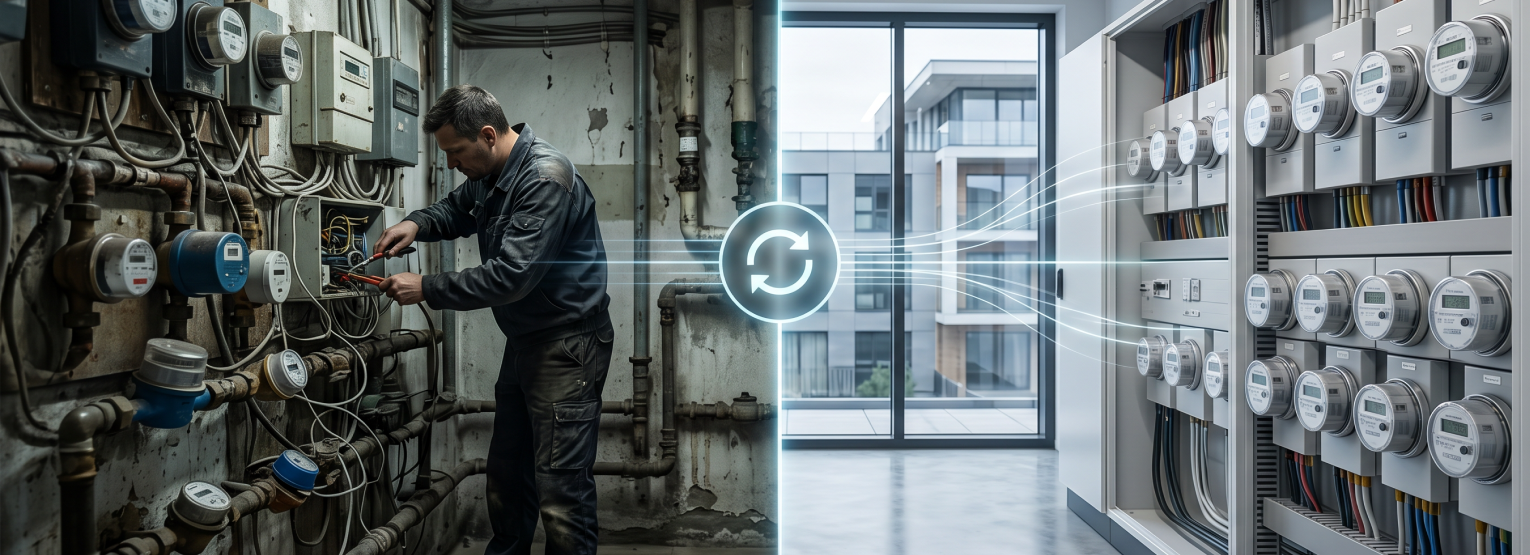
At this stage, the choice in approach – whether to retrofit or replace utility meters – is usually driven not by which protocol is more popular, but by the core implementation strategy. A retrofit entails upgrading existing equipment with radio modules and sensors while keeping the current meter fleet. The alternative is a new installation with the associated meter replacement cost, and where the metering architecture is rebuilt. In practice, the most effective solution to modernizing utility metering systems is usually the one that best matches the asset type and organizational constraints.
The ongoing shift toward smart metering is driven less by a general desire to automate everything and more by practical factors, such as higher requirements for transparent billing, customer expectations for online services, the need to identify losses and anomalies faster, and the broader digitalization of processes among utility providers and property management companies.
Against this background, remote data collection and centralized analytics are becoming the standard, and both regulatory approaches and consumer expectations are gradually aligning with it.
According to Transforma Insights (IoT Forecast Database, 2026), the integration of electricity smart meters is expected to increase significantly by 2035 compared with 2025.
The map shows that in 2025 adoption levels vary widely by country, with some markets already demonstrating a high share of smart meters, while in other regions integration remains moderate or low. In the 2035 outlook, the coloring becomes notably more uniform and darker across most of the map, reflecting the trend toward broader deployment and a gradual convergence in digital metering maturity across regions.
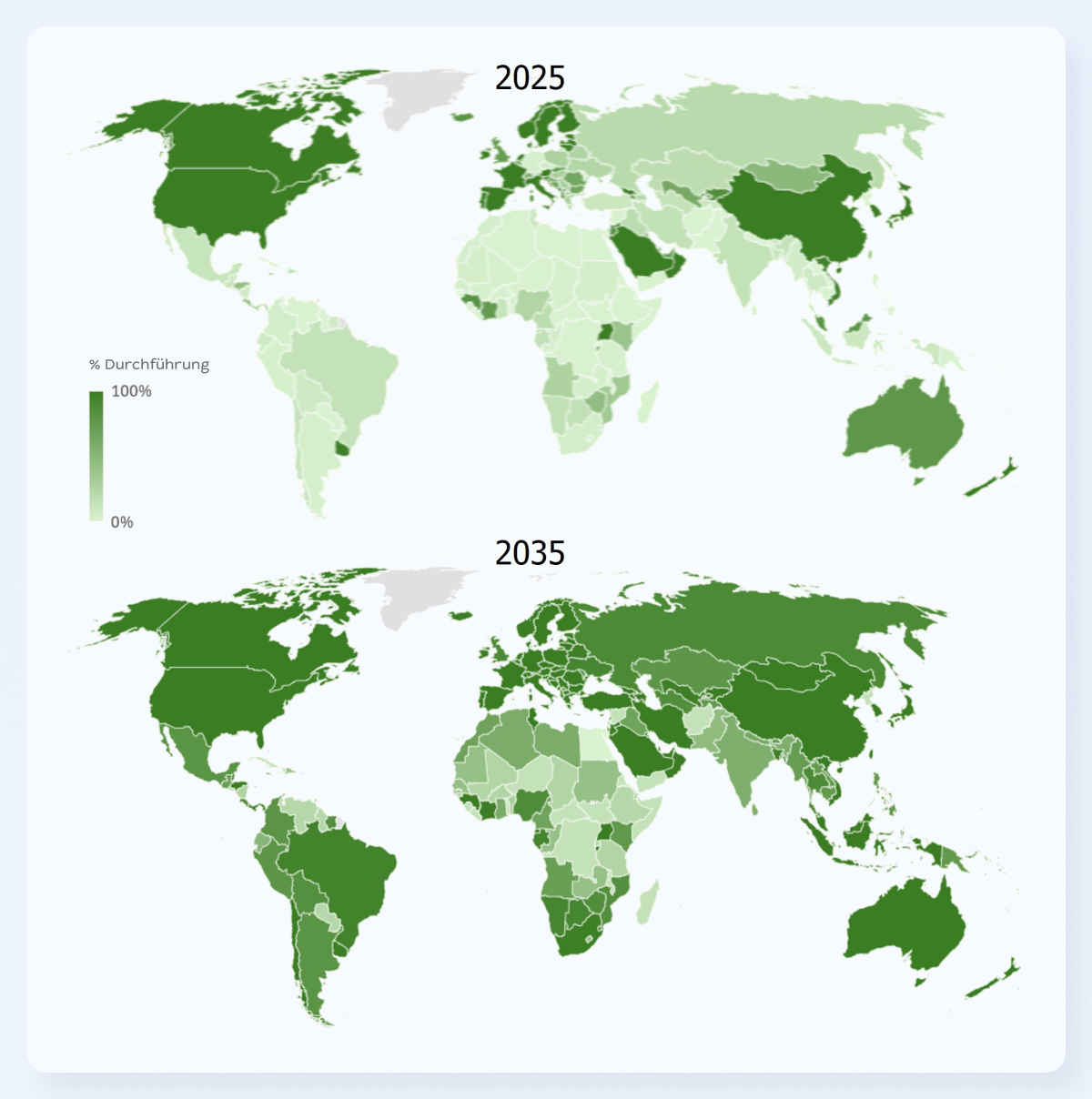
Global Smart Meter IoT forecast, 2025–35
A second Transforma Insights chart shows the growth of the global installed base of smart electricity, gas, and water meters in 2025–2035. The chart indicates steady growth (CAGR 6% is noted) and an increase in the total installed base from just over 2 billion in 2025 to nearly 4 billion by 2035, with contributions from all three segments – electricity, gas, and water.
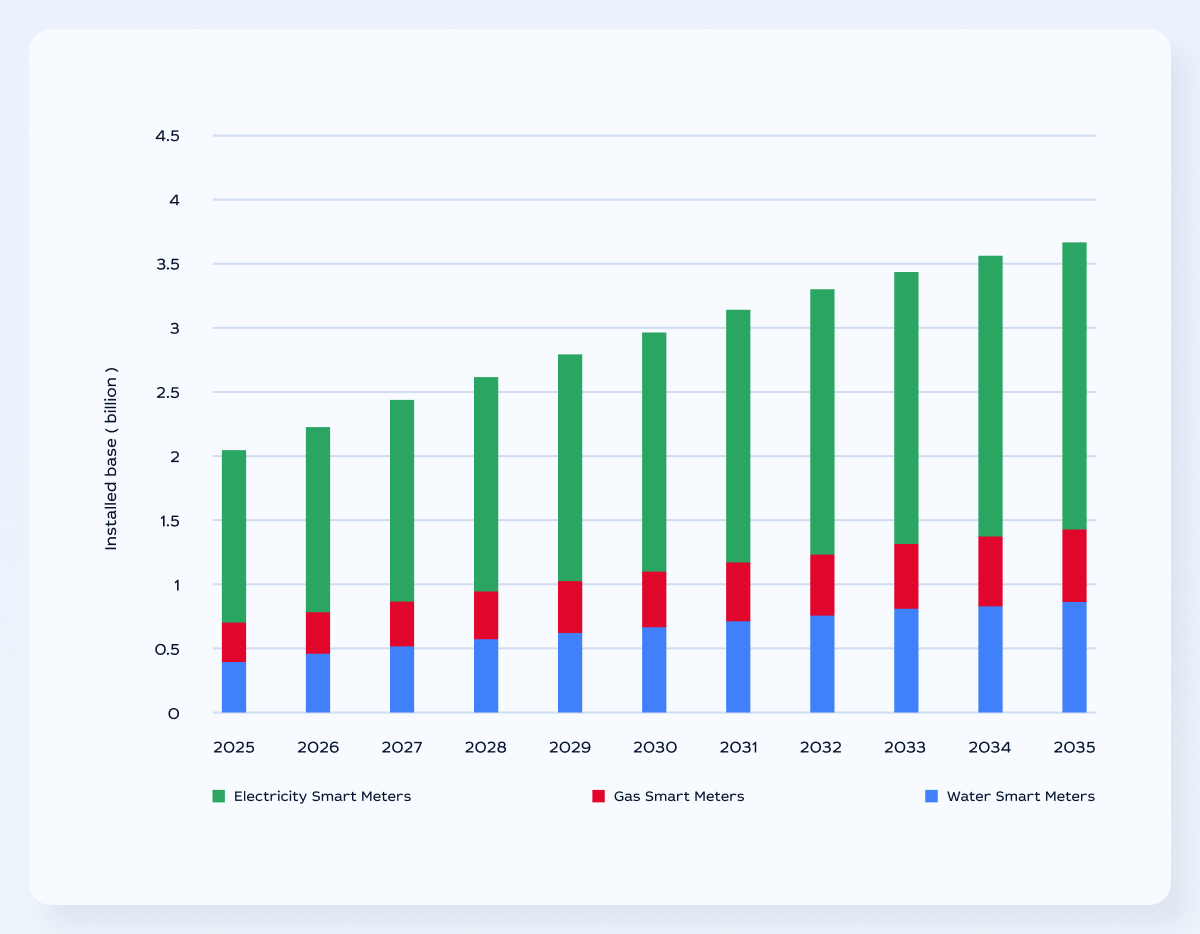
Global Smart Meter IoT forecast, 2025–35
In older buildings and at sites with limited access to meters, the organization of work often becomes the key factor. For instance, if a meter is installed in an apartment, a locked niche, a basement, or a technical room where it is difficult to arrange regular visits and fast approvals, retrofit may be the most realistic way to obtain data within acceptable timeframes. In such conditions, compatibility with specific meter models, repeatable installation, and the ability to detect tampering are important.
In new residential complexes, it is usually easier to design a convenient metering setup in advance. Access to devices is more often standardized, and device placement and platform connectivity can be planned during commissioning. Hybrid approaches also appear here, with some meters selected as IoT smart meters from the start, while others are equipped with radio modules if that is more appropriate for specific device types or operating scenarios.
At industrial sites, additional requirements relate to the environment and operations. Resistance to harsh conditions, event monitoring, stable connectivity, and correct integration into dispatching systems or SCADA are typically important.
When the connectivity infrastructure is under the customer’s control, the focus of a smart meter replacement strategy is more often on manageability and predictability than on the lowest possible upfront cost.
For distributed metering points across a district or city, the approach is often built around the data transport layer. Depending on coverage and project economics, teams either rely on the operator’s network or deploy their own network where it;s justified by the density of points.
From the outside, retrofit may look like a simple operation: a device is connected and data starts flowing. What it actually involves is a sequence of decisions, each affecting the outcome.
First, it’s important to correctly capture pulses or the signal from the meter – selecting a sensor and a connection scheme for the specific meter model. Next, reliable mounting and fixation are required. In retrofit projects, data quality often depends on electronics as much as it does on installation stability, correct reading, and protection against accidental displacement or tampering.
The next step is activation, initial verification of readings, and alignment of data with the metering system. Even with stable connectivity in smart grid systems an error in coefficients or settings may lead to disputed billing. Therefore, in mature projects, data validation and quality control typically accompany scaling.
A new installation often provides a more unified architecture, where the meter fleet is standardized, device models and maintenance requirements are defined, and a single metering contour is established. However, this usually requires more time and organizational effort.
Meter replacement as part of an infrastructure upgrade includes commissioning, registration, documentation procedures, and warranty processes.
In residential stock, access to a large number of premises becomes a separate factor. As a result, new installation is more often preferable where the asset is prepared for it – during new construction, reconstruction, or when standardized infrastructure is available.
For retrofit smart metering solutions, the most common risks relate to compatibility and correct reading (the “sensor/meter” pair), installation quality, and real radio conditions at the installation location. While for new installation, timelines, approvals, and mass access to metering points tend to be more critical – these are primarily managerial factors that can significantly shift the project schedule.
These differences explain why combined strategies are used more frequently in 2026. Within one project, retrofit may be applied in older buildings, new installation in new developments and industrial sites, and a hybrid model across distributed territories.
From an operational perspective, connectivity is primarily an answer to how reliably a device can transmit data from a specific location.
In some cases it is more convenient to rely on the operator’s infrastructure to avoid deploying a private network. In others, it is more rational to build a network on site and manage coverage – especially when there are many points concentrated in one area.
Therefore, data transport is typically selected based on the radio environment: basements, metal structures, dense development, and remote points.
To make conclusions practical, it helps to review implementation examples of energy metering solutions.
In Slovenia, in the Domplan project, the starting point was manual gas metering and limited access to meters. For this case, an NB-IoT retrofit was selected with data transfer to a partner platform. The project used 1,000 autonomous NB-IoT devices in different modifications, including Jooby devices with NB-IoT technology for different meter types and installation scenarios. This example shows that digitalization can start without replacing the meter fleet.
In Moldova, in the Moldovagaz project, the scale was significantly larger: it involved installing 12,000 Jooby radio modules operating on LoRaWAN technology in multi-storey residential buildings, deploying base stations, and organizing remote access to data. This case illustrates how, at high volumes, the role of infrastructure, standardized connection patterns, and repeatability across thousands of points increases.
Another scenario is a pilot in the new residential complex “Vostok” (Odesa). The team tested a model typical for new developments: 150 multi-tariff single-phase MTX electricity meters with an integrated LoRa radio module and 60 Jooby radio modules with two pulse inputs for water meters. Data was consolidated in the Jooby RDC Dashboard, and transmission was arranged via the provider’s LoRaWAN base stations.
This example shows how a digital metering contour can be built quickly on a new site and provide transparency both for consumption and for device status.
Finally, the Sombor Gas case (Serbia) illustrates the common trajectory “pilot → scaling.” The company started with a test deployment: 30 Jooby EPHIR RMS GMEL10 102 EU devices were installed, after which expansion to 5,000 gas meters was planned with integration into the customer’s internal software. In such projects, the key question is how stable the entire data path is from installation to reporting in the system and how repeatable the process is when scaling.
The practical value of Jooby is that the company’s solutions fit both retrofit and new installation scenarios. In retrofit projects, compatibility, repeatable installation, and deployment speed are usually important; radio modules and sensors for common meter models are used.
In LoRaWAN-based projects, it is important to be able to build a network on site (including base stations/gateways) and consolidate data in a platform where it can be monitored and integrated into billing or dispatching systems.
In NB-IoT projects, the emphasis is more often on fast geographic coverage using the operator’s network and on integrating data into existing customer systems.
In general terms, choosing to retrofit IoT devices is more often suitable where meters are already installed, access is limited, and replacing the fleet increases timelines and complicates approvals. New smart metering deployment is more often justified at new sites and during reconstruction, where a single standard can be designed from the start.
A similar approach is recommended for the data transport layer, where distributed assets are often easier to cover by relying on the operator’s network, while territories with a high concentration of points are better served by a private network that can be designed for specific radio conditions.
Even when the choice seems obvious, real on-site conditions will heavily influence any new smart meter installation. Therefore, a practical step after defining the strategy is usually a pilot across 50–200 points. This is enough to assess the radio environment, test installation scenarios, confirm data quality, and tune integration with the metering system.
After the pilot, it becomes clearer where retrofit delivers the best results in terms of timelines and costs, where a new installation is justified for utility data collection, and in which segments a hybrid approach to remote meter reading is rational.
Was it helpful?
 1249
1249


Stay on top of the latest industry news
Thank you, we have received your message. Our manager will contact you shortly.


Our experts are always happy to help and promptly answer your questions. Please fill out the form to discuss your project and develop a tailored action plan.
Thank you, we have received your message. Our manager will contact you shortly.
Thank you, we have accepted your request. In the near future the responsible manager will contact you and clarify the details of the order.
Our experts are always happy to help and promptly answer your questions. Please fill out the form to discuss your project and develop a tailored action plan.
Thank you, we have received your message. Our manager will contact you shortly.