27.07.2026
 157
157
How to Use IoT Data to Detect Unauthorized Tampering with Utility Meters
157
Unauthorized tampering with utility meters remains a significant challenge for utility providers, property management companies, municipalities, and developers. The issue extends far beyond direct losses of water, gas, electricity, or heat, and any manipulation of meter readings affects billing accuracy, resource balancing, planning quality, and trust in the data.
In the past, meter bypass detection was usually done manually during inspections, control checks, or after complaints. However, this approach does not scale well when managing a large subscriber base. An inspector can’t regularly check thousands of metering points, especially when meters are located in basements, technical rooms, cabinets, manholes, private houses, or distributed sites.
IoT systems change this process. Smart meters, radio modules, sensors, and software platforms make it possible not only to collect readings but also to analyze device behavior.
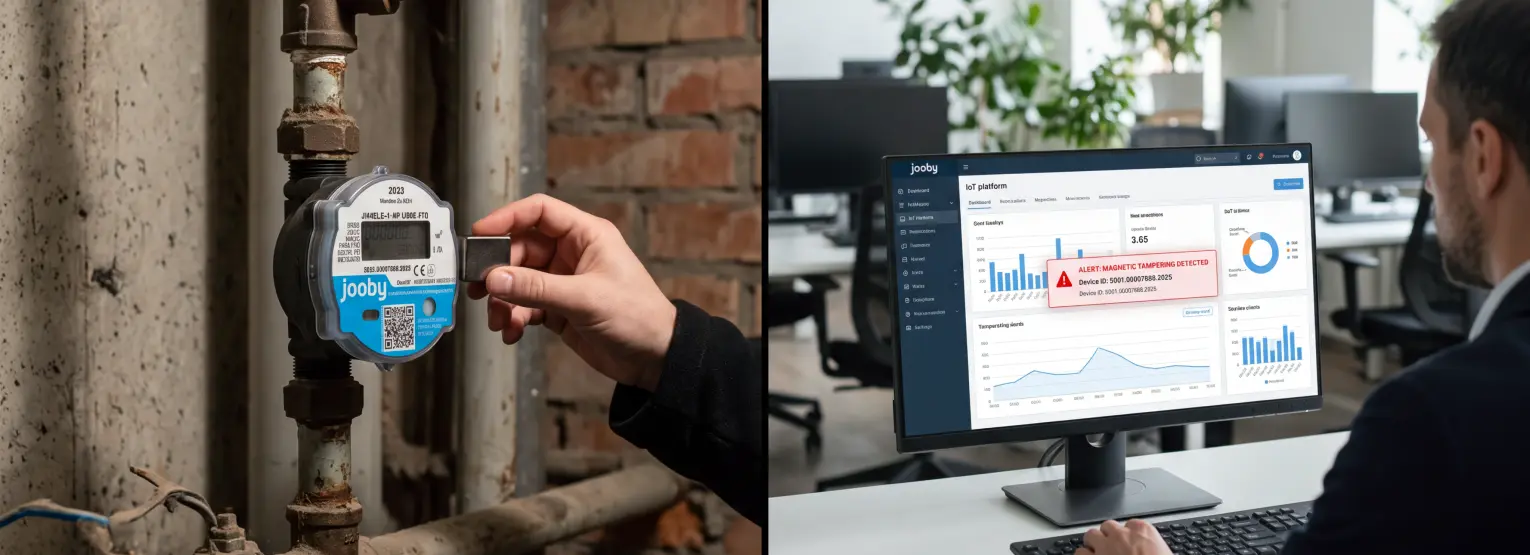
If a meter suddenly stops transmitting data, readings change abnormally, an attempt at magnetic influence appears, or a device is removed from the housing, the system can record the incident in event logs and send it to the platform. As a result, the utility provider receives not just figures for billing, but a tool for monitoring, analysis, and prioritizing inspections.
In an IoT system, data is received from metering devices regularly: according to a schedule, by event, or based on a defined scenario. The device can transmit not only consumption data but also service parameters, including battery status, connection quality, errors, alerts about opening, removal, magnetic influence, changes in flow direction, and missing pulses.
On the platform side, this data is compared with the expected behavior of the site. For example, if consumption suddenly drops to zero while the site remains active, this is a reason for inspection. If the device reports magnetic influence or dismantling, the event can be marked as potential meter tampering. If readings stop coming in, the system helps determine what is more likely: a connection problem, a depleted battery, a device failure, or possible interference with the metering point.
In Jooby projects, LoRaWAN and NB-IoT radio modules, sensors for analog meters, smart meters, LoRaWAN base stations, and the Jooby RDC Dashboard platform can be used for such tasks. Devices collect data from meters and transmit it to the system, while the platform helps the operator see readings, events, device statuses, and problem points.
It’s important to understand that IoT doesn’t replace on-site visits and inspections, but makes them more accurate. Instead of scheduled inspections “in the dark,” the team can see where there are signs of a problem and send an inspector to the points where the probability of tampering is higher.
Unauthorized access doesn’t always look the same. Depending on the type of resource, meter design, and method of connecting the IoT device, anomaly detection takes place using different signals.
Typical signals include:
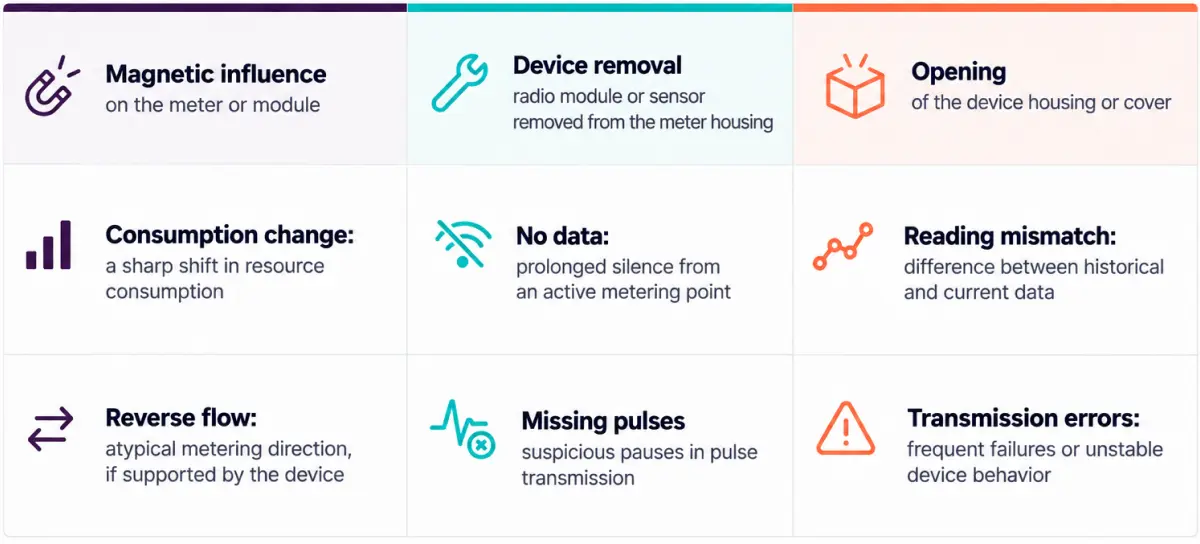
A single signal does not always mean a confirmed violation. For example, missing data may be caused by poor coverage, a metal cabinet, a depleted battery, or a temporary connection issue. Therefore, the system’s task is not to automatically “accuse “ the subscriber, but to detect anomalies, store event history, and help the operator make informed decisions.
In water metering projects, IoT data helps detect both technical problems and signs of tampering. A smart water meter or a radio module connected to a water meter can transmit regular readings and events related to the operation of the metering point.
For water, consumption anomalies are especially important. Consumption patterns that may indicate unauthorized interference could include usage suddenly disappearing in an apartment or commercial premises when it had previously been stable, indicating a reason for inspection. Another example is prolonged nighttime consumption, which may suggest a leak or malfunction. In some scenarios, the system can also detect reverse flow, sharp jumps in readings, or an atypical consumption profile.
For property management companies and developers looking at how to detect meter tampering, this is especially useful at the level of buildings and residential complexes. Data helps identify problematic apartments, risers, technical rooms, and zones where consumption differs from the expected pattern. A water provider can respond more quickly to suspicious changes without waiting for the next inspector round.
In the Jooby ecosystem, smart water meters, radio modules, sensors, and Jooby RDC Dashboard are used for such tasks. The system makes it possible to collect data from metering points and analyze it over time: by hour, day, month, and site.
In gas metering, it’s especially important to monitor physical interference with the meter. Common risks include attempts to affect the mechanism with a magnet, remove the module, interfere with the sensor mounting, or stop correct data transmission.
Jooby radio modules for gas meters are installed on the meter housing and read its data using a sensor. Depending on the model and configuration, the device can respond to tampering attempts, including module removal or magnetic influence. Such an event is recorded and transmitted to the system together with metering data.
This gives the provider several advantages. First, the company receives a signal about possible gas meter tampering faster than during a scheduled inspection. Second, the event is stored in the history and can be used for further analysis. Third, inspection visits can be planned not only according to a schedule, but also based on actual risk indicators.
At the same time, installation conditions must be taken into account. Gas meters may be located indoors, in cabinets, on facades, in private houses, or in technical zones. Therefore, at the project stage, it is necessary to check connection quality, the device mounting method, service accessibility, and data transmission stability.
In electricity metering, IoT data helps detect not only missing readings but also atypical load behavior. If a smart meter or connected device transmits data regularly, the system can analyze consumption over time: peaks, drops, nighttime load, seasonality, sharp changes, and deviations from the site’s normal profile.
For a provider, suspicious situations indicating possible electric meter tampering may include cases where consumption drops sharply without an objective reason, data arrives irregularly, the device reports an opening event, or the load profile doesn’t match the type of site. For example, a commercial premises may continue operating, but metering shows almost zero consumption. Or a private house may demonstrate sharp changes that are not typical of its previous history.
For municipalities and developers, electricity metering is also important at the level of common building systems, such as lighting, pumps, engineering equipment, and technical rooms. Data analysis not only assists with electricity theft detection, but also identifies overloads, inefficient consumption, metering errors, or equipment that operates outside its schedule.
In this scenario, an IoT platform shouldn’t simply display current values, but help compare data between sites, find deviations, and generate events for inspection.
In heat metering, tampering can appear as direct interference with the meter as well as a disruption of normal consumption patterns. For heat substations, residential complexes, municipal buildings, and commercial facilities, it’s important to monitor data over time, compare sites with each other, and identify deviations from the expected operating mode.
IoT data helps analyze heat consumption, detect sharp changes, inconsistencies between sites, prolonged absence of data, transmission errors, or unusual behavior of a metering point. If the system receives data regularly from a meter or connected radio module, the operator can notice more quickly when a site falls out of the overall pattern.
For heat, the combination of metering and analytics is especially important. A single indicator is not very informative on its own, but if consumption history, temperature, building operating mode, meter data from similar sites, and device events are compared, it becomes possible to identify areas that require inspection.
This helps detect not only possible tampering but also technical problems: incorrect settings, leaks, equipment faults, or installation errors.
Tamper events are only part of the picture. Maximum value appears when the system combines device data, consumption history, connection quality, battery statuses, a site map, and information about previous field visits. Then the operator sees everything in context, not an isolated signal.
For example, if a device stops transmitting data, the platform helps check whether there had been connection issues before, whether the battery charge had been decreasing, whether there had been repeated transmissions, and whether the signal level had changed. If consumption drops sharply, it can be compared with the site’s history and similar metering points. If magnetic influence is detected, it’s possible to see when it occurred and what changes in readings appeared afterward.
This reduces the number of false alarms and allows the team to prioritize events: what requires an immediate field visit, what should be checked remotely, and what can be included in scheduled maintenance.
For IoT data to truly help with smart meter tamper detection, the rules for working with events must be described in advance. It’s not enough to simply connect devices and look at the dashboard. Instead, it’s necessary to define which events are considered critical and who receives them, who checks the data, who makes the decision about a field visit, and how the inspection result is returned to the system.
A practical model can include several steps. First, the system records an event or anomaly. Then, the operator checks the context: reading history, connection quality, device status, and the site. After that, the event is assigned a priority. If the probability of tampering is high, a field visit task is created. After the inspection, the team records the result as either a confirmed violation, technical fault, connection problem, installation error, or no violation.
This cycle helps accumulate knowledge, so that over time, the utility provider better understands which events truly indicate risk, which sites require more frequent attention, and where control should be strengthened.
Jooby solutions make it possible to build smart metering as a system in which devices, connectivity, and the software platform work together.
Radio modules and sensors help connect existing analog meters without fully replacing metering devices. Smart meters are suitable for new installations and modernization projects. LoRaWAN and NB-IoT connectivity make it possible to transmit data from distributed sites, while Jooby RDC Dashboard helps display readings, events, and device statuses in a unified system.
For utility providers, this is vital because tamper detection cannot be based on one sign alone. Regular data, history, device events, a site map, clear roles, and the ability to analyze deviations are needed.
In this format, smart meter data analytics becomes not only a tool for remote monitoring and automated reading collection, but also a system for controlling data quality, the technical condition of the network, and potential losses.
IoT data helps detect unauthorized tampering and deviations in metering point operation faster: for water, it helps monitor consumption and anomalies; for gas, it helps detect magnetic influence, device removal, and suspicious changes in readings; for electricity, it helps analyze the load profile and meter events, and for heat, it helps compare consumption and monitor distributed infrastructure.
Such a system does not simply transmit readings. Using anomaly detection for smart meter data helps see events, analyze history, find problem areas, prioritize inspections, and reduce losses, turning smart metering into a full-fledged infrastructure management tool.
Was it helpful?
 23


Stay on top of the latest industry news
Thank you, we have received your message. Our manager will contact you shortly.


Thank you, we have accepted your request. In the near future the responsible manager will contact you and clarify the details of the order.