27.05.2026
 585
585
585
How to calculate the cost of connecting one building to a LoRaWAN network: calculation examples and approaches
585
The cost of connecting a building to LoRaWAN can’t be calculated correctly simply by basing it on the price of one gateway or radio module. In a real project, the LoRaWAN infrastructure cost is formed by four layers, namely the meters or radio modules, the radio network, the server side, and operations.
A mistake at any of these levels can lead to unwanted financial consequences. For example, you buy an inexpensive gateway but end up overpaying for integration, you install high-quality meters but fail to account for basement installation conditions, or you make calculations for one building but forget that LoRaWAN delivers its economic value primarily when scaled.
LoRaWAN is well suited for remote reading of water, gas, heat, and electricity consumption, as it’s a low-power LPWAN technology operating in unlicensed ISM bands, with a flexible architecture of public and private networks.In this article, we show a practical approach to calculating the potential IoT deployment cost using LoRaWAN: from a simple house to a multi-apartment building and a network of several buildings.
In smart metering projects, the term “building” can refer to very different scenarios.
A private house typically has 1–4 metering points for electricity, gas, water, and sometimes heat. In this scenario, it’s rarely cost-effective to build a separate LoRaWAN infrastructure for just one site. Instead, any economic benefits appear when the house connects to an existing network (public/utility/operator’s/developer’s).
A multi-apartment building includes dozens or hundreds of metering points. For example, 100 apartments × 2 meters = 200 devices. Here, a dedicated gateway can be considered, especially if there is a basement, technical floors, a rooftop area, a boiler room, or other zones where regular data access is required.
A residential complex or district includes multiple buildings and thousands of devices. At this scale, the LoRaWAN gateways cost, as well as that for the server and integration, is distributed across a large number of meters, so the cost of connecting one apartment or one device decreases sharply.
This is why the first question to ask should not be how much does LoRaWAN cost per device, but how many devices will be connected at the beginning and how many will appear in 1–3 years?
For a LoRaWAN network cost calculation, it’s convenient to split costs into CAPEX and OPEX.
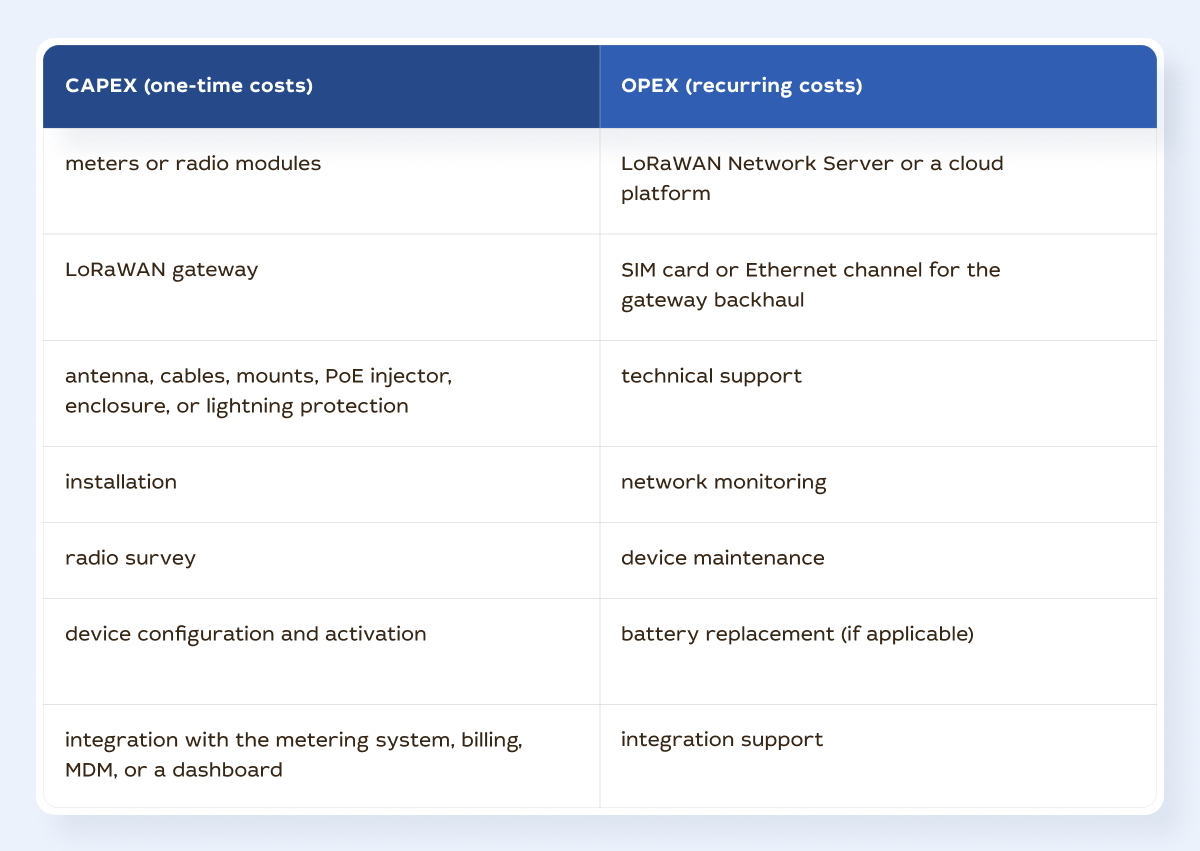
Before launching a project, the provider needs to break down the budget into two parts: one-time investments and recurring expenses. This helps not only to estimate the cost of connecting one building, but also to understand project economics over a multi-year horizon.
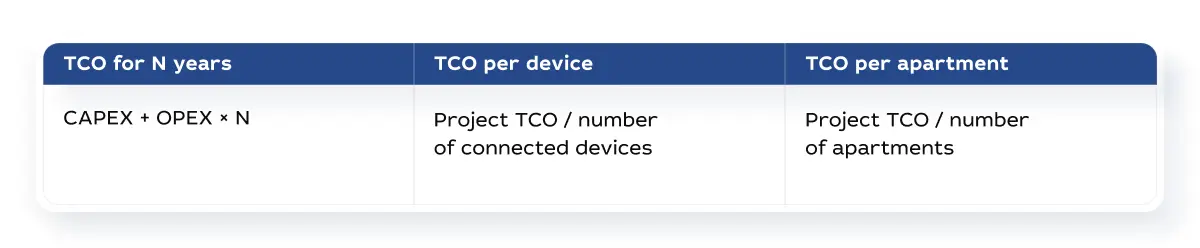
In practice, it’s better to build a dedicated TCO model where the number of devices, expected number of gateways, smart metering installation cost, expenses for server infrastructure, connectivity, support, and maintenance are all defined. These costs should then be recalculated per device, per apartment, or per building—depending on how the provider plans to evaluate project efficiency.
This approach allows different scenarios to be compared, such as connecting to an existing network, deploying a private LoRaWAN infrastructure, or a hybrid model.
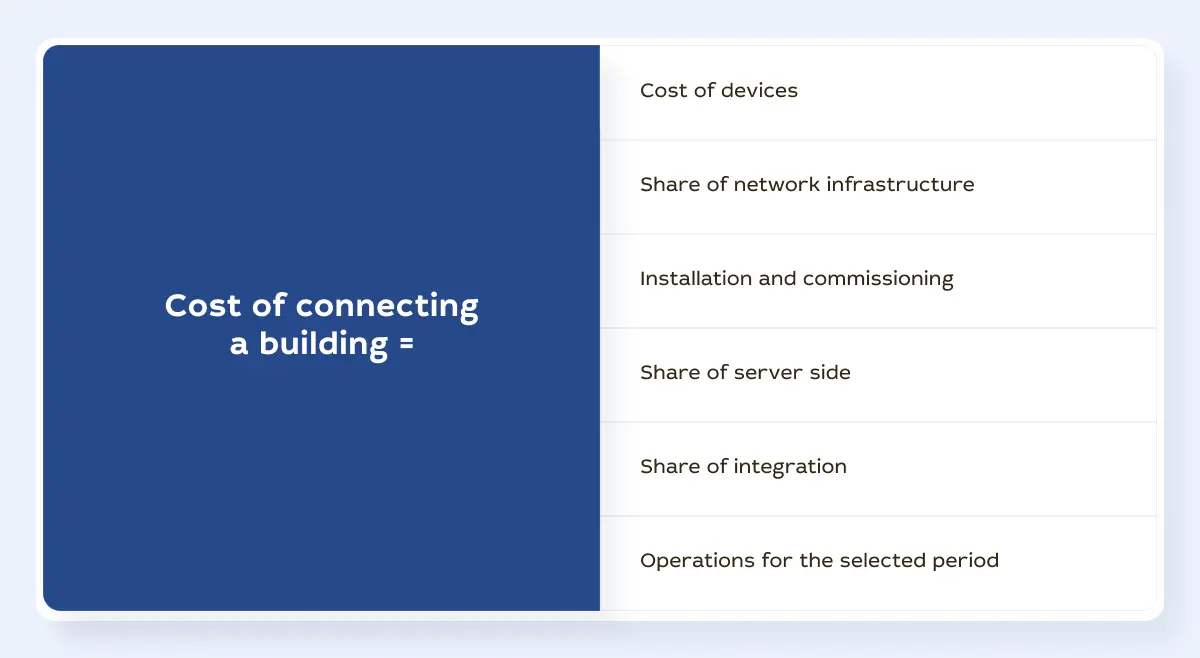
For one building, you can use the following model:
If you want to calculate not only the connection, but the full cost of ownership, it’s better to use TCO:
An important point: the cost of connecting one building is not tied to the cost of one gateway. A single gateway can serve one building, several buildings, or even an entire block—depending on building density, installation height, wall materials, basements, data transmission frequency, and redundancy requirements.
When planning a LoRaWAN project, it’s necessary to separate two types of data: publicly confirmed reference points and commercial parameters of a specific project. The former can be taken from open sources such as reports from industry organizations, manufacturer documentation, supplier price lists, and platform tariffs. The latter must be requested from equipment suppliers and integrators or calculated based on internal costs.
Public information shows that LoRaWAN is already used in large smart metering projects. LoRa Alliance reports more than 100 million connected LoRaWAN devices worldwide and forecasts growth of 25% per year. This includes multi-million deployments for water and gas metering in EMEA, North America, and China.
More recent LoRa Alliance data from December 2025 indicates that there are 125 million deployed LoRaWAN end devices and the same growth rate—25% CAGR.
Of course, while these numbers help assess technology maturity, they don’t replace a project estimate.
For network infrastructure, public prices for Jooby gateways can be used. In the official Jooby store, the Jooby Gateway LoRaWAN 300 EU costs €295.12, the Jooby Gateway LoRaWAN 300 EU costs €436.14, and indoor models start at €145.66 for the Jooby Indoor Gateway LoRaWAN 500 EU.
In a preliminary estimate, this price should be treated only as the base equipment cost: installation, power supply, connectivity, configuration, and equipment protection must be added. This helps avoid underestimating the initial budget and immediately shows the full cost of connecting a building to the network.
Public tariffs also need to be added to the LoRaWAN network setup cost for the server side. The Things Stack Standard costs €198,08 per month and includes a license for 1,000 end devices, an unlimited number of gateways, applications, and teams, as well as a 99.9% SLA. MCCI cites the same conditions for The Things Stack Cloud: up to 1,000 devices, an unlimited number of gateways, applications and teams, a Network Operations Center, and a 99.9% SLA.
These figures allow you to calculate the server infrastructure share per device if the project uses a cloud LNS.
The remaining parameters are better not averaged. The price of a radio module, a smart meter, installation, an engineer visit, integration with billing, and ongoing service depends on the country, purchase volume, device type, certification requirements, site access conditions, and the operating model.
For the purposes of this article, such values should be treated as variables and substituted into the calculation after requesting a commercial offer or completing a pilot site survey.
Suppose you need to connect a private house with three metering points: electricity, gas, and water.
Connection to an existing LoRaWAN network. This is the best scenario for a single private house. There’s no need for a dedicated gateway and the device transmits data via an existing operator, developer, or utility network.
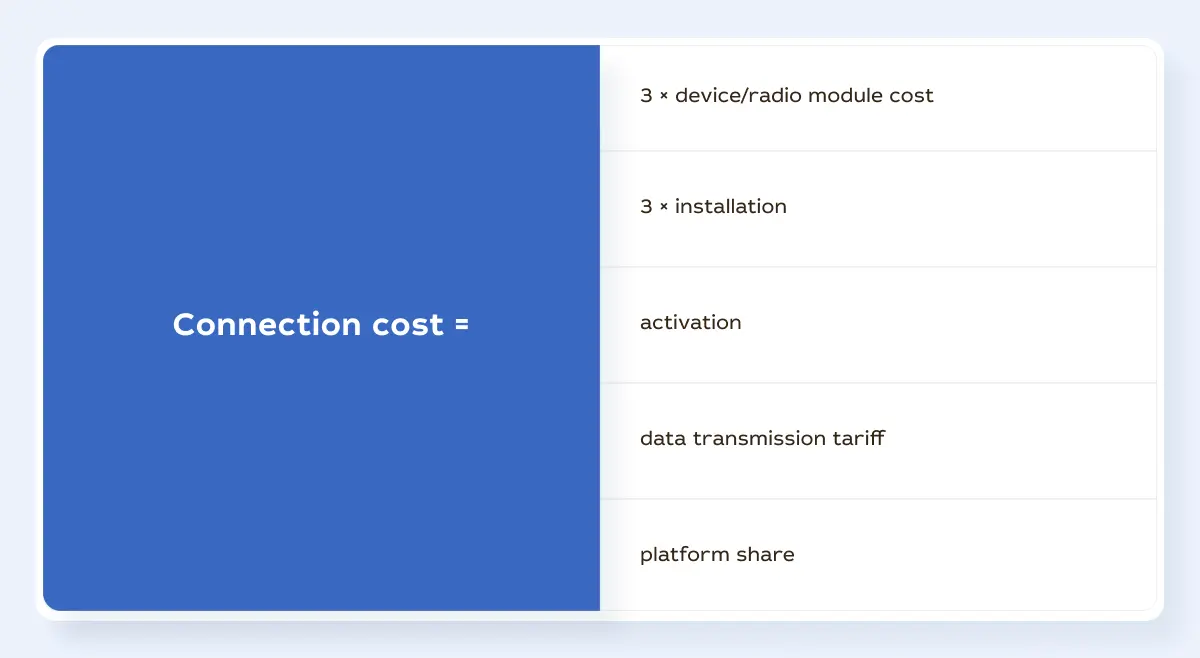
Connection formula
In this case, it’s impossible to provide a universal final figure without a commercial offer for devices, installation, and the operator tariff. However, an engineering conclusion can be made, which is that if the network already exists, the connection cost depends almost entirely on device price, installation, and service, not on radio infrastructure.
A network for one household. One LoRaWAN gateway receives data from many devices, so a house with several meters does not require a separate gateway for each device. The economic question here though is different, because if the network is deployed only for one house, the gateway cost is distributed across only a few devices.
For example, in the official Jooby store, the outdoor Jooby Gateway LoRaWAN 300 EU costs €295.12. If a private house has three meters installed, then the gateway cost per device will be:
€295.12 / 3 = €98.37 per device
This is not yet the full connection cost. The calculation for LoRaWAN deployment cost per house must include the meters or radio modules themselves, installation, power supply, the internet channel, configuration, the server side, and ongoing maintenance.
Therefore, a private LoRaWAN network for a single private house rarely looks economically justified, although such a scenario may fit an isolated site, a farm, an industrial facility, or a pilot project. For mass connection of private houses, it’s more cost-effective to use an existing network or build infrastructure for a group of sites from the start.
Consider a multi-apartment building with 100 apartments. Each apartment has two meters installed, so 200 devices must be connected to the network.
Network infrastructure. After a radio survey, the designer determines how many gateways are required for stable coverage. This depends on the building layout, wall materials, meter locations, the presence of basements, shafts, technical rooms, and the level of radio interference. In this example, we will take a basic scenario: one outdoor gateway is sufficient for the building.
For calculation, we use a Jooby Gateway LoRaWAN 300 EU priced at €295.12. Then the gateway cost share per device is:
€295.12 / 200 = €1.48 per device
That is, when connecting 200 devices, the cost of one gateway per device is €1.48. This is not the full connection cost, only the share of network equipment. The final estimate will also include gateway installation, power supply, connectivity, configuration, the server side, maintenance, and the meters or radio modules themselves.
Server side. If the project uses The Things Stack Cloud Standard for €198,08 per month, the tariff covers up to 1,000 end devices. If you distribute this cost across the full tariff limit, you get:
€198,08 / 1000 = €0.20 per device per month
For a building with 200 devices, the proportional server share will be:
200 × €0.20 = €39,62 per month
However, this model works only if other sites are connected to the same server infrastructure and the tariff is actually distributed across the full device pool. If the building remains the only site and the entire tariff is purchased only for 200 devices, the calculation changes:
€198,08 / 200 = €0.99 per device per month
This difference shows why, in LoRaWAN projects, it’s important to calculate not one building in isolation, but the entire network, taking into account current devices, future connections, and planned scale.
What to add to the estimate. To obtain a realistic cost of connecting a building, you need to add other project components to the gateway and server price:
200 × price of the meter or radio module + 200 × installation per device + radio survey + gateway installation and commissioning + LNS setup + integration with the metering system + operations
It’s convenient to define variables as follows:
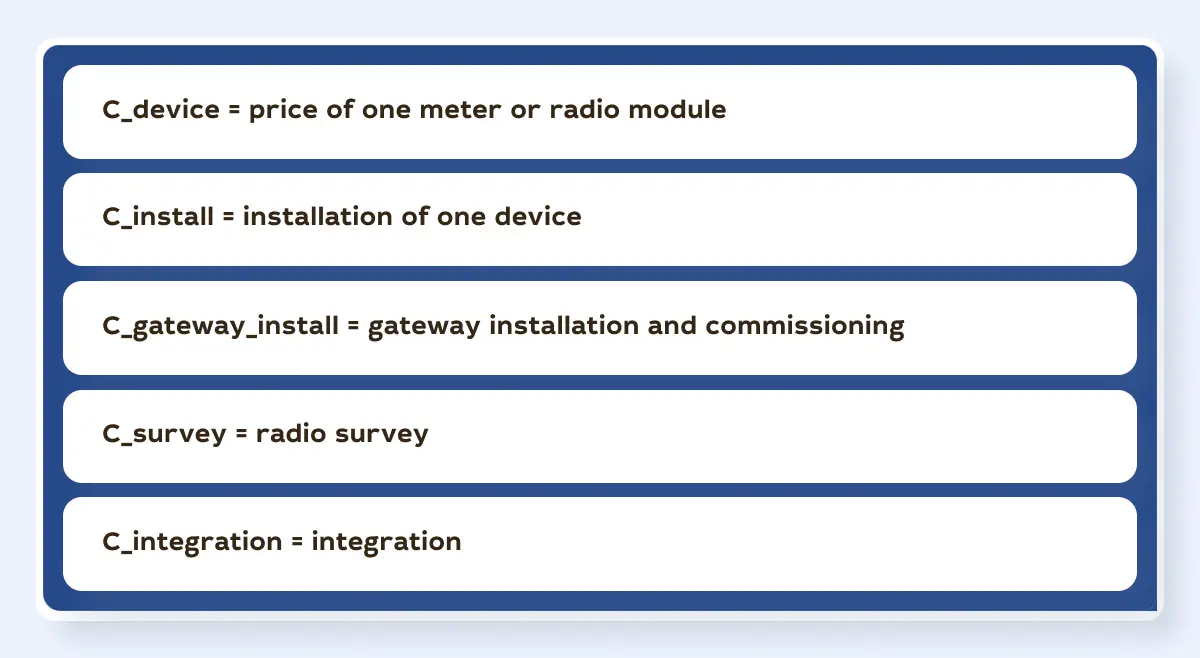
Then one-time costs for the building can be calculated as:
CAPEX = 200 × C_device + 200 × C_install + €295.12 + C_gateway_install + C_survey + C_integration
And monthly operating costs can be calculated as:
OPEX = LNS share + connectivity for the gateway + technical support + monitoring + maintenance
This model helps compare several scenarios to calculate LPWAN network pricing: connection to an existing network, deployment of a private LoRaWAN infrastructure, a hybrid model, or working through an IoT operator. In each scenario, not only does the initial cost change, but also the structure of recurring expenses.
Now consider a project with 10 buildings, each with 200 devices. Total: 10 × 200 = 2000 devices.
If you assume one gateway per building, the publicly confirmed hardware part will be:
10 × €295.12 = €2 951.20
Per device:
€2 951.20 / 2000 = €1.48 per device
But in a real residential complex, the IoT network cost per device may be different: one well-placed rooftop gateway may cover multiple buildings, and basements or technical rooms may require additional gateways. Therefore, the correct sequence is:
For smart metering, payback usually appears not only due to the elimination of manual meter reading. The economic effect consists of several components:
Payback formula:
Annual effect = savings on manual collection + reduction of losses/errors + savings on dispatching + effect from detected incidents/leaks – annual OPEX
Payback period:
Payback = CAPEX / annual effect
If there’s no data on savings, don’t try and invent it—it’s better to run a pilot and measure:
Number of devices. A favorable LoRaWAN scaling cost means that the more devices, the lower the share of the gateway, server, and integration per device. One building with 20 devices and one complex with 2000 devices have completely different economics.
Network architecture. There are three models:
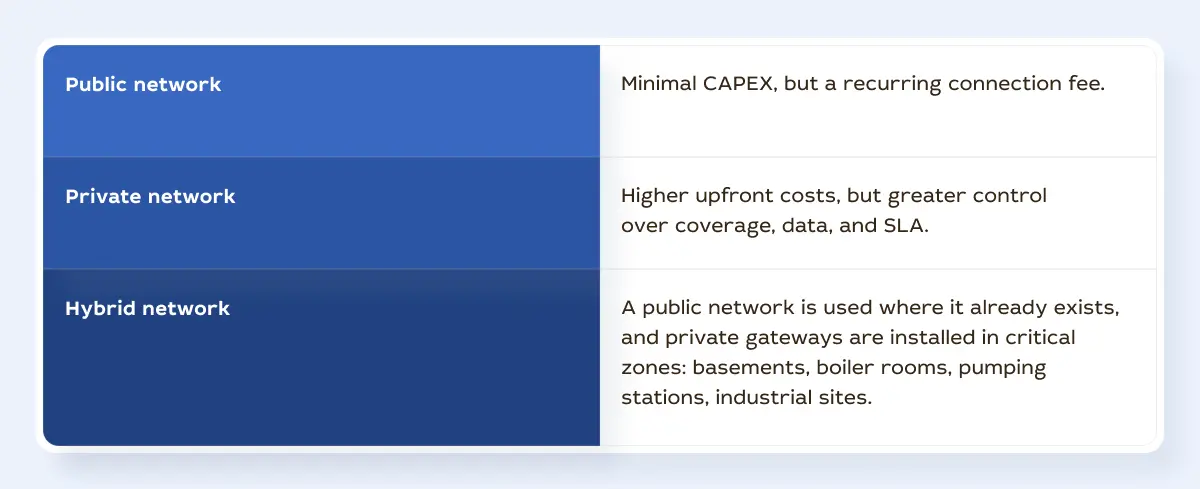
Radio environment. Thick walls, basements, metal doors, shafts, dense urban development, and low antenna installation can increase the number of gateways.
The coverage of an outdoor LoRaWAN gateway depends on terrain, antenna, installation height, and interference; in dense urban environments, coverage up to 2 km is possible, and in open areas up to 15 km. However, real projects require on-site validation.
Data transmission frequency. Transmitting readings once a day is cheaper for battery life and radio resources than once every 15 minutes. For commercial water or gas metering, daily transmission is often sufficient, while alarm events require separate alert messages.
Integration requirements. A simple dashboard and full integration with billing are different budgets. The more automation is required, the higher the implementation cost, but the less manual work remains after launch.
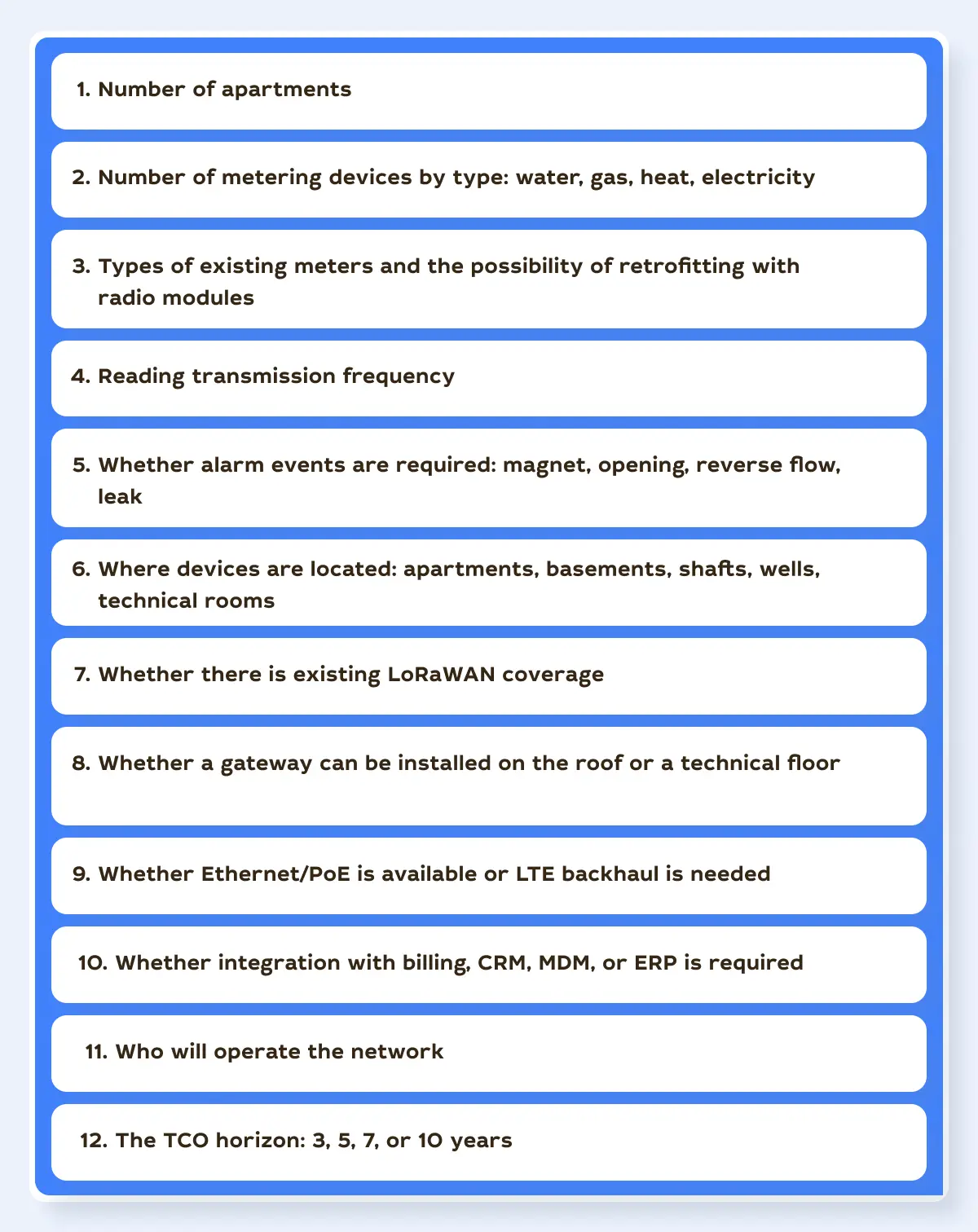
To calculate the cost of connecting one building without guesswork, the following data must be collected:
LoRaWAN economics depend on scale and network coverage planning. For one private house, private infrastructure is most often too expensive, with the gateway, server side, and maintenance costs being distributed across only a few devices. In a multi-apartment building, the calculation looks different: one gateway can potentially serve hundreds of devices and its share in the connection cost per device becomes much lower.
LoRaWAN performs best at the level of a residential complex, district, or a network of sites, where several buildings share common infrastructure, a single server contour, and a repeatable operating model. As a result, it’s worth calculating not only the price of connecting one device, but the total cost of ownership of IoT for the selected period.
Approaching the cost of LoRaWAN installation in this way will show where it’s more advantageous to connect to an existing network, where to build a private one, and where to choose a hybrid architecture for your utility IoT infrastructure.
Was it helpful?
 95
95


Stay on top of the latest industry news
Thank you, we have received your message. Our manager will contact you shortly.


Thank you, we have accepted your request. In the near future the responsible manager will contact you and clarify the details of the order.