01.10.2025
 1108
1108
1108
Emergency Protection: NB-IoT Valves and LoRaWAN Leak Sensors in Apartment Buildings
1108
Modern apartment buildings are becoming increasingly complex in their engineering systems, while the risk of accidents due to water leaks or heat loss remains high. Pipe damage or unnoticed leaks can lead not only to costly repairs, but also lawsuits and reputational losses for utility providers and property management companies. Against this background, the implementation of emergency protection systems is not just a trend but a necessity.
One of the most promising directions in this field is the use of NB-IoT valves and LoRaWAN leak sensors. These water leakage prevention technologies allow for an almost instantaneous response to leak threats, remote equipment control, and real-time data collection, significantly reducing the risk of large-scale damage.
NB-IoT (Narrowband Internet of Things) is a cellular data transmission technology characterized by low power consumption and extended coverage range. Valves operating via NB-IoT are integrated into the water and heating systems to create smart leak detection apartment buildings, allowing operators to shut off the supply of resources when anomalies or leaks are detected.
The advantage of NB-IoT water valves lies in their independence from local infrastructure, operating in areas where Wi-Fi or wired communication is unavailable and providing two-way communication. This is especially important for homeowners’ associations, municipalities, and utility providers who need to monitor dozens or even hundreds of facilities simultaneously.
Alongside NB-IoT emergency shut-off valves, the market is also actively developing LoRaWAN leak sensors. LoRaWAN (Long Range Wide Area Network) is an open protocol that supports long-distance communication and is ideal for installation in basements, technical rooms, and other hard-to-reach areas.
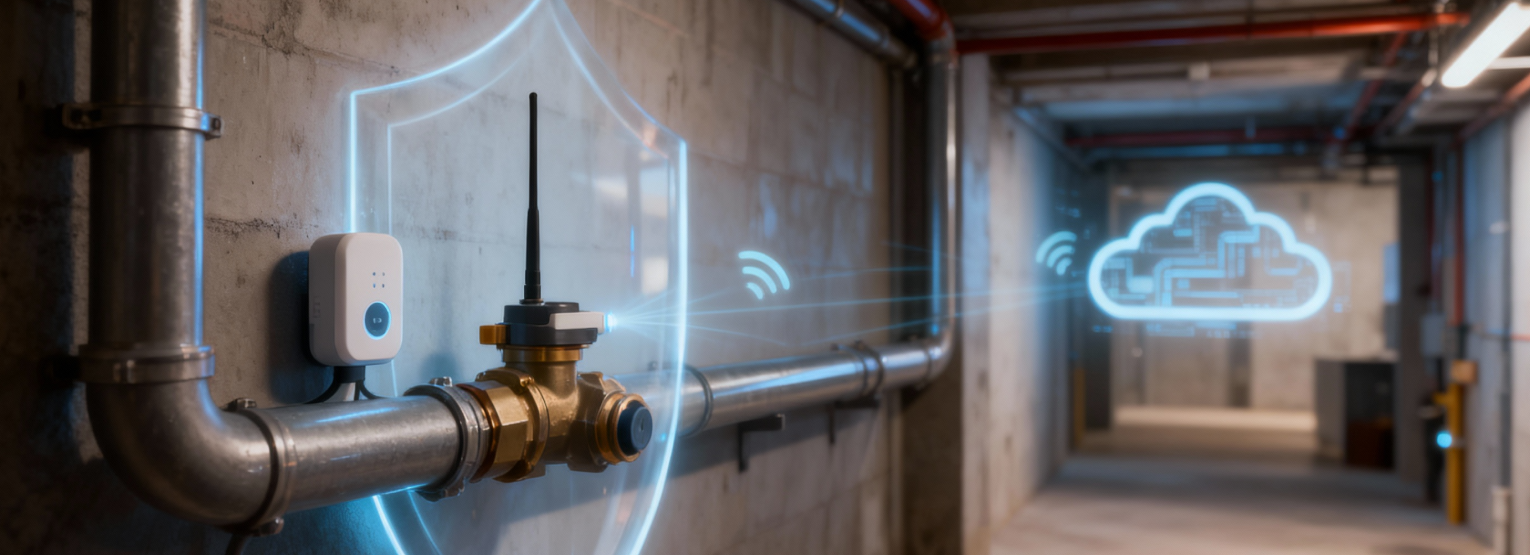
LoRaWAN water leak monitoring uses sensors that continuously track humidity and the presence of water on surfaces. Issuing real-time leak alerts, these connected leak sensors immediately transmit a signal to a gateway, which then relays it to a cloud service or dispatch center. This setup minimizes the response time of emergency plumbing management, enabling coordinated resource shutoff through the NB-IoT valve.
The key value in these wireless leak detection solutions lies in the combination of sensors and actuators. LoRaWAN sensors detect leaks, while NB-IoT smart valves respond by shutting off the flow of water or heat carrier. This creates a closed loop of emergency protection that works autonomously and does not require constant human intervention.
Building automation with IoT in this type of system is particularly useful for developers and homeowners’ associations: during construction, installation points can be planned in advance, and during operation, costs for emergency visits and repairs are significantly reduced. The systems for IoT enabled municipal water safety are also easily scalable and can be integrated with existing smart home or dispatching solutions.
The implementation of NB-IoT valves and LoRaWAN sensors allows utility providers and property managers to move from a reactive approach to a preventive one. The cost of the equipment pays off through reduced losses from leaks, fewer resident complaints, and lower insurance payouts.
The low power consumption of the devices and the use of standard communication protocols also simplify their maintenance. Batteries last for several years, and monitoring software allows data integration into a single analytical platform.
With the development of smart cities and the Internet of Things, NB-IoT safety solutions and LoRaWAN technologies are set to become the standard for apartment buildings. Municipalities and homeowners’ associations that implement LoRaWAN emergency protection systems gain both economic advantages and a strategic image of innovative management.
Investing in modern emergency protection systems for predictive maintenance leak detection and remote water shutoff is not just about installing equipment, it is a transition to a new level of safety, transparency, and resource control. The result is having LoRaWAN smart infrastructure where every liter of water and every megawatt of heat is under your management.
Was it helpful?
 242
242


Stay on top of the latest industry news
Thank you, we have received your message. Our manager will contact you shortly.


Thank you, we have accepted your request. In the near future the responsible manager will contact you and clarify the details of the order.