02.09.2025
 1298
1298
1298
A City Without Cables: Roadmap for Transitioning Stationary Meters to Wireless LoRaWAN Accounting
1298
Modern cities are changing rapidly. Where kilometers of cables once stretched, wireless communication and IoT smart metering is now increasingly taking over key monitoring and management functions.
Electricity, water supply, and heating networks — all these sectors require transparent and reliable monitoring, yet old wired solutions are becoming too costly and cumbersome. In dense urban environments, with limited budgets and rising demands for energy efficiency, the question of switching to wireless accounting is now coming to the forefront.
Upgrading utility infrastructure using LoRaWAN (Long Range Wide Area Network) is leading the way to “cities without cables,” where every meter can be connected to a unified monitoring system without large-scale construction work. LoRaWAN is not just a buzzword — it’s a proven technology that has already demonstrated efficiency in dozens of countries and is becoming the standard for smart metering.
Historically, metering systems were built around cables, with electricity and heating networks creating local communication channels to transmit readings to a control center.
But every modernization or breakdown turned this system into an expensive project that would involve creating new routes, wall and hallway repairs, and endless approvals. In the end, the cost of maintaining the cable infrastructure often exceeded the cost of the meters themselves.
LoRaWAN smart city solutions and wireless technologies eliminate these barriers. A LoRaWAN signal travels for kilometers even in dense urban areas, while the narrowband protocol allows devices to operate on a single battery for up to ten years.
This means that by setting out a LoRaWAN adoption roadmap, municipal services and housing associations can abandon cable-based projects in favor of a flexible and scalable network.
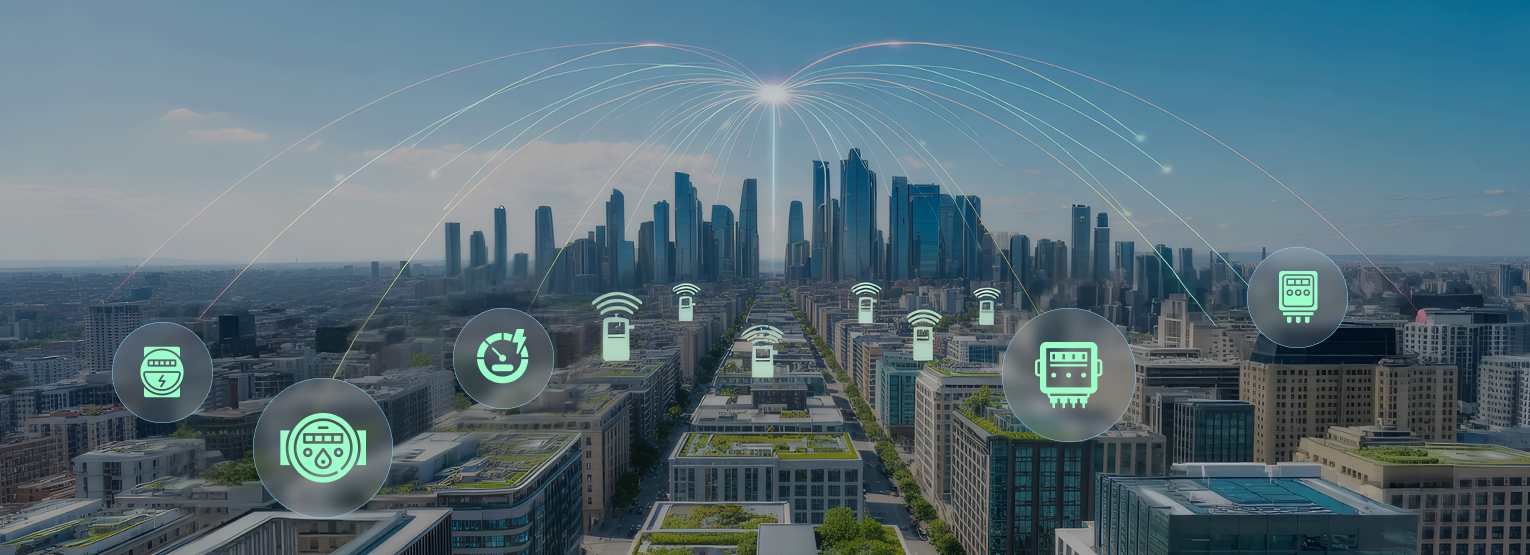
LoRaWAN is a low-power network built on a star topology. Wireless utility meters use sensors to send data to base stations (gateways), which forward the information to a cloud server or local system. This approach removes the need for local cabling and provides centralized access to real-time data.
The main advantage of having LoRaWAN infrastructure for the utilities sector is scalability. That’s because utility modernization with IoT allows the network to be deployed across a neighborhood, a city, or even a region, connecting tens of thousands of devices without a radical increase in costs. In addition, the technology is protected by built-in cryptographic security, ensuring data integrity and fostering trust in digital services.
The migration of stationary meters to LoRaWAN metering usually starts with a pilot project. Typically, one residential block or district is selected, where gateways are installed and the first batch of devices connected. Such a test allows utility providers to evaluate actual coverage for remote meter reading, signal stability, and integration with existing billing systems.
The next stage to a LoRaWAN adoption strategy is scaling. At this level, it is important to carefully plan gateway placement: for optimum LoRaWAN data transmission they must cover not only residential buildings but also basements, heating plants, and pumping stations. In parallel, software for data management and analytics is introduced.
Once the system is in place for LoRaWAN coverage in cities, network expansion becomes almost automatic — new meters are simply added and registered in the system.
For resource suppliers, wireless meter accounting means reduced losses and transparent billing. With remote consumption monitoring, manual readings become unnecessary and the risk of input errors decreases. For municipalities, it’s a tool for control and planning, enabling accurate assessment of consumption and better energy management.
Developers and homeowners’ associations also benefit because LoRaWAN meter migration allows them to deliver housing that is “infrastructure ready” without additional spending on cable networks. Residents, in turn, gain convenience and confidence — their meter data is always available and correctly accounted for, reducing disputes over bills.
The transition of stationary meters to LoRaWAN for municipalities is only the beginning. Once a city builds a wireless network for cable-free metering, it can connect leak detectors, lighting systems, parking sensors, and environmental monitoring solutions. This makes LoRaWAN a universal platform for smart cities, where resource and infrastructure management becomes fully digital.
The transformation to wireless billing solutions opens new horizons for all stakeholders: utilities, businesses, and residents alike. In a world where time and resources are key values, wireless metering is not just a technology — it’s the foundation for sustainable utility management and a comfortable future.
Was it helpful?
 282
282


Stay on top of the latest industry news
Thank you, we have received your message. Our manager will contact you shortly.


Thank you, we have accepted your request. In the near future the responsible manager will contact you and clarify the details of the order.