25.08.2026
 614
614
614
Integrating LoRaWAN with SCADA systems: benefits and challenges
614
A SCADA system is a combination of software and hardware for supervisory control and management of technological facilities. It collects data from equipment, displays the state of infrastructure, records alarms, and helps operators make decisions.
SCADA has long been used in power generation and distribution, water supply, gas distribution, heat supply, industry, and urban infrastructure. However, SCADA infrastructure has usually been built around wired channels, PLCs, Modbus TCP, RTUs, and facilities that already have power supply, connectivity, and engineering preparation.
Problems arise when remote sensors, meters, wells, pumping stations, basements, or temporary monitoring points need to be connected. Laying cables is expensive, while data for operational management is often insufficient. In such cases, LoRaWAN, a wireless network infrastructure, complements SCADA: the dispatching system remains the central monitoring layer, while LoRaWAN becomes the low-power, wide-area network (LPWAN) layer for collecting data from distributed devices.
The relevance of this approach is growing together with the IoT and industrial automation markets. According to the market researcher IoT Analytics, there were 21.1 billion connected IoT devices worldwide in 2025, and this number may approach 39 billion by 2030. Another research company, MarketsandMarkets, has suggested that the industrial IoT SCADA market may grow from $12.89 billion in 2025 to $20.05 billion by 2030.
In this article, we will examine the benefits of integrating LoRaWAN with SCADA systems, where this combination is especially useful, and what challenges a project team may face. We will also look at how to reduce risks in advance: test coverage, build the right architecture, prepare the integration layer, and separate responsibilities between LoRaWAN, PLC, and SCADA.
LoRaWAN integration with SCADA is built as a multi-level system for data collection, real-time monitoring, processing, and transmission. Remote sensors, meters, or radio modules transmit data through an industrial LoRaWAN network to a base station. The data then goes to a network server, is processed at the application level or through an edge gateway, normalized, and transferred to SCADA. Data exchange may use an MQTT broker, REST API, Modbus TCP, OPC UA, or another protocol supported by a specific SCADA system.
In simplified form, the chain looks like this:
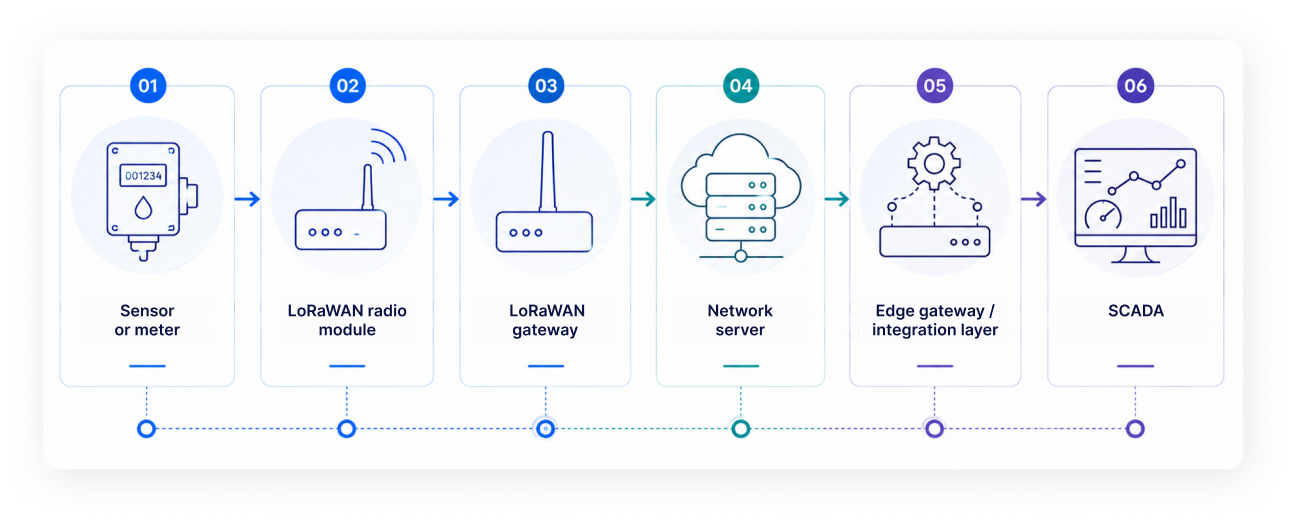
In the Jooby RDC smart metering platform, data collection and transmission at this part of the chain are provided through its infrastructure by radio modules, sensors, smart meters, and LoRaWAN base stations. The data can be used in the Jooby RDC Dashboard platform or forwarded to third-party metering, dispatching, and industrial monitoring systems.
For a utility provider, this is not a replacement for SCADA, but an extension of its visibility to facilities that were previously difficult to connect to telemetry.
The main value of LoRaWAN and SCADA integration is the ability to connect remote and distributed points to dispatching control without expensive cable infrastructure. This is especially important for utility networks, where facilities are often spread across a district or a city: water metering units, gas meters, pumping stations, heating points, wells, basements, tanks, transformer substations, and technical rooms in residential complexes.
LoRaWAN is well suited for such tasks because of its long communication range, low power consumption, and ability to work with battery-powered devices. Where SCADA usually relies on wired lines or local controllers, an industrial LoRaWAN network makes it possible to add a layer of wireless telemetry. This is especially useful when a facility does not require continuous real-time control but must regularly transmit readings, statuses, alarms, or events.
For a utility provider, this means that more factual data can be brought into SCADA, not only the status of major stations, but also readings from peripheral points of the network. As a result, the dispatcher sees a more complete picture of the infrastructure, rather than isolated “islands” of automation.
In classic automation, each new point often requires a project, cable route, power supply, cabinets, approvals, installation work, and further maintenance. In LoRaWAN scenarios, part of this burden is removed: a device can be installed near a meter or a monitored unit, data transmission can be configured, and the device can be connected to the existing LPWAN architecture.
This is especially beneficial when many similar facilities need to be connected. For example, if hundreds of meters, pressure sensors, flood sensors, manhole cover status sensors, or temperature sensors in heating points need to be monitored, the cost of connecting each point becomes critical. LoRaWAN allows data collection to be scaled without a proportional increase in cable infrastructure costs.
For developers and management companies, this opens up a convenient scenario where LoRaWAN gateways can be planned at the construction or modernization stage, and new sensors and radio modules can then be added gradually. For municipalities, this is a way to develop smart city infrastructure, not through separate, unrelated projects, but a unified network for different services.
SCADA remote monitoring becomes much more useful when the system receives data not only from PLCs and large automated units, but also from small field devices. LoRaWAN is well suited for transmitting telemetry: meter readings, battery statuses, opening events, magnetic influence, loss of connectivity, alarm signals, threshold exceedances, and temperature, humidity, or pressure readings.
Continuous real-time data transmission is not required for all such parameters. However, if the data arrives steadily and at a clear interval, SCADA turns from a system for monitoring separate technological sections into a tool for monitoring distributed infrastructure.
For example, in water supply, this helps detect areas with abnormal consumption faster. In gas distribution, it helps monitor remote meters and record interference. In heat supply, it assists in detecting deviations in temperature or flow by facility, while in electricity distribution, it can be used to collect statuses from distributed metering units. The LoRa Alliance also notes the use of LoRaWAN as an infrastructure layer for utility systems, cities, buildings, industry, and critical infrastructure — precisely the areas where SCADA and industrial IoT increasingly overlap.
A SCADA telemetry system works well with technological parameters, but they do not always conveniently receive a large flow of “raw” IoT messages. Therefore, in a proper architecture, LoRaWAN data collection should not turn into a chaotic stream of data sent directly into SCADA. An integration layer is needed between the LoRaWAN network server and SCADA, using an edge gateway, MQTT broker, API service, or industrial gateway.
This layer performs several tasks: it receives messages from devices, checks the data structure, organizes values, links them to facilities, filters unnecessary events, stores history, sends only the required parameters to SCADA, and creates correct tags. This approach reduces the load on the dispatching system and preserves its logic.
As a result, SCADA receives not just packets from radio modules, but prepared data, such as “pressure below threshold,” “meter is not transmitting data,” “water level has exceeded the norm,” “magnetic influence detected,” or “battery requires attention.” This makes the integration not only technically correct, but also useful for the operator.
A well-designed LoRaWAN industrial network can support different scenarios on the same infrastructure. First, an operator connects water metering, then adds gas, heat, flood monitoring, temperature sensors, monitoring of technical rooms, or other tasks. This is what network scalability means, where gateways are already installed, the network is operational, and new devices can be connected as needed.
For SCADA, this is important because the dispatching system receives an extension without the constant creation of separate communication channels for each new sensor type. This works especially well for facilities where data is transmitted at intervals: once an hour, several times a day, by event, or according to a schedule.
In this case, LoRaWAN becomes not a “network for meters,” but a basic transport layer for the SCADA telemetry system. This helps move from separate IoT pilots to full-scale SCADA IoT solutions.
In utility and urban infrastructure, it is not always possible to connect a device to the power grid. A project becomes more complex if devices are placed in basements, wells, remote cabinets, temporary facilities, or hard-to-reach points. LoRaWAN supports low-power devices that can operate on batteries for years if the data transmission frequency and operating modes are configured correctly.
This is essential for retrofit projects, where existing meters or metering units need to be upgraded without large-scale reconstruction. The device is installed on site, connected to a sensor or meter, the transmission interval is configured, and the data enters the system without manual rounds. For SCADA, this results in more control points with less dependence on local power supply.
After LoRaWAN is integrated with SCADA, data becomes available for several management levels. The operator sees current events and alarms. The technical service analyzes connection quality, missed transmissions, battery statuses, and event history. Management can evaluate consumption dynamics, the number of incidents, the efficiency of field visits, and the condition of facilities.
Data logging and long-term storage are extremely important here. If data is stored not only in SCADA, but also in a metering platform or analytical environment, the company can compare periods, find recurring failures, identify weak sections of the network, and plan maintenance. In this way, SCADA industrial IoT stops being a system that only helps “see an alarm” and instead becomes an operations management tool.
LoRaWAN is not intended for high-frequency control of technological processes with strict latency requirements. If drives, pumps, or protection systems need to be controlled in real time, the foundation remains PLC connectivity, industrial controllers, Modbus TCP, wired networks, and classic automation.
The solution is to separate tasks correctly. PLC and SCADA should be responsible for critical control and operational automation. LoRaWAN should handle remote sensors, reading collection, alarm events, statuses, monitoring of hard-to-reach facilities, and data that does not require a millisecond-level response.
SCADA works with tags, structures, facilities, alarms, and archives. LoRaWAN devices transmit messages in their own format. If data is simply “pushed” into SCADA without normalization, operators will receive an inconvenient set of parameters rather than a manageable system.
The solution is to use an edge gateway or integration layer. It should decode the payload, convert data into understandable parameters, link it to facilities, check data quality, transmit only the required values to SCADA, and record exchange errors. An MQTT broker, API, OPC UA, or Modbus TCP can be used for exchange — the choice depends on SCADA capabilities and project requirements.
Signal coverage is one of the key risks in LoRaWAN data acquisition projects. Communication quality is affected by terrain, dense development, basements, metal cabinets, shafts, gateway installation height, antenna quality, and interference. If the network is designed only on a map, some devices may operate unstably.
The solution is to conduct a radio survey, pilot, and testing of difficult points. Before mass deployment, communication quality must be measured at the actual device installation locations, with RSSI/SNR, missed transmissions, retransmissions, and coverage margin assessed. In large projects, gateway redundancy should be planned, and locations for additional base stations identified in advance.
LoRaWAN and SCADA integration adds new components: devices, gateways, network server, MQTT broker, edge gateway, API, and data storage platform. If access and keys are not managed, there is a risk of unauthorized access or incorrect data transmission.
The solution is to design security at all levels: separate networks, use protected channels, manage keys, restrict user rights, keep event logs, control updates, and avoid connecting IoT components directly to critical SCADA segments without an intermediate zone.
After the launch of LoRaWAN industrial automation, the network must be maintained, with batteries, missed transmissions, gateway operation, signal quality, updates, device statuses, and integration errors all needing to be monitored. If responsibilities are not assigned, SCADA will show not the full picture, but a set of recurring problems.
The solution is to include the operating model in the project. It is necessary to define who is responsible for LoRaWAN gateways, the monitoring of devices, responding to missing data, checking the SCADA integration, and maintaining data logging. For large projects, regulations are useful, including what counts as an alarm, when a field visit is required, how missed transmissions are handled, and how data transmission frequency is changed.
The LoRaWAN integration with SCADA systems helps expand industrial and utility telemetry without expensive cable connection for every point. SCADA remains the central supervisory control system, while LoRaWAN adds a flexible layer for remote sensors, meters, and autonomous devices.
This approach increases facility coverage, reduces connection costs, simplifies scaling, and helps obtain data where monitoring used to be difficult.
Potential challenges of LoRaWAN SCADA integration— latency, coverage, integration, security, and operations — can be addressed through a pilot, radio survey, edge gateway, MQTT broker, data normalization, and clear separation of tasks between LoRaWAN, PLC, and SCADA.
Was it helpful?
 73
73


Stay on top of the latest industry news
Thank you, we have received your message. Our manager will contact you shortly.


Thank you, we have accepted your request. In the near future the responsible manager will contact you and clarify the details of the order.