09.06.2026
 629
629
629
How Remote Meter Reading Reduces the Operating Costs of Utility Companies
629
For a water, gas, heat, or electricity supplier, meter readings are not a mere formality. Readings form the basis of revenue, customer billing, and loss control, so when data arrives late, is collected manually, or requires constant clarification, every billing cycle becomes more expensive.
Remote meter reading helps reduce these costs, not through a single technology, but by transforming the entire operating model. The company becomes less dependent on on-site visits, manual data entry, access to premises, and human intervention. Readings are received regularly, while disputed or suspicious situations can be identified earlier.
This is particularly important for utility companies, property developers, municipalities, and homeowners’ associations: the number of metering points is growing, transparency requirements are increasing, and the cost of manual servicing is becoming more significant. Remote meter reading should therefore be viewed not as an additional meter feature, but as a cost management tool.
Manual meter reading may seem like a familiar routine, but its actual cost is often hidden across different budget items. These include meter inspectors’ salaries, transportation, fuel, route planning, repeat visits, report processing, calls to customers, and manual data entry into accounting systems.
Incomplete readings are another major problem. An inspector may be unable to access an apartment, basement, meter pit, or utility room, while a customer may forget to submit the data, send it late, or enter the wrong figures. As a result, the company has to bill based on average consumption, make adjustments, and spend time handling customer inquiries.
The larger the network, the more expensive this process becomes. For apartment buildings, residential developments, municipal facilities, and geographically dispersed network sites, a single billing cycle may involve thousands of small operations, each requiring time and oversight. With this in mind, let’s take a look at how utilities reduce OPEX with IoT metering.
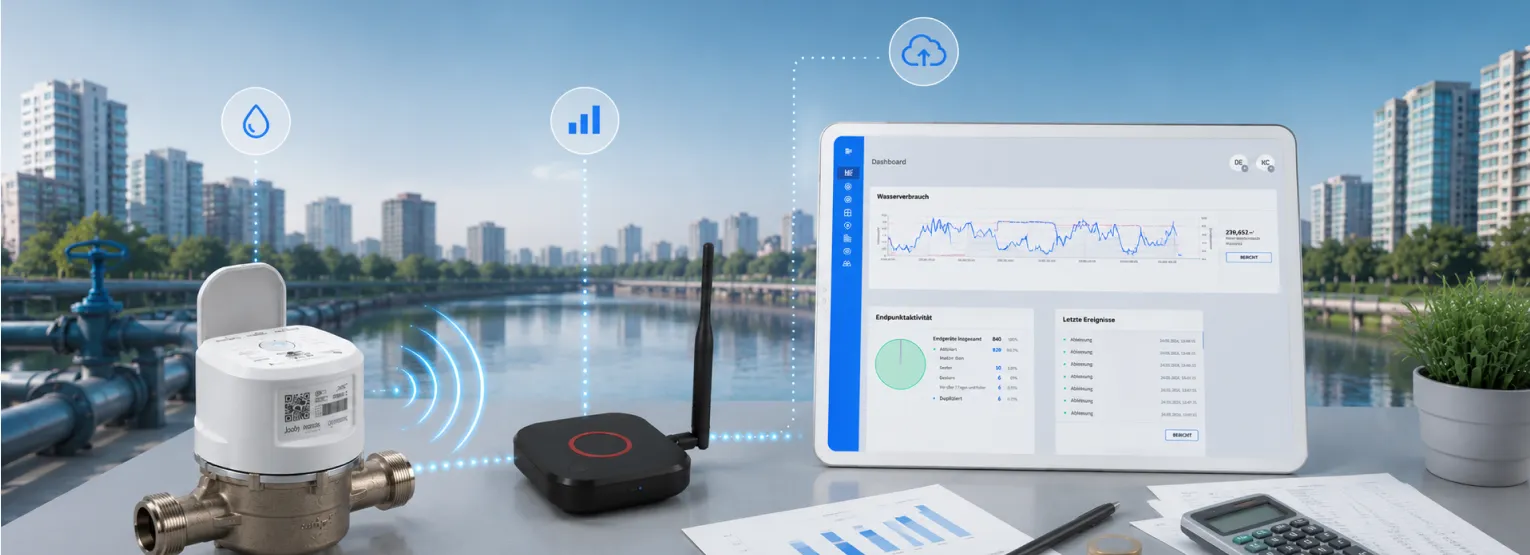
With remote meter reading, a meter, radio module, or sensor records readings and transmits them to the metering system via a wireless network. LoRaWAN or NB-IoT is often used for such tasks because meters do not require high data transmission speeds. What matters is their ability to reliably send small data packets and operate on battery power for a long time.
Instead of receiving a single value at the end of the month, with automatic meter reading the company gets a continuous history of real-time consumption data. This may include daily, hourly, or other interval data, depending on the task and system settings. This level of detail makes it possible to see not only the total consumption volume but also the consumption pattern at the site.
For example, a sudden increase in water consumption at night may indicate a leak. Zero consumption in an occupied building may point to a faulty meter or a communication problem. Alerts about casing tampering, reverse flow, or low battery levels help the company plan maintenance in advance.
If we do a remote meter reading vs manual cost comparison, the most obvious benefits are a reduction in scheduled site visits and maintenance optimization. When a company services 10,000, 50,000, or 100,000 meters, even a small cost per visit adds up to a significant recurring expense. With remote meter reading, mass inspections of every metering point are replaced by targeted visits to locations where the system has identified an actual problem.
This is particularly noticeable at sites with restricted access. Basements, locked electrical rooms, meter pits, private homes, and municipal buildings often require visits to be arranged in advance. If an inspector arrives but cannot gain access, the company has already incurred costs without obtaining any useful result.
Of course, remote meter reading does not eliminate maintenance entirely. Equipment must be installed and inspected, batteries may occasionally need to be replaced, and faults must be repaired. However, instead of continuously checking every metering point manually, the company moves to event- and priority-based maintenance.
According to FERC, 128.4 million smart meters were in use in the United States by the end of 2023, accounting for 76.8% of all meters, their numbers increasing by 9.1 million over the year. While these figures do not provide a direct estimate of savings for a specific company, they clearly demonstrate the scale of the industry’s transition to automated metering.
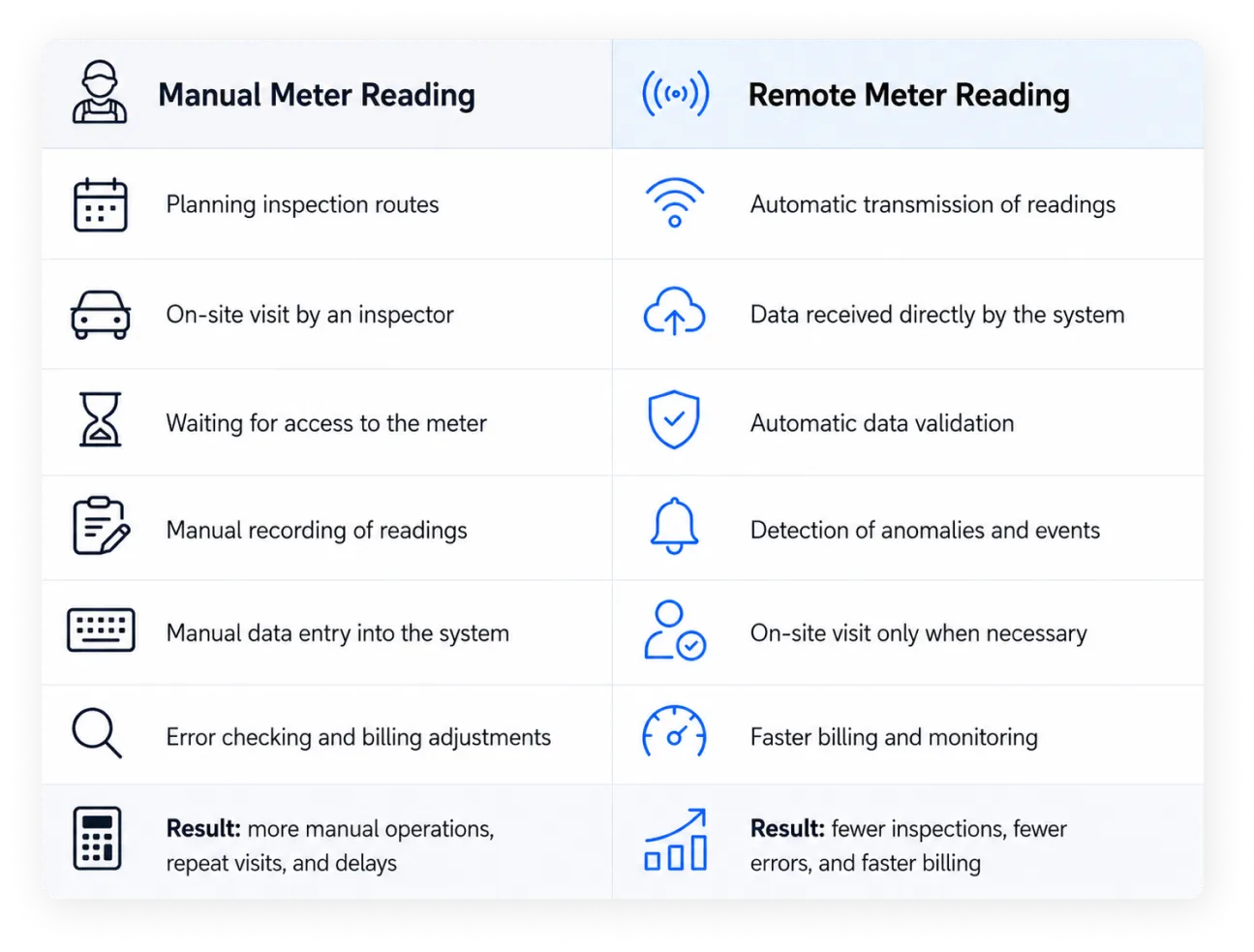
Comparison of Manual and Remote Meter Reading
Manual data entry always creates a risk of error. An incorrectly recorded digit, confusion between meters, an illegible report, an incorrect date, or a delay in transferring data to the billing department can all result in inaccurate charges.
Each such error triggers a chain of additional costs. The customer contacts the call center, a specialist checks the data, the billing department makes an adjustment, and in some cases a repeat site visit is required. Even when the correction amount is small, the cost of handling the inquiry can be significant.
One of the benefits of remote meter reading for utilities is that it reduces this workload because data enters the system without being copied manually. When properly configured, the system can automatically flag suspicious values, such as an unusually sharp increase, an impossible decrease, zero consumption, or an atypical consumption pattern.
For homeowners’ associations and property management companies, this data accuracy also helps reduce disputes. When a dated history of readings is available, it is easier to explain charges, confirm leak detection, or show why total building consumption differs from the sum of individual readings.
With a manual process, the billing period is often prolonged. Some customers submit their readings on time, some later, some do not submit them at all, and some data requires verification. The billing department is forced to operate under peak workloads, while charges may be generated with delays.
Automated collection makes it possible to receive readings by the required date without mobilizing large numbers of staff. This reduces the workload at the end of the month and helps issue bills more quickly. For a utility provider, this affects not only internal efficiency but also cash flow.
For a property developer, this benefit is important as early as the commissioning stage. If a residential complex is equipped with a remote metering system from the outset, the property management company gains a controlled billing automation process from the first month of occupancy. This is extremely useful when access to apartments is inconsistent and the number of resident inquiries is usually high.
Operating costs are reduced not only by decreasing the number of site visits. In many cases, the more significant benefit comes from the early detection of losses. In water supply, these include leaks, faulty meters, unauthorized connections, and the difference between the volume supplied and the volume paid for. In the electricity sector, they include technical and commercial losses, overloads, and meter tampering.
Infrequent readings provide only a total for the billing period. If a leak occurs at the beginning of the month, the company may detect it too late. Frequent remote data reduces the time between the emergence of a problem and the response to it.
This is a particularly important issue for water utilities. World Bank materials describe non-revenue water as a major financial problem for utility companies; one industry document estimates global utility losses at approximately USD 141 billion per year. This figure cannot be applied directly to a specific city or company, but it does illustrate the scale of the unaccounted-for resource problem.
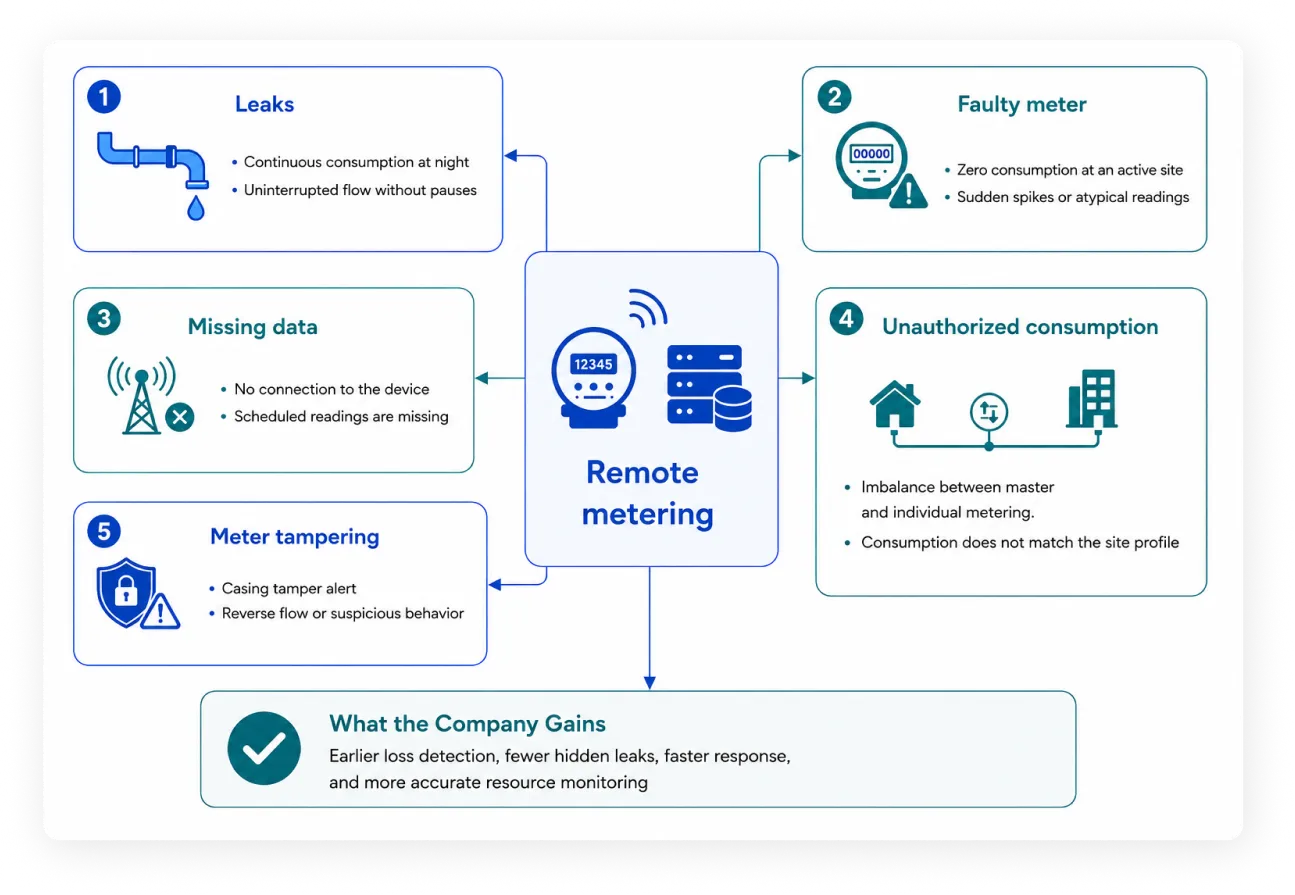
Main Types of Losses and the Signals Detected by the System
For meters, high speed and large data volumes are less important than stability, range, energy efficiency, and reliable operation in challenging installation environments. Devices are often located in basements, meter pits, metal cabinets, or utility rooms where conventional connectivity may be unstable.
LoRaWAN is suitable for projects in which a company or infrastructure operator wants to deploy its own network across a city, district, industrial site, or residential complex. Gateways can be positioned to provide coverage in the required areas and support a large number of low-power devices.
NB-IoT uses a mobile operator’s network. This is convenient for geographically dispersed sites where metering points are located far apart and building a private network would not be cost-effective. The choice between LoRaWAN and NB-IoT depends on meter density, network coverage, installation conditions, required battery life, and the preferred network ownership model.
In remote metering projects, it is important for the hardware and software components to operate as a single system. Jooby RDC is a resource consumption data collection solution that includes devices for transmitting readings and the Jooby RDC Dashboard for processing, displaying, and analyzing data. The solution is designed for water, gas, heat, and electricity metering.
For a utility company, property developer, homeowners’ association, or municipality, the value of this approach lies in the fact that data does not remain “on the device.” It is collected in a system where users can view readings, device status, reports, and events, as well as use an API to transfer data to other software.
At the same time, implementing remote metering does not necessarily require the immediate replacement of the entire existing infrastructure. In some scenarios, radio modules are installed on meters that are already in use and transmit data to the metering system without affecting the meter’s metrological characteristics. This is especially important for the phased modernization of existing facilities.
For property developers, remote metering is best incorporated at the design stage. This makes it easier to plan gateway locations, access to power, coverage areas, communication cabinets, and integration with building management systems. Modernization after residents move in is usually more difficult and expensive.
For municipalities, the main value lies in controlling utility costs at publicly funded facilities. Schools, hospitals, administrative buildings, pumping stations, and boiler houses can transmit data regularly without separate manual collection.
For homeowners’ associations, the main benefit is transparency. With a history of readings, it is easier to explain charges, compare individual and building-wide consumption, identify problem areas, and make repair decisions based on data rather than assumptions.
The payback of remote meter reading cannot be calculated solely on the basis of the cost of the meter or radio module. The calculation should include equipment, installation, connectivity, software, integration, maintenance, staff training, and user support.
The economic benefit also extends beyond field service reduction. It is necessary to consider fewer repeat visits, reduced errors, a lower workload for the contact center, faster billing, the detection of leaks and tampering, fewer disputed charges, and improved payment collection – all of which contribute to OPEX reduction.
A practical approach to assessing smart metering ROI for utility companies is to begin with a pilot area. Before launch, the company should establish baseline indicators: the cost of a single inspection round, the time required to collect readings, the proportion of inaccessible meters, the number of inquiries received after billing, and the number of manual adjustments made by the billing department.
After 3–6 months, these indicators and any projected automated meter reading cost savings can be compared with the actual results. Such internal data is the most suitable basis for calculating payback because labor, transportation, connectivity, and maintenance costs vary considerably from one company to another.
Remote meter reading reduces costs only when the system operates reliably. The main risk is poor coverage at meter installation sites. Reinforced concrete, metal structures, basements, meter pits, and remote technical areas can weaken signal transmission.
For this reason, it is advisable to conduct a coverage survey or run a pilot at real sites before scaling the system. This makes it possible to determine in advance where additional gateways, external antennas, or a different data transmission approach may be required.
The second risk is a lack of integration. If data is collected automatically but then transferred manually into spreadsheets, much of the benefit is lost. The system should be integrated with billing, dispatching, or other operational software.
The third risk is unclear operational responsibility. It is important to define in advance who monitors devices that have lost connectivity, who responds to alerts, who verifies disputed readings, and who plans maintenance. Without such procedures, a digital system may create a new stream of unprocessed notifications.
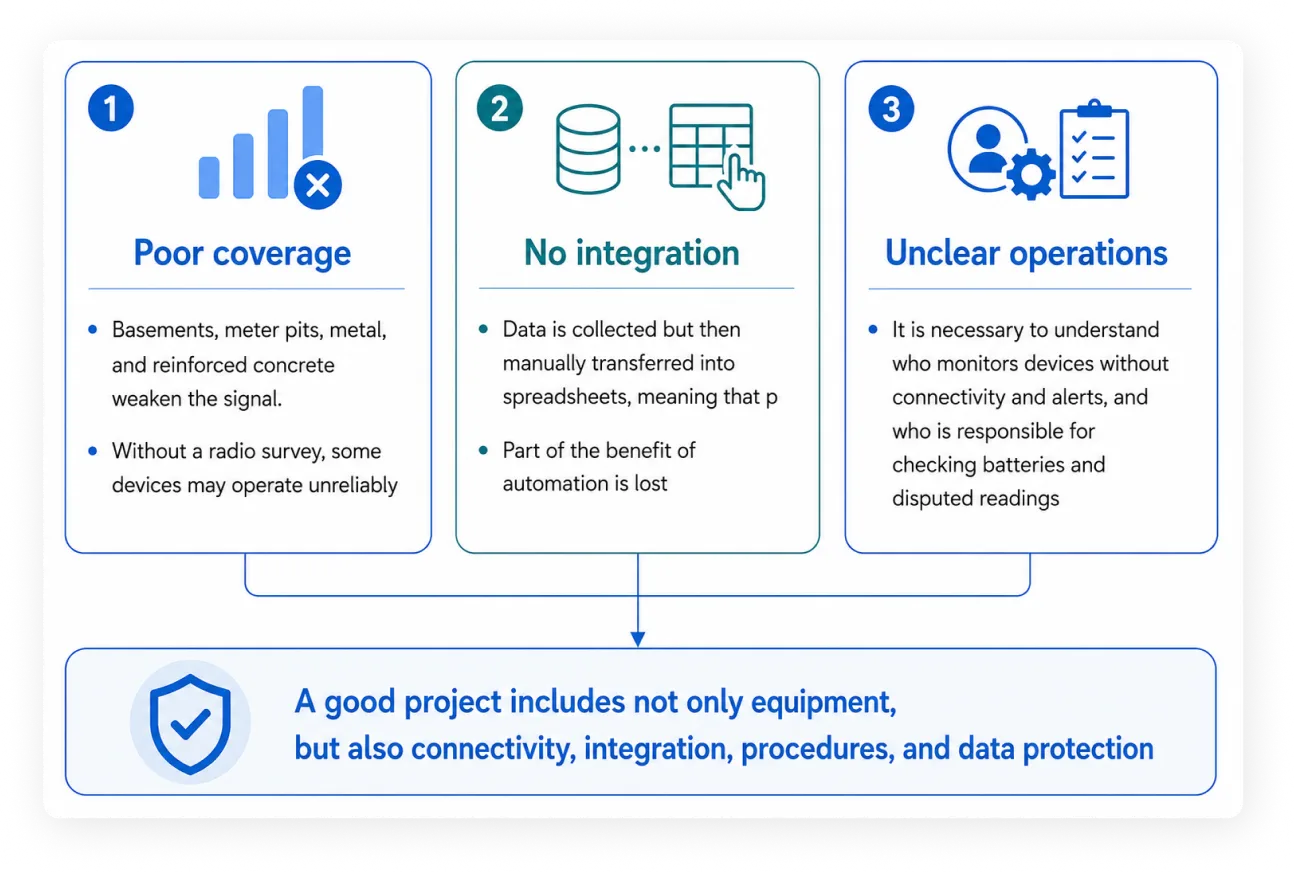
What Risks Should Be Considered
After implementation, it is important to look beyond the number of connected meters. More useful indicators of increased operational efficiency are the relevant metrics: the share of successfully received readings, the number of offline devices, the number of manual adjustments, the time required to close the billing period, the number of billing-related inquiries, and the number of site visits per thousand metering points.
For water supply, it is also worth monitoring nighttime consumption, continuous leaks, and the difference between master and individual metering. For electricity, key indicators include load profiles, overloads, and signs of tampering. For gas and heat, it is important to track transmission stability, seasonal deviations, and the correct operation of metering units.
These indicators help not only to demonstrate payback, but also to manage the system after launch. If data is received reliably but manual operations do not decrease, the problem lies in the processes, not the equipment. If the successful data collection rate falls, coverage, transmission settings, or device condition should be checked.
Remote meter reading reduces operational costs, including labor cost savings, when it is integrated into a company’s actual processes: it reduces the number of site visits, minimizes manual data entry, speeds up billing, helps detect losses earlier, and decreases the number of disputes.
For utility providers, property developers, municipalities, and homeowners’ associations, an automated utility management system is not merely a technological upgrade, but a way to make metering more efficient, transparent, and financially predictable.
Was it helpful?
 111
111


Stay on top of the latest industry news
Thank you, we have received your message. Our manager will contact you shortly.


Thank you, we have accepted your request. In the near future the responsible manager will contact you and clarify the details of the order.