31.08.2026
 28
28
28
Why Smart Metering Projects Need a 10-Year Operation Strategy
28
Smart metering is often viewed too narrowly, simply thought of as a way for utility providers to automatically collect meter readings and transmit them to a system.
At the pilot stage of a metering project this view may appear accurate, with a device sending data, a platform displaying a chart, and a resource provider seeing the first results. But after several years of use, it becomes clear that smart metering is not just a set of meters, but long-term infrastructure that must be maintained, developed, updated, and integrated with other systems.
For municipalities, developers, utility companies, and resource providers, a 10-year horizon is more realistic than a short-term equipment installation plan. Devices require field maintenance, operating on sites for years. In addition, batteries must support the selected data transmission frequency, the network must cover difficult areas, and the software platform must support new scenarios, reports, integrations, and user roles.
If this long-term strategy is not planned in advance, the project may start as a modern digital solution, but ultimately turn into a fragmented device fleet that, without adequate smart meter management, becomes difficult to control.
Smart metering projects live longer than a single budget cycle. During this time, tariff models, reporting requirements, cybersecurity approaches, communication standards, site structures, team composition, and user expectations may all change. That’s why an operation strategy should answer not only the question of how to launch the system, but also how it will operate and evolve as part of a smart grid in 3, 5, and 10 years.
The market in this sector confirms the long-term nature of such investments.
According to the Smart Meter Market Report 2026, the global smart meter market may reach $43.95 billion by 2030, with a compound annual growth rate of 8.9%. The report highlights investments in smart utility infrastructure, the development of AMI meters, the expansion of smart gas and water metering, and integration with energy management platforms among the growth drivers.
The gas metering segment is growing separately as well. According to the Smart Gas Meter Market Report 2026, the smart gas meter market may reach $6.72 billion by 2030, with a CAGR of 7.7%. This shows that resource providers are increasingly treating digital metering as an infrastructure direction rather than a one-time modernization of metering devices.
A comprehensive smart metering project includes several layers:
The first is subscriber-side devices: smart meters, radio modules, sensors, batteries, enclosures, antennas, and interfaces for connecting to existing metering devices.
The second layer is communication: LoRaWAN, NB-IoT, or another technology, gateways, SIM profiles, coverage zones, signal parameters, and redundancy.
The third is the software layer: the platform, dashboards, logs, notifications, reports, APIs, firmware updates, and integrations.
The final layer is operation: roles, regulatory compliance, service routes, staff training, emergency handling, and data analysis.
If one of these layers is not properly designed, the system loses stability. For example, it’s possible to:
For these reasons, a 10-year strategy should describe both the equipment list, as well as the entire architecture: devices, network, platform, data, integrations, and operational processes.
The first element is an asset and metering point map. For a residential complex, this includes entrances, floors, basements, utility rooms, meters, cabinets, and equipment installation points. For a district or municipal infrastructure, it will involve houses, pumping stations, heating substations, manholes, transformer substations, commercial premises, and utility facilities.
Accurate asset tracking will rely on this map being kept up to date when new sites are added, meters are replaced, new zones appear, and devices are moved or decommissioned.
The second element is the communication model. For LoRaWAN, it’s necessary to plan the placement of base stations, coverage, redundancy, installation height, antennas, difficult zones, and network expansion. For NB-IoT, this includes operator coverage, tariffs, SIM profiles, and network availability in actual installation locations, including basements, metal cabinets, and utility rooms.
Over a 10-year horizon, it’s important to consider that the number of devices may grow, while requirements for data transmission frequency and data quality may change.
The third element is the platform and data. At the beginning, the project may be limited to viewing readings, but over time, the customer needs reports, notifications, user roles, exports, and integration with billing, SCADA, ERP, CRM, or BI systems. Therefore, the platform should not only collect data, but also help manage the device fleet, identify problem areas, analyze history, and support new scenarios.
In Jooby projects, this requirement for meter data management is performed by Jooby RDC Dashboard. The Jooby RDC ecosystem includes LoRaWAN and NB-IoT radio modules, sensors for analog meters, smart meters, LoRaWAN base stations, and a software platform for collecting, displaying, and further transmitting data. Using this type of system data management system makes it possible to build smart metering as a complete system, rather than a set of separate devices.
A smart metering pilot should not be just a demonstration of data transmission. Its purpose is to check whether the selected architecture can withstand the real conditions of future deployment. To do this, the pilot should include typical, borderline, and problematic points.
Typical points show how the system works under standard conditions. Borderline points help assess coverage margin and autonomy. Problematic points in smart meter asset management reveal weak spots: basements, metal cabinets, weak signal, difficult access, different meter models, non-standard sensor mounting, or the need for an external antenna.
During the pilot, it’s important to test not only the fact of data transmission, but also communication quality, the percentage of successful transmissions, retransmissions, battery life and consumption, ease of installation, reading accuracy, notification performance, staff response, and the ability to integrate with the customer’s systems.
If these issues are not tested at a small scale, they will become expensive and difficult to fix during mass deployment.
The most expensive mistakes often arise from underestimating site conditions, rather than the choice of technology. On a plan, all points may look the same, but in reality, one meter is located in a dry utility room, another in a basement behind a metal door, a third in a manhole, and a fourth in a cabinet with poor radio signal.
For LoRaWAN projects, RSSI, SNR, the percentage of successful transmissions, and coverage margin should be measured in advance. For NB-IoT, this means checking the operator’s signal level, the stability of device registration in the network, and device behavior indoors.
If conditions are difficult, the solution may require relocating the device, using an external antenna, adding another base station, choosing a different installation scenario, or selecting another communication technology.
This kind of investigation is especially important for municipalities and utility companies. Their sites are often distributed across a territory, have different access conditions, and may be serviced by different contractors. Without a survey of problem areas, the project will scale unevenly: some areas will work reliably, while others will constantly require on-site visits.
A smart metering project cannot be assessed only by the cost of a meter or radio module. The full cost includes the site survey, pilot, installation, base stations, connectivity, platform, integrations, support, battery replacement, staff training, on-site visits, updates, and system expansion.
Over a 10-year horizon, it’s especially important to separate capital and operating expenses in advance. Capital expenses include devices, base stations, installation, initial configuration, and integrations. Operating expenses include maintenance, connectivity, platform support, device replacement, service team work, data quality control, and integration support.
If the budget is calculated only for equipment procurement, the project will quickly face a shortage of resources for operation. For example, batteries should be planned based on the actual data transmission mode, not on the promised maximum service life. The more often a device sends data, the higher the load on the battery. As such, the data transmission frequency should be linked to the business objective, where scheduled readings may be sufficient for billing, while emergency events require a separate notification logic.
Even a high-quality platform cannot replace clear roles and a trained team. A long-term strategy should define in advance who is responsible for devices, maintains base stations, checks missing data, responds to emergencies, manages the asset directory, manages access rights, is responsible for integrations, and decides whether an on-site visit is required.
Training should cover more than just the platform interface. The team should understand what device statuses mean, how to interpret data gaps, when a problem is related to communication, when it’s related to the battery, when it’s caused by installation, and when it comes from an integration issue.
For a dispatcher, response scenarios are important. For an installer, installation rules and signal checks matter. For an administrator, user, report, and directory management are essential. For a manager, analytics, performance indicators, and budget planning are key.
Without training, smart metering remains a technical system understood by only a few specialists. Staff training turns it into a working tool for the entire organization.
The maximum value of smart metering appears when data is used for more than just billing. Regular readings help provide predictive maintenance for utilities, analyzing seasonality, comparing sites, detecting anomalies, planning repairs, monitoring losses, assessing network load, and forecasting consumption.
For a resource provider, this is an opportunity to move from a reactive model to a more controlled one, not only responding to complaints or missing readings, but also seeing problem areas in advance. For a management company, it means understanding the condition of a building and its engineering infrastructure. For a municipality, it provides data for planning district modernization, assessing the effectiveness of programs, and justifying investments as part of its long-term operations.
But for all of this to work, data must be high-quality, linked to the correct sites, protected from errors, available in history, and transmitted to the required systems. That’s why the operation strategy should include rules for working with data: who checks accuracy, how gaps are handled, where history is stored, which reports are generated, and which indicators are monitored regularly.
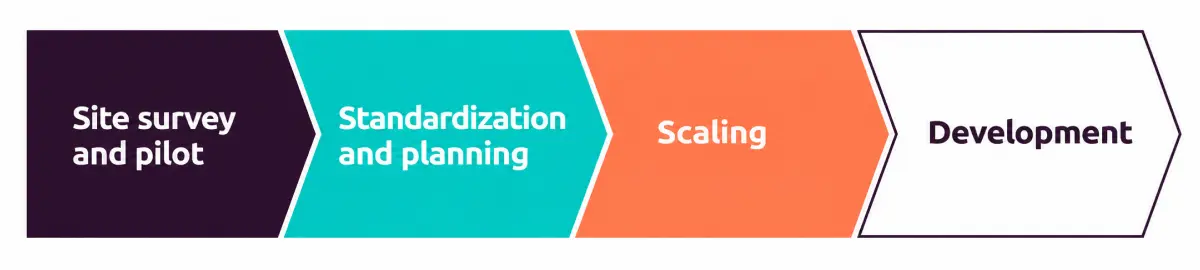
A practical operation strategy for a smart metering project can be built in stages:
At the first stage, the company surveys the sites, checks connectivity, selects technologies, launches the pilot, and defines success criteria.
At the second stage, it approves the installation standard, the list of compatible devices, service rules, user roles, and the integration model.
At the third stage, it scales the system in batches while monitoring installation and data quality.
Finally, it develops analytics, adds new device types, integrations, and scenarios.
Such a strategy should include several mandatory blocks: solution architecture, asset map, coverage plan, device list, platform requirements, integrations, operation model, life-cycle budget, training plan, data management rules, update plan, and expansion scenarios.
It’s also important to account for technological development and its impact on device lifecycle. Over 10 years, new meter models may appear, cybersecurity requirements may change, new communication modules may become available, the platform may be updated, and the range of analytical tools may expand.
The strategy should not lock the system into a single state, but instead provide a clear development path, including asset lifecycle management, without the need to rebuild the project completely every few years.
Smart metering delivers maximum value only when it’s treated as long-term infrastructure.
Automatic meter reading is important, but it’s not the only function. Real value appears when devices, connectivity, base stations, the software platform, team roles, integrations, and smart meter data management and analysis all work as a single system.
A 10-year strategy helps avoid typical mistakes, including underestimating problem areas, poorly designed operation, insufficient maintenance budget, weak staff training, and isolated data.
For municipalities, developers, utility companies, and resource providers, this approach to their utility asset management turns smart metering from a technical project into a tool for managing infrastructure, costs, and service quality.
Was it helpful?
 4
4


Stay on top of the latest industry news
Thank you, we have received your message. Our manager will contact you shortly.


Thank you, we have accepted your request. In the near future the responsible manager will contact you and clarify the details of the order.