27.01.2026
 1030
1030
1030
New Residential Developments: a Standard “Meters + LoRaWAN Gateways” Kit at the Construction Stage
1030
In new residential complexes, expectations from all parties involved have risen: utility providers want accurate data from fully automated meter reading systems, developers need controlled operation and a clear service cost model, and homeowners’ associations expect transparent billing and fewer disputes with residents.
Against this backdrop, remote meter reading is increasingly seen as infrastructure that logically belongs alongside electrical systems, low-voltage networks, and metering nodes, rather than a separate project after commissioning.
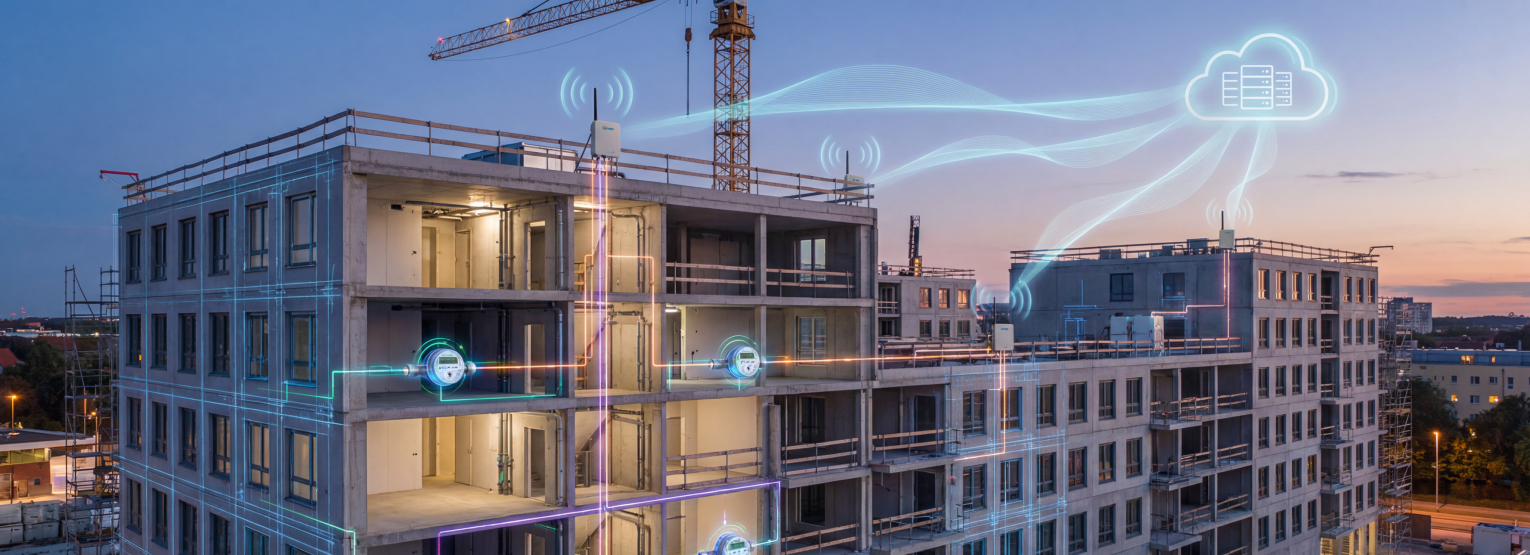
With remote reading no longer being an afterthought in development projects, the use of a standard meters and gateways kit is now being adopted as part of the construction stage: smart meters (or radio modules for meters) plus LoRaWAN gateways that connect apartment-level and building-level nodes to a server or platform.
Retrofitting an already occupied building is almost always more expensive, because access to shafts and technical rooms is harder, more approvals are required, labor costs are higher, and there’s a greater risk of “point” compromises in radio coverage. In addition, installation in a finished building often turns into several stages due to engineering systems that can’t be shut down for long.
During construction, it’s easier to make the network part of the building: to plan locations for gateways and antennas, power and redundancy, cable routes, access points to technical rooms, and to agree in advance where metering nodes will be installed (in apartments, corridors, ITPs, heating substations). This reduces implementation costs and increases repeatability from one project to another.
A wireless metering infrastructure kit includes water/heat/electricity meters with support for remote data transmission (or meters plus external radio modules), LoRaWAN gateways, and the server side (network server/application) that receives telemetry and passes it to the billing or dispatch systems. Once in operation, this provides regular automatic readings, historical archives, and anomaly detection.
In terms of smart utility meters for developers, standardization is key, and they benefit from uniform installation requirements, clear rules for gateway placement, and a single approach to software integration. For utility providers, construction-ready metering systems mean a predictable data model and the ability to scale a project from a single building to an entire district or city without a multitude of protocols.
In multi-storey buildings, connectivity is influenced less by abstract kilometers and more by the environment. This will usually involve reinforced concrete floors, elevator shafts, the density of engineering communications, and the placement of meters in niches and cabinets.
Community practice and engineering discussions often mention significant signal losses when passing through walls and slabs, and advise relying on radio surveys or a pilot on a typical floor rather than on the idea of using one gateway for the whole building.
When it comes to infrastructure planning for housing projects and calculating the required number of gateways, there is no “one size fits all” figure.
Open guidelines for LoRaWAN residential networks repeatedly emphasize the same idea: first assess the building’s geometry, device density, and environmental interference, then take measurements, and only then fix the placement scheme. This approach avoids overpaying for unnecessary points while preventing blind zones.
For buildings of different heights, key parameters are antenna installation height, shielding obstacles, and the vertical permeability of floor slabs. It’s also emphasized that incorrect height or placement of a gateway can drastically degrade results even with the same hardware, while proper positioning (including by height) is one of the cheapest ways to improve coverage.
Is capacity reserve necessary? Yes–if you plan not only meters, but also expansion for leak sensors, smoke detectors, air quality monitoring, and technical room supervision.
Semtech’s research on LoRaWAN capacity shows that scalability depends on gateway density, data rate/ADR settings, and the share of confirmed messages (downlink is limited by duty-cycle regulations). Therefore, it’s simpler and cheaper to build in reserve architecturally: with multiple gateways, the right message profile, and minimizing “ACK-by-default.”
The economics surrounding smart metering for new residential projects are built from small factors that together create a noticeable positive effect. These include fewer manual rounds, a reduction in errors and repeat visits, faster detection of anomalies and losses, and easier reconciliation of bills.
In addition, reports and business cases on AMI/AMR usually highlight reduced costs for meter-related operations and transport/work, as well as further benefits such as improved accounting and loss detection.
There is another important aspect for developers: when the metering system is standard and automated, a building is easier to hand over for operation—there are fewer manual procedures and less dependence on specific contractors.
For homeowners’ associations, this often results in improved relations with residents as a result of data being available regularly, fewer disputes, and the availability of consumption history. All of this helps resolve issues based on facts rather than words.
Even though specific regulations vary by country and city, the general trend is clear: remote readability and more frequent consumer information are becoming an expected standard in smart city-ready housing. In European energy-efficiency regulation, for example, requirements have been introduced for remote-readability of new heat meters and allocators, along with deadlines for upgrading existing devices.
The second mandatory aspect relating to wireless utility networks is data and security. Data protection documents explicitly state that smart meter data may be considered personal, as it’s linked to an identifiable user and reflects consumption patterns. This means that access control, storage, and data minimization must be designed in advance.
At the same time, attention to the cyber resilience of devices and gateways in metering systems is increasing, with industry and standardization materials frequently referencing requirements and frameworks such as IEC 62443 for components and processes.
A meters + LoRaWAN gateways kit built in during construction is not about “trendy IoT,” but about controlled operation of standardized metering systems and a clear economic model for years ahead.
As well as reducing retrofit costs, LoRaWAN deployment in new builds simplifies life for utility providers, makes the work of homeowners’ associations more transparent, and gives developers a technologically advanced building with a future-proof utility infrastructure. And all of this can be achieved without painful retrofits after occupancy.
With an engineering-driven approach–radio surveys, capacity planning, growth reserve, and compliance with data and security requirements–such infrastructure for scalable residential metering becomes a stable foundation: first for remote meter reading, and later for expanding “smart” services throughout the entire residential complex.
Was it helpful?
 226
226


Stay on top of the latest industry news
Thank you, we have received your message. Our manager will contact you shortly.


Thank you, we have accepted your request. In the near future the responsible manager will contact you and clarify the details of the order.