23.05.2025
 1732
1732
How LoRaWAN and NB-IoT Help Reduce the Carbon Footprint of Smart Cities
1732
The issue of sustainable urban development has become increasingly urgent. Urbanization, population growth, and rising resource consumption are all pushing municipalities and utility providers to seek new approaches to infrastructure management.
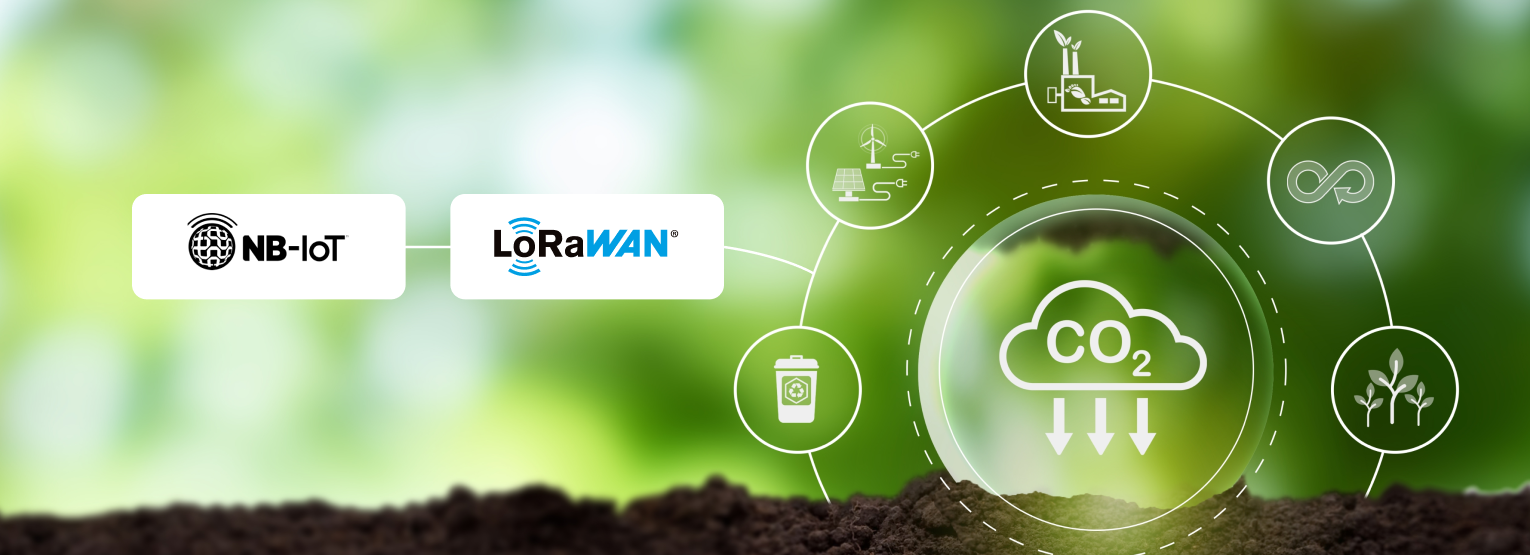
One of the most effective solutions comes from Internet of Things (IoT) technologies—specifically, LoRaWAN and NB-IoT. These wireless communication standards enable real-time data collection from sensors and devices, but how exactly do they help reduce the carbon footprint and make cities more environmentally friendly?
In this article, we’ll explore emission-aware urban planning, specifically, how LoRaWAN and NB-IoT contribute to resource optimization, improved energy efficiency, and reduced environmental impact. We’ll also look at why these technologies are becoming essential for developers, utility providers, and homeowners’ associations as part of sustainable IoT networks.
The most obvious application of LoRaWAN and NB-IoT is remote data collection from water, heat, gas, and electricity meters. Smart meters equipped with radio modules eliminate the need for manual meter readings and allow real-time consumption monitoring. This enables quick detection of leaks, anomalies, and inefficient usage.
For end-users, LoRaWAN smart cities result in transparent billing and the ability to optimize their own consumption behavior. For utility providers, they provide reduced technical losses and lower operating costs.
Ultimately, this leads to reduced energy consumption and, consequently, fewer CO₂ emissions associated with the production and delivery of resources.
Street lighting, heating, ventilation, and water supply systems can all be integrated into a unified IoT network using LoRaWAN and NB-IoT for energy optimization. For instance, smart lighting energy savings are made by using light and motion sensors that enable streetlights to turn on only when needed, significantly reducing electricity consumption. This directly reduces greenhouse gas emissions, especially in regions where electricity is generated from fossil fuels.
IoT technologies and the way in which they facilitate smart city emissions reduction, also allow for more flexible building heating management. For example, network-connected heating nodes can automatically adjust heat delivery based on outdoor temperatures and occupancy. This not only enhances comfort but also reduces unnecessary energy use, lowering the carbon footprint of residential and administrative buildings.
A key advantage of LoRaWAN and NB-IoT smart city solutions is their extremely low energy consumption, with sensors using these protocols operating for up to 10 years on a single battery. This is crucial in urban environments, where thousands of devices need to work autonomously without frequent battery replacements.
This approach significantly lowers maintenance costs and reduces the environmental impact of battery disposal. Additionally, reducing the need for technical maintenance lowers logistics and specialist travel, further cutting CO₂ emissions.
LoRaWAN and NB-IoT enable real-time monitoring of air quality, noise levels, humidity, dust concentration, and other parameters. This allows for prompt responses to environmental deterioration in specific city areas—for example, restricting traffic during peak hours or increasing green space efforts.
By using low-power IoT urban monitoring, municipalities gain not just monitoring tools, but the ability to make informed, data-driven decisions. This kind of timely, targeted response avoids excessive measures, reduces overall environmental impact, and ensures more efficient resource use.
For developers and homeowners’ associations, implementing LoRaWAN and NB-IoT technologies is both an ecological investment and a competitive advantage. New residential complexes and renovated buildings with smart infrastructure attract residents who value energy efficiency and lower utility bills.
Integrating IoT sensors during the construction phase enables transparent management, preventative maintenance, and reduced building operation costs. It also makes real estate more resilient to tariff policy changes and evolving regulations aimed at reducing greenhouse gas emissions.
LoRaWAN and NB-IoT are not just data collection technologies, they are the infrastructural foundation for the smart, sustainable, and efficient cities of the future. Through the use of real-time resource monitoring, they enable informed and responsible decision-making at all levels—from individual apartments to city administrations.
For utility providers, developers, and homeowners’ associations, eco-friendly IoT deployment offers an opportunity to both cut costs and contribute to combating climate change as part of smart-city sustainability plans.
As environmental standards become stricter and public awareness grows, such solutions for the creation of climate-friendly urban infrastructure are becoming essential.
Was it helpful?
 288


Stay on top of the latest industry news
Thank you, we have received your message. Our manager will contact you shortly.


Thank you, we have accepted your request. In the near future the responsible manager will contact you and clarify the details of the order.