18.09.2026
 64
64
IoT Infrastructure for Apartment Buildings and Homeowners Associations: From Meters to Data Management
64
In an apartment building, utility metering depends on more than just properly functioning meters.
Residents submit readings on different days, some apartments remain inaccessible for inspections, and discrepancies between total building consumption and the sum of individual apartment readings can be difficult to explain. In addition, any queries have to be investigated manually by property managers, often after charges have already been calculated.
Internet of Things (IoT) infrastructure helps establish a far more efficient process: devices capture readings, the network delivers them to a server, and a software system records consumption history and flags anomalies.
However, installing radio modules alone to enable remote utility monitoring does not solve every problem. Reliable operation also requires the equipment and data transmission channels to support the everyday tasks of those responsible for maintaining the building.
For a homeowners’ association—an association of co-owners in an apartment building—the priority may be a clear overview of the utility consumption balance and less manual meter reading. Utility providers need complete data and reliable transfer to their billing systems. Developers need to plan equipment and installation locations during the design stage, while municipalities need comparable information across multiple buildings.
These objectives are related, but they require different configurations. Monthly billing requires reliable readings as of an agreed date. Analysing nighttime gas, water and electricity consumption data requires a more detailed history. And detecting water on the floor requires a separate leak sensor as changes in meter readings can reveal suspicious consumption, but they can’t reliably pinpoint the location of a leak.
Before purchasing equipment for IoT utility monitoring, stakeholders should agree on who owns the devices, pays for connectivity, receives alerts, and arranges repairs. For example, an alert about continuous consumption is only useful if someone is responsible for investigating it. Otherwise, the building gains a digital log of problems while maintenance procedures remain unchanged.
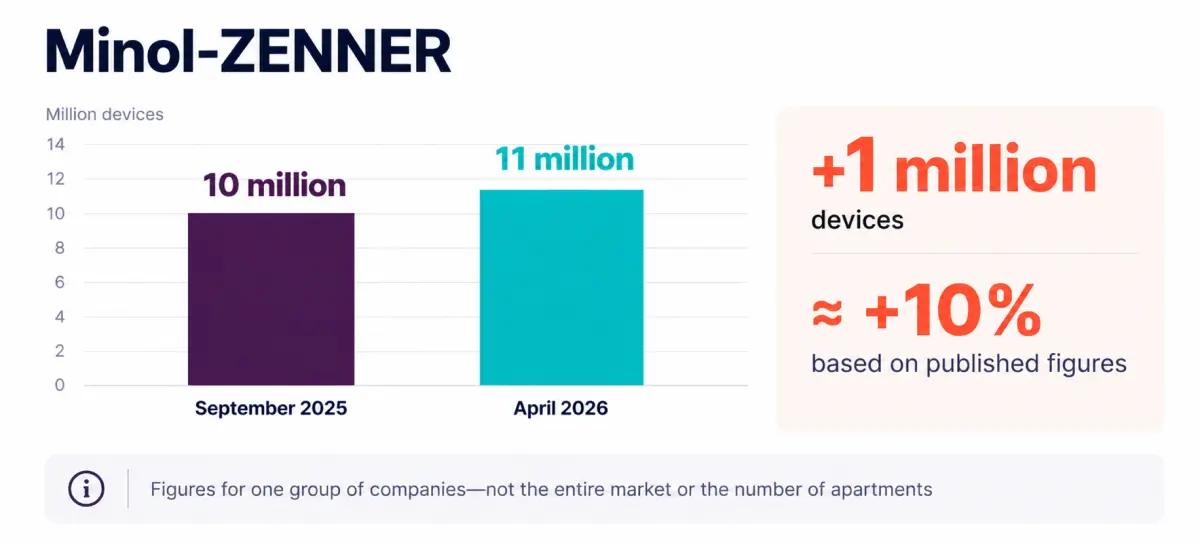
Wireless metering is already used in large infrastructure projects for utility billing data integration. In September 2025, the Minol–ZENNER Group reported connecting the ten-millionth device to its LoRaWAN network. In April 2026, the company announced that it had 11 million active devices.
These figures refer to just one group of companies, not the entire market or the number of connected apartments, showing that the scale on which the technology is being used goes well beyond pilot installations.
For an individual building, the key question is the quality of the specific project. Being part of a large network does not guarantee reliable connectivity in that building’s basement, compatibility with its meters, or financial benefits for the homeowners association. All of these factors need to be verified on site before a full rollout.
LoRaWAN Network Scale
The project starts with a register of metering points. For each point, record the meter model and serial number, the utility being measured, its location, the available reading method, and installation conditions. In an occupied building, meters may differ even between neighbouring apartments, so the number of apartments does not equal the number of identical equipment kits required.
A properly functioning meter doesn’t always need replacing. If its design supports a compatible pulse output, optical reading, or another supported reading method, a suitable radio module with a built-in or external sensor can be installed. If no compatible solution is available, or the meter is approaching its scheduled replacement date, compare the cost of retrofitting it with that of a new meter with built-in connectivity.
Compatibility must be checked against the exact model, rather than just the manufacturer’s brand. For a pulse connection, the volume or amount of energy per pulse, initial reading, and units of measurement must be configured correctly. An error at this stage can compromise metering even if radio communication works perfectly.
Basements, utility rooms, and enclosed cabinets should be surveyed at the same time. Check the availability of electrical power and a connection between the gateway and server, either over the internet or through a private IP network. For a new building, these requirements are best incorporated into the design in advance. For an occupied building, arrange access to apartments and organise installation by building entrance.
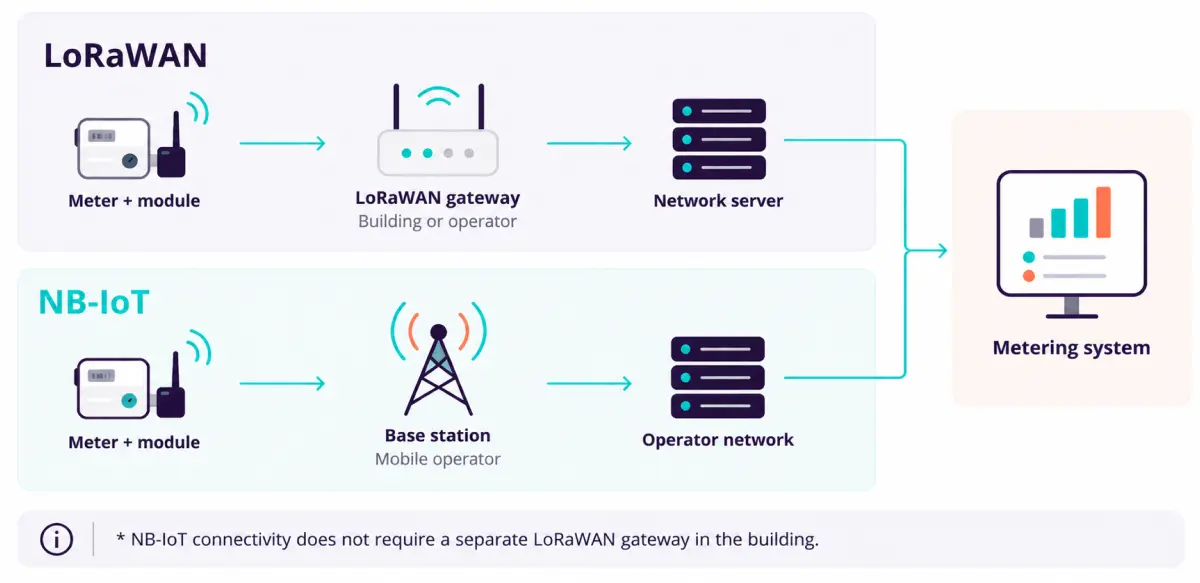
LoRaWAN smart metering allows you to deploy your own network with one or more gateways or connect to an available operator network. Radio modules transmit messages, smart meter gateways forward them to a network server, and the data then reaches the application system.
For a compact group of buildings, dedicated LoRaWAN network infrastructure can be convenient: the same gateways serve many compatible devices. Their power supply, connectivity, and maintenance then become part of the project.
NB-IoT uses a mobile operator’s cellular infrastructure. Devices, such as smart water meters, connect to it without a separate LoRaWAN gateway in the building. This approach is worth considering for dispersed sites or locations where installing your own network equipment is difficult.
Before choosing it, check whether the selected operator offers an NB-IoT service, whether the frequency bands are compatible, and what conditions apply to connecting devices.
Two Ways to Transmit Meter Readings
Neither technology guarantees reception in every basement. Reinforced concrete, metal doors, and cabinets can significantly affect connectivity. Testing should be carried out with the selected device at the actual installation point, with doors closed. The mobile signal strength shown on a phone is no substitute for testing an NB-IoT module.
The number of LoRaWAN gateways in residential IoT solutions can’t be determined solely by the number of floors or the advertised range. It should be based on a site survey and trial operation, taking into account device locations, message traffic, and reliability requirements.
Automated meter reading systems can use a mixed setup across several buildings if the software system supports receiving and processing data from both networks.
It’s important to distinguish between how often readings are recorded and how often they are transmitted. A device may store an hourly history but send it in several messages per day, provided the model supports this function. This makes detailed data available without constant radio transmissions.
All other things being equal, more frequent transmissions increase the number of communication sessions and usually raise energy consumption. The actual impact depends on message size, retransmissions, and the device’s operating mode.
Battery life also depends on operating conditions and power-saving settings. The stated operating life should therefore be assessed alongside the conditions used to calculate it. Experimental studies confirm that device and network parameters affect NB-IoT energy consumption.
For emergency events, the acceptable notification delay should be defined separately and tested in practice. A remote metering system p should not automatically be treated as a flood protection system. If the water supply needs to be shut off when a leak occurs, suitable sensors, actuators, and validated control logic are required, including operation without external connectivity.
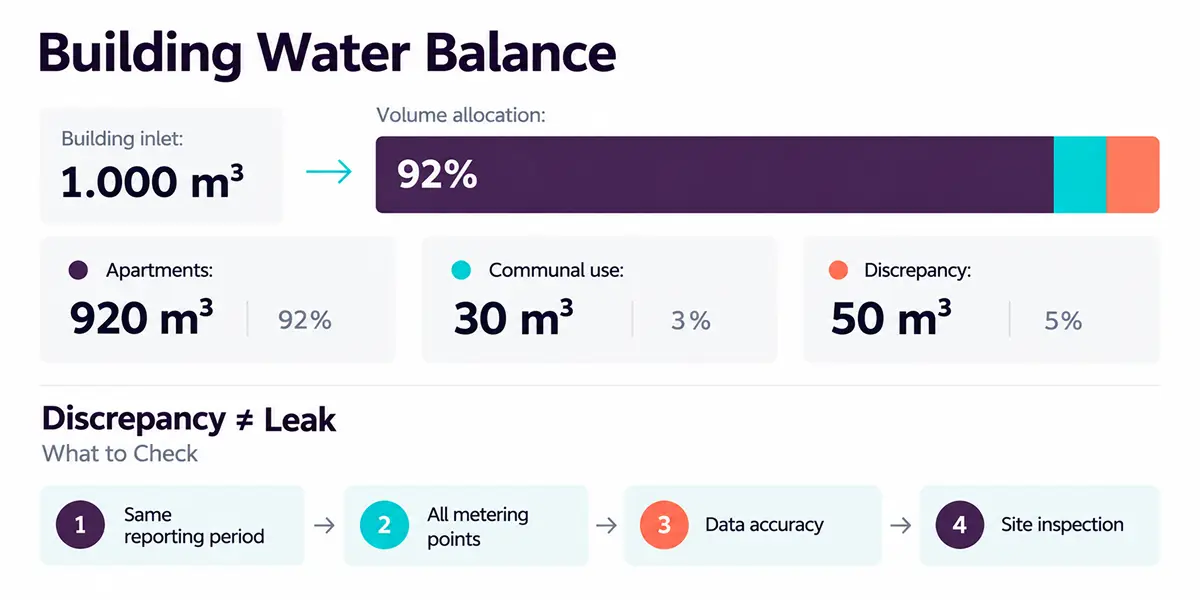
One useful task for a homeowners association is to compare the volume of water entering the building with apartment consumption and separately metered communal use. The volumes must cover the same period and the same metering boundary. If the main meter is read on the first day of the month while apartment readings are collected over a week, part of the discrepancy may be explained by the different reading dates.
Consider a hypothetical example: all consumption points are accounted for, the volumes cover the same period, and communal use is excluded from apartment readings. The main meter records 1,000 m³, apartment meters record 920 m³, and a separate meter for communal use records 30 m³. The remaining discrepancy is 50 m³, or 5% of the incoming volume. This is the result of the example, not a standard for acceptable losses.
A discrepancy requires investigation, but it does not by itself prove that there is a leak.
Possible causes include incomplete data, incorrect meter assignments, measurement errors, or actual losses. The distinction between physical losses and metering errors underpins AWWA’s approach to water auditing. First, check that readings are complete and consistent, then analyse consumption patterns and inspect the selected sections of the system.
Investigating the technical causes of a discrepancy and allocating volumes for billing are separate tasks. Charges are calculated under the applicable rules for billing metering and consumption allocation. In Ukraine, the allocation of water consumed within a building is governed, among other provisions, by Article 10 of Law No. 2119-VIII.
Remote Water Metering
For utility data management, on the server each device must be linked to a specific meter, premises, and account. When a meter is replaced, its history must be preserved, and new readings processed with the replacement date and initial reading taken into account. Otherwise, a fully functioning network will deliver data that can’t be used correctly.
The interface must distinguish between zero consumption, a loss of connectivity, and outdated readings. The last received value mustn’t be presented as current without a timestamp. Useful operational features include a data reception history, alerts when a device hasn’t reported for an extended period, battery information, and a change log.
Utility providers need verified data transfer to their billing systems, while homeowners associations require clear reports for their buildings. Having an application programming interface, or API, doesn’t mean that integration is ready. Data formats, units of measurement, identifiers, and the handling of duplicate messages and missing data must be agreed in advance.
Access permissions should reflect each user’s responsibilities. Residents may have access to information about their own apartments, maintenance companies to equipment status, and authorised staff to the data needed for billing. The contract with the system provider should secure the ability to export historical data and transfer it when changing maintenance companies.
Jooby RDC is one option to consider for this architecture. Its catalogue includes sensors and radio modules that transmit data over LoRaWAN and NB-IoT, as well as smart meters and gateways. For an occupied building, equipment is selected to match the installed meters. For a new building, compatibility can be addressed when choosing the meters.
It should be noted that having both technologies in the product range doesn’t mean that every model supports both connectivity options.
Jooby RDC Dashboard provides access to reading histories, device information, and an event log, as well as supporting CSV report exports. An API is available for integration with external software. In a project involving IoT for homeowners associations, this can connect apartment meter reading collection with equipment monitoring and data preparation for metering and billing.
For the selected configuration, it’s necessary to confirm model compatibility with the platform, available events and monitoring parameters, and the scope and terms of API integration.
A battery-powered radio module doesn’t keep the entire system operational. During a power outage, the device may continue recording consumption, but transmission to the server depends on gateway or cellular network availability. For a privately operated gateway, backup power therefore needs to be assessed, while recovery procedures must be defined for the system as a whole.
It’s particularly important to check where historical data is stored and how missing data is recovered. Having onboard memory doesn’t guarantee that the full history will be transmitted automatically once connectivity is restored. This function should be verified through testing.
Cumulative readings can establish consumption over the missing interval, provided metering continued without a reset, meter replacement, or lost pulses. Without an archive, a detailed breakdown within that interval may be unavailable.
Maintenance planning should account for access to apartments, battery or module replacement, mounting checks, and updates to the meter register. Data protection also extends beyond the radio link: individual user accounts, restricted permissions, backups, and access revocation for staff or contractors who no longer maintain the building are all required.
Comparing proposals for smart metering for apartment buildings solely by the price of a radio module is not enough. Cost calculations for the chosen operating period should include the site survey, equipment, installation, gateways, connectivity, software, integration, and maintenance. Repeat visits and work inside apartments should be accounted for separately, as they can significantly affect the total cost.
The financial benefit of adopting digital infrastructure for property management is best calculated against the building’s current costs. How much time does collecting readings take? How often do errors need correcting? How much do inspection rounds and repeat checks cost? Potential reductions in water losses should be assessed separately: adding connectivity won’t reduce consumption if no one addresses the anomalies identified.
Before a full rollout, conduct a pilot covering challenging locations and equipment, such as the basement, upper floors, metal cabinets, and different meter types. Testing of building management systems should span several transmission cycles and an agreed metering period to verify both connectivity and report preparation.
Acceptance criteria should be defined in advance:
After acceptance, the client receives the device register, configuration settings, necessary access permissions, and maintenance procedures. For a developer, this is part of handing the building over for operation. For a homeowners association, it provides the foundation for ongoing management, and for a municipality, it enables a proven approach to centralized meter data collection that can be replicated at other sites.
Effective IoT infrastructure for apartment building automation starts with clear objectives, compatible meters, and clearly assigned responsibilities. The choice between LoRaWAN and NB-IoT metering depends on site conditions, while success is measured by the completeness of readings, ease of use, and maintenance costs.
A phased rollout of infrastructure for wireless meter reading allows these factors to be verified before substantial investment. It also helps create a system that supports a better understanding of utility consumption and informed decision-making.
Was it helpful?
 5


Stay on top of the latest industry news
Thank you, we have received your message. Our manager will contact you shortly.


Thank you, we have accepted your request. In the near future the responsible manager will contact you and clarify the details of the order.