15.09.2026
 39
39
39
What Is IoT in a Smart City: An Explanation for Municipalities and Developers
39
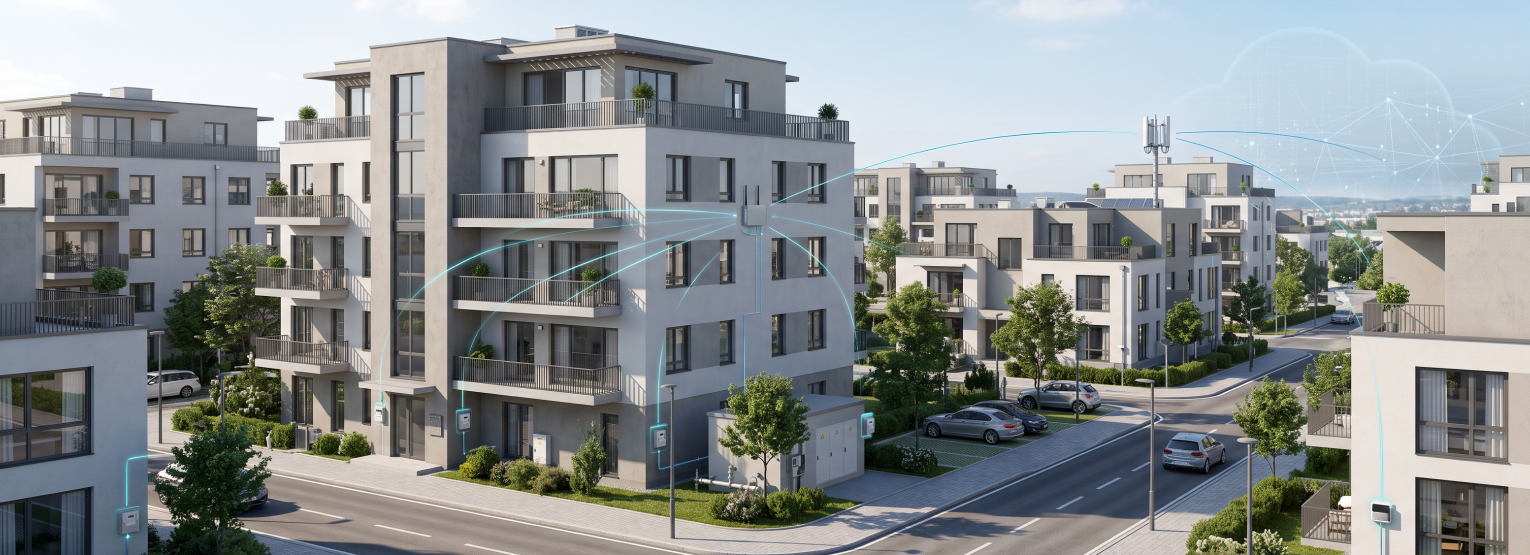
A smart city is often imagined as an urban environment with automated lighting, intelligent parking systems, digital displays, and apps for residents. But behind most of these services is a less visible infrastructure, consisting of sensors, meters, communication equipment, gateways, servers, and software systems that continuously collect data about the condition of physical assets.
This infrastructure is commonly referred to as the Internet of Things, or IoT. For a municipality, utility provider, property developer, or homeowners’ association, the value of IoT in smart cities doesn’t simply lie in having equipment that is connected to a network. Perhaps even more importantly, it’s about the ability to monitor infrastructure without constant manual inspections, detect abnormalities faster, and make decisions based on actual data.
The Internet of Things is a system in which physical devices automatically collect information and transmit it into a digital environment. A device can be a water meter, heat meter, temperature sensor, lighting controller, leak detector, or another type of equipment.
The European Commission defines IoT as a technology that connects the physical world with the digital environment: connected buildings and objects transmit information about their own condition and surrounding circumstances. At city scale, such devices become a distributed infrastructure monitoring system.
For example, a conventional water meter stores readings locally, which means an employee must physically access it. A smart meter, or a radio module installed on an existing meter, can automatically carry out remote meter reading several times a day. Depending on the architecture, the system can also detect reverse flow, tampering, prolonged periods of zero consumption, or other events.
The collected information can also be used for data-driven city planning, not just for billing. For example, when thousands of meters are connected to one system, a water utility can compare the volume of water supplied with total consumption, identify areas with elevated losses, and determine which sections require inspection.
Many other smart city solutions operate according to the same principle: sensors monitor parameters, a communication network delivers the data, and a software platform converts it into useful information for dispatchers, property management companies, or municipal services.
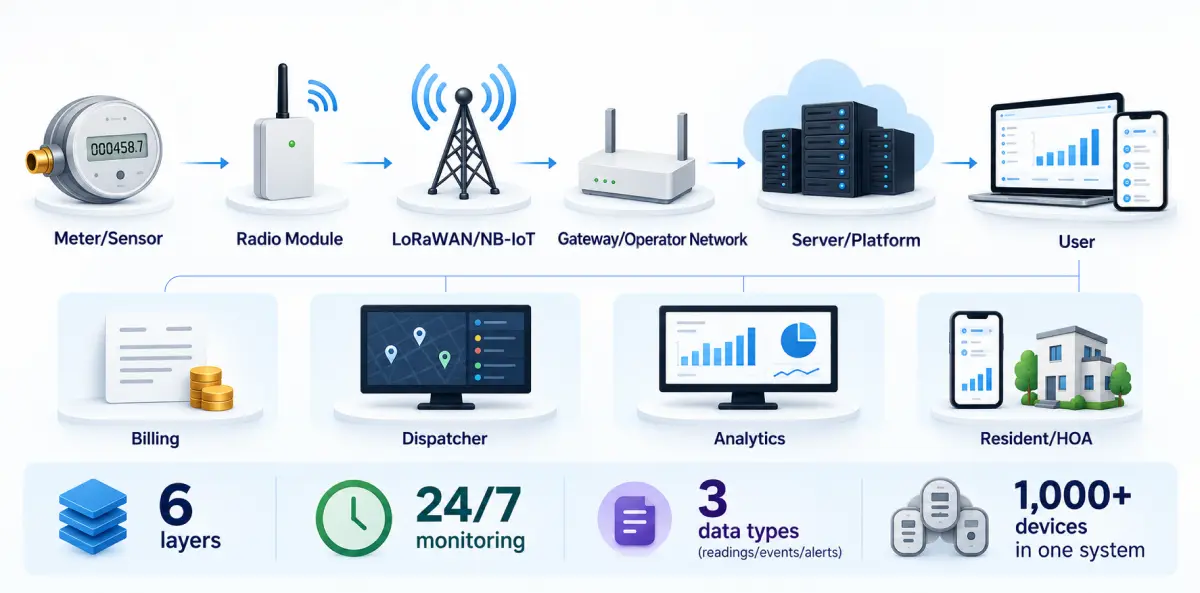
A complete solution cannot be reduced to a single “smart” device. There are several technological layers between measuring a physical parameter and displaying that information to an operator.
The first layer of smart city infrastructure is the devices themselves. These may include smart water, gas, electricity, or heat meters, radio modules used to modernize installed equipment, temperature, humidity, pressure, air-quality, or container-fill sensors, and other devices.
The next layer is data transmission. For urban projects, long-range, energy-efficient networks designed for thousands of devices transmitting small amounts of information are particularly important. These include LoRaWAN and NB-IoT.
In LoRaWAN wireless sensor networks, data from devices is usually received by gateways, which then forward it to a server. With NB-IoT, a device communicates directly with the mobile operator’s infrastructure. The information is then sent to the server layer, where it’s stored, processed, and delivered to application systems.
The final layer consists of applications and integrations. These may include dispatch systems, utility billing, building management systems, ERP, analytics dashboards, or municipal data platforms.
How IoT Works in a Smart City
One of the most mature use cases in municipal IoT projects is remote utility metering. In a study of smart-city projects across eight countries, GSMA notes that IoT smart metering already accounts for approximately half of all deployed IoT devices on average. This shows that a significant share of real-world urban IoT projects are associated not with experimental services, but with essential utility infrastructure.
For a water utility, smart water management using remote data collection can reduce the need for manual meter-reading visits, enable more frequent readings, and help detect unusual consumption faster. For a gas utility, the value lies not only in billing, but also in monitoring equipment condition and safety-related events.
In electricity supply, smart metering provides a more detailed picture of load and consumption. In district heating, a similar approach can help analyze actual heat usage in buildings and compare performance across different facilities.
However, IoT applications go far beyond metering. Municipal services can use sensors to monitor street lighting, air quality, water levels, technical rooms, or waste-container fill levels. In each case, the principle behind smart energy monitoring remains the same: periodic manual inspections are replaced by a continuous automated data flow.
For a property developer, the Internet of Things is particularly important at the design stage of a new development. If device installation locations, radio coverage characteristics, gateway placement, and integration with building engineering systems are considered in advance, digital infrastructure can be created together with the physical infrastructure.
Pre-planned use of IoT for developers is easier than adding it after the building is occupied. When modernizing existing buildings, installed meters, technical-room locations, basements, shafts, floors, and other factors that may affect radio transmission must be taken into account.
For homeowners’ associations and property management companies, the usefulness of a system is also determined by the number of installed sensors, as well as the processes they help improve. For example, remote metering can reduce the need for regular staff access to apartments and technical rooms, while leak sensors can provide earlier warning of a potential incident.
For this reason, any projects related to the digital transformation of municipalities shouldn’t begin with the question “Which sensors should we install?” but with “Which activities currently require too much manual work, are not performed frequently enough, or happen only after a problem has already occurred?”
Urban infrastructure is very different from home Wi-Fi. A meter may be located in a basement, manhole, or metal cabinet, transmit only a few small messages per day, and operate on battery power for many years. Therefore, high connection speed for smart city IoT is often less important than range, energy efficiency, and the ability to support large numbers of devices.
LoRaWAN allows an organization to build its own communication infrastructure. Radio modules and smart city sensors transmit data to gateways deployed in the area, and the gateways forward the messages to a server. This approach is convenient when the project operator wants to control the network independently and expand it gradually across a city, residential complex, or industrial site.
NB-IoT uses mobile operator infrastructure and licensed radio spectrum. A device doesn’t require its own LoRaWAN gateway: connectivity is provided by the operator’s network wherever the required coverage is available.
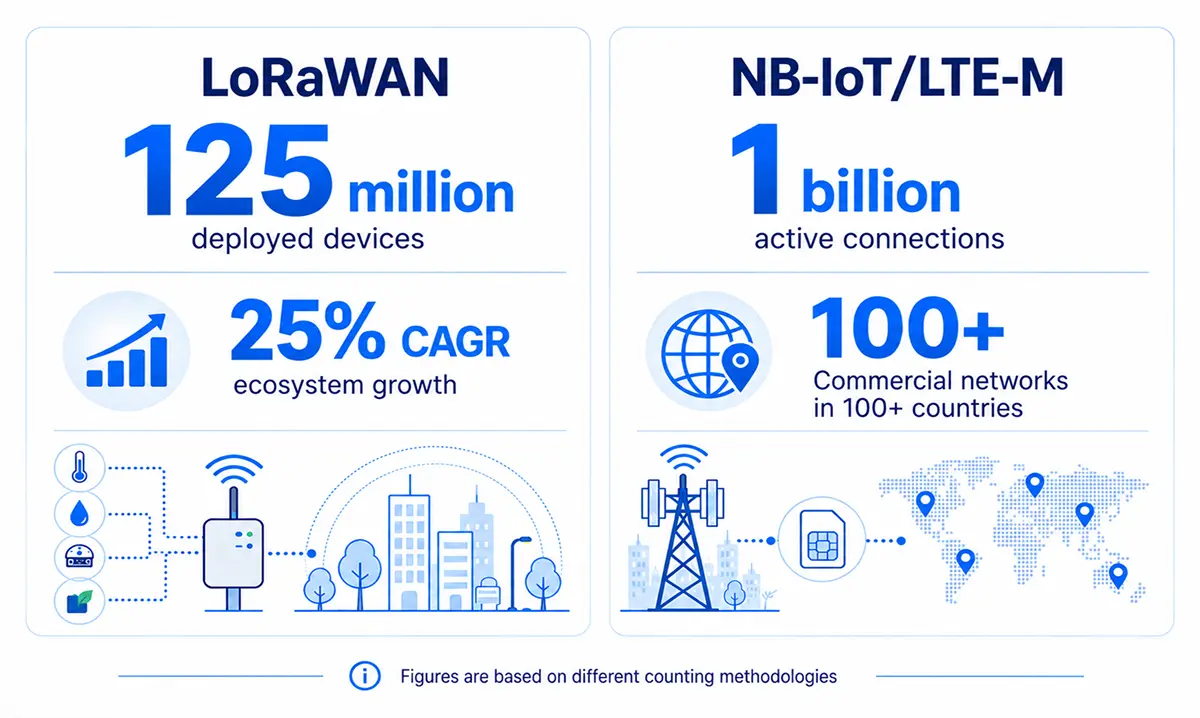
Both technologies are already used in large-scale systems. According to the LoRa Alliance, by the end of 2025 more than 125 million LoRaWAN smart city devices had been deployed worldwide, while the ecosystem’s compound annual growth rate was estimated at 25%. The organization lists smart metering, smart buildings, and smart cities among the largest application areas.
At the same time, GSMA reports that by the end of 2025 the number of active NB-IoT and LTE-M connections worldwide had reached 1 billion, while commercial networks using these technologies were available in more than 100 countries.
Scale of Energy-Efficient IoT Networks by the End of 2025
Not necessarily, and it would be a mistake to try to determine the “best” technology without considering the specific conditions of a given site.
For one district, a privately operated LoRaWAN network serving water meters, technical-room sensors, and other devices may be the most practical choice. In another project, existing NB-IoT infrastructure may already provide the required coverage, making the deployment of a private network unnecessary.
Large systems can also use a hybrid architecture. Different types of assets may use different data-transmission methods, while the information is unified at the server level. From the perspective of a municipality or management organization, having a single consolidated view of the data is much more important than forcing the entire infrastructure to operate on one radio standard.
For this reason, real connectivity conditions should be tested before purchasing equipment. Coverage maps are only a starting point: basements, manholes, reinforced concrete structures, and metal cabinets can significantly alter radio performance at the actual installation site.
In remote metering projects, this type of architecture can be built around Jooby RDC solutions. The portfolio includes radio modules and sensors for existing metering devices, smart meters, and equipment for data transmission via LoRaWAN and NB-IoT.
For LoRaWAN projects, gateways are available for building a private network, allowing the system to be adapted both to a single residential complex and to distributed utility infrastructure.This approach makes it possible to avoid replacing the entire installed meter base.
In some cases, a compatible meter can be equipped with a radio module or sensor and connected to a remote data collection system. The information is then transmitted to the server layer, where it can be monitored centrally and integrated with metering, dispatch, or analytics systems.
This is especially useful for phased modernization when a municipality, utility provider, or property management organization is not ready to replace equipment across all sites at once.
In urban IoT for municipalities, the cost of an error rises quickly as the number of devices increases. A solution that works reliably on ten devices in an office may not perform equally well across five thousand meters installed in different buildings.
For this reason, a pilot is usually carried out on a representative group of assets before mass deployment. It should include not only convenient installation points, but also basements, remote buildings, difficult technical rooms, and other locations where radio conditions may be challenging.
During the pilot, the project team evaluates communication quality, actual message-delivery frequency, battery consumption, installation procedures, device onboarding, and the correctness of data transfer into existing systems. It’s equally important to understand what happens in the event of a failure: how the operator detects missing data, who is responsible for diagnostics, and how quickly the source of the problem can be identified.
Only after such testing of smart city technology is it possible to estimate gateway requirements, coverage needs, installation effort, and operating costs more accurately.
Installing thousands of devices does not by itself make a city smart. If the data is sent to an isolated system that employees rarely use, the project remains little more than an expensive source of telemetry.
Practical value emerges when information becomes part of operational processes, with meter readings flowing into billing systems, emergency events into dispatch systems, and accumulated historical data into analytics tools.
The European Commission also treats system interoperability as one of the key principles of urban digitalization. European smart-city initiatives are developing local platforms and data spaces that allow public and private organizations to exchange information securely and reuse it across different services.
This is particularly important for long-term projects. Because the service life of urban infrastructure can be significantly longer than the life cycle of a particular software product, the ability to access data through standard interfaces and integrate a system with other platforms reduces the customer’s dependence on a single vendor.
When preparing an IoT infrastructure project, a municipality, utility provider, or developer should consider more than the price of a single sensor or meter. The total cost includes equipment, connectivity, server infrastructure, installation, configuration, integration, maintenance, and eventual device replacement.
It’s important to determine in advance which parameters are actually needed and how often they must be transmitted. With monthly billing and real-time leak detection requiring different data-transmission modes, the more frequently a device communicates, the greater the requirements placed on the network and power consumption.
Data ownership, retention periods, access rights, and information-security policies should also be defined in advance. This is particularly important where consumption data may be linked to a specific household or commercial property.
Finally, the project should define how success will be measured. Possible metrics include the share of readings collected automatically, the reduction in manual meter-reading visits, the speed of incident detection, lower non-revenue consumption, or greater accuracy in resource balancing.
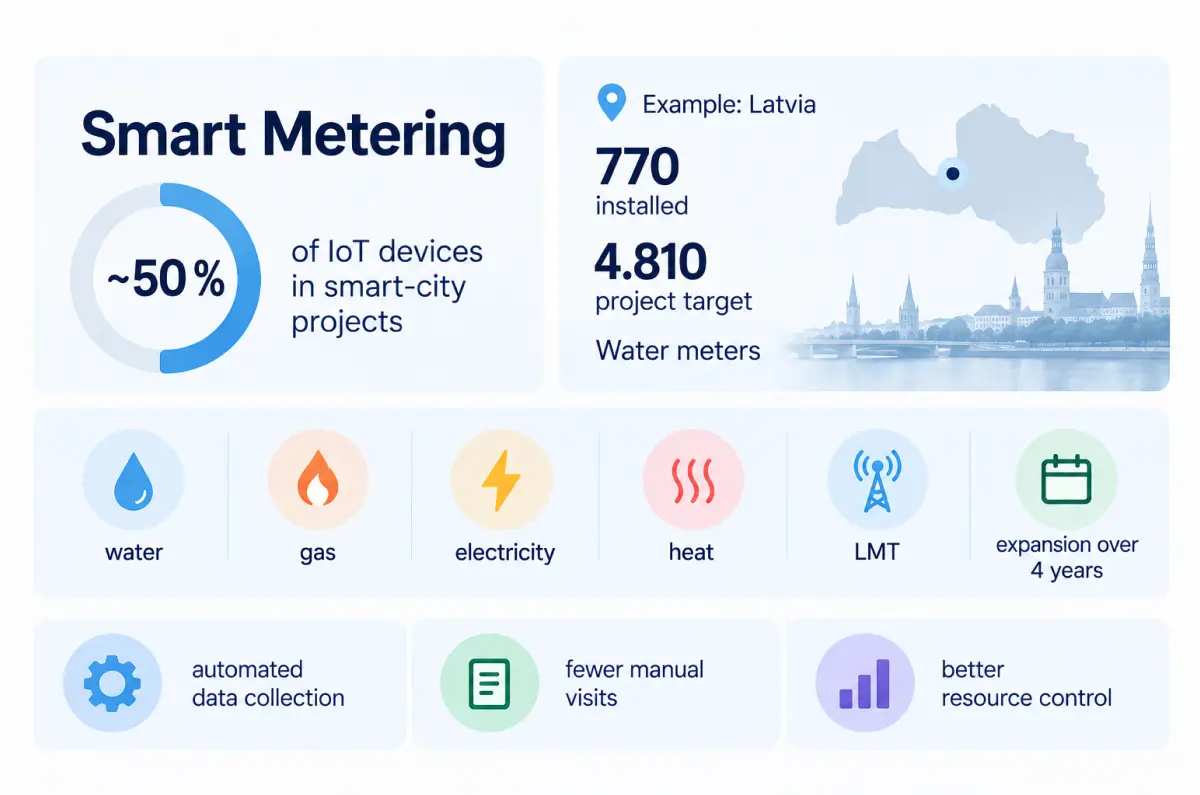
It’s telling that real smart-city projects are increasingly built around core utility tasks. According to GSMA data for 2025, smart metering accounts for approximately 50% of IoT devices in the smart-city projects across eight countries examined by the organization.
Individual projects show what this approach looks like in practice. In The Mobile Economy Europe 2025, GSMA cites an example from Latvia: operator LMT installed 770 ultrasonic water meters with NB-IoT in two cities and reported plans to add another 4,040 devices over the following four years. The goal of the project is to automate metering and billing, reduce manual meter-reading activities through real-time city monitoring, and improve urban resource-management efficiency.
Practical IoT in a Smart City
IoT is justified where there is a physical process that must be measured, monitored, or serviced regularly, and where manual data collection is too expensive, slow, or inconsistent.
For a utility provider, that process may be collecting readings from thousands of meters. For a municipality, it may be monitoring distributed urban infrastructure. A use case for a developer may be managing the engineering systems of a residential or commercial complex, while for a homeowners’ association, it may be monitoring utility consumption and the condition of technical areas.
At the same time, IoT should not become an objective in itself for utility data collection. If a problem can be solved more reliably and at lower cost without installing additional devices or creating new infrastructure, digitalization for the sake of digitalization has no economic value.
IoT in a smart city is not a single sensor or an app, but an interconnected infrastructure that transfers information from the physical environment into digital management systems. It delivers the greatest value where automated data collection replaces repetitive manual work, helps identify abnormalities earlier, and provides a more accurate picture of resource use.
For a municipality, utility provider, or developer, a sensible IoT project therefore begins not with choosing LoRaWAN, NB-IoT, or a specific device, but with defining a measurable objective, testing connectivity at real sites, and planning data integration carefully.
Once these objectives have been established, a pilot can be run that proves the solution is viable for smart city infrastructure management before scaling it.
Was it helpful?
 6
6


Stay on top of the latest industry news
Thank you, we have received your message. Our manager will contact you shortly.


Thank you, we have accepted your request. In the near future the responsible manager will contact you and clarify the details of the order.