07.09.2026
 628
628
628
Benefits of Smart Gas Metering for Resource Providers
628
Gas metering has long remained one of the most labor-intensive areas for resource providers. Until recently, data was collected manually by an inspector who would visit a site, record the readings, and then pass them to the metering system. The utility company then reconciled the information, looked for errors, and worked with delays.
While this method is suitable for a small subscriber base, it’s time consuming and scales poorly when thousands of apartments, private houses, commercial facilities, or distributed nodes of the gas network are involved.
Smart gas metering changes this model. Instead of periodic readings collected during inspections, automated billing systems give the provider regular data from metering points, allows them to see device statuses, and detects deviations faster using real-time monitoring.
In addition to their use for billing, readings can also be used for utility data analytics, procurement planning, anomaly detection, and reduction of operating costs.
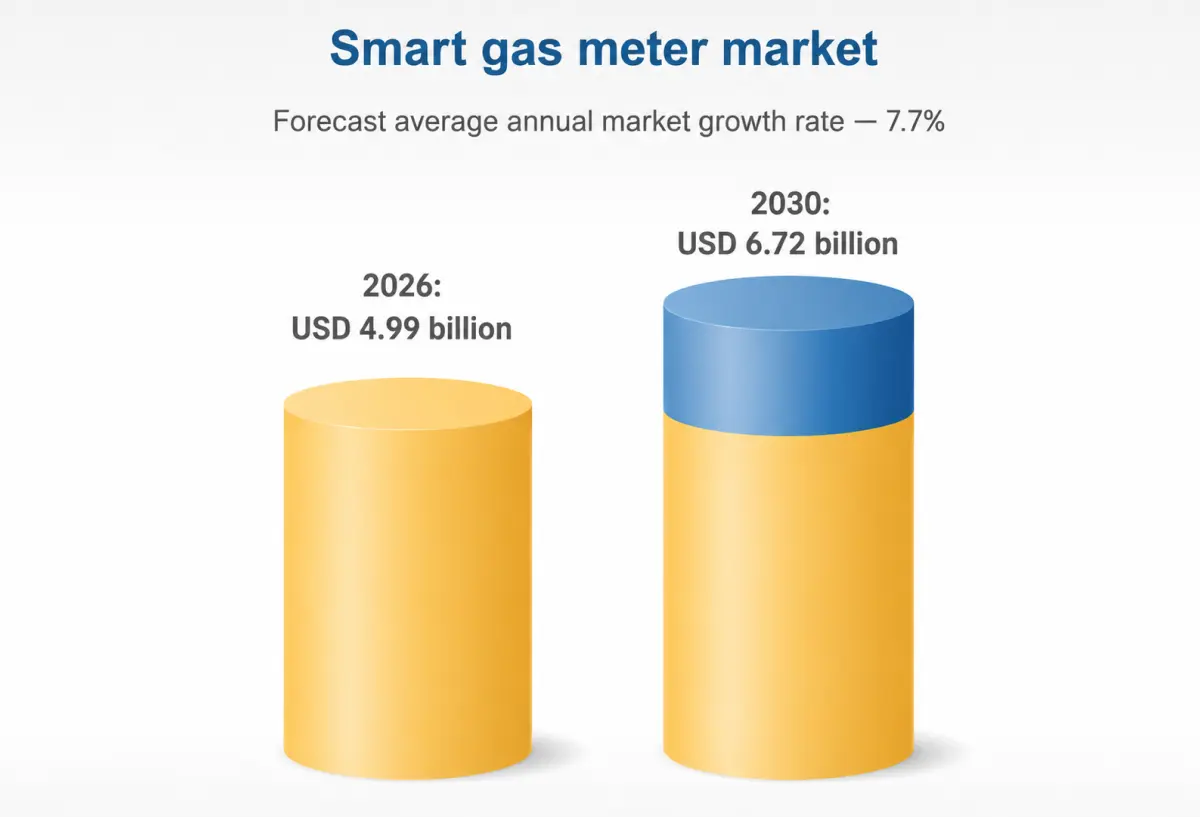
The relevance of smart gas meters for utilities is also confirmed by the market. According to the Smart Gas Meter Market Report 2026 by ResearchAndMarkets, the global smart gas meter market may grow from USD 4.64 billion in 2025 to USD 6.72 billion by 2030, at a CAGR of 7.7%.
The report lists the development of Advanced Metering Infrastructure (AMI), the spread of ultrasonic gas meters, and the need for real-time gas leak detection solutions among the growth drivers.
The main goal of utility gas management systems using smart metering is to provide the resource provider with reliable and timely consumption data. In practice, however, the value of the system is broader than simply transmitting readings remotely.
Smart gas metering benefits include the ability to update data regularly without inspections, reduce the number of manual entry errors, generate charges faster, see abnormal situations, and work with consumption history. If the system supports events and statuses, it also helps record missing data, low battery level, interference with device operation, magnetic influence, or module removal.
For the subscriber, the process also becomes simpler: there is no need to submit readings manually, remember the date when they were recorded, or wait for an inspector. For the resource company, this means more transparent metering, fewer disputed situations, and more manageable operation.
Smart gas metering can be organized in different ways. The choice depends on which meters are already installed at subscribers’ sites, whether they can be replaced, whether connectivity is available at the facility, how often data is needed, and which implementation model the resource provider chooses.
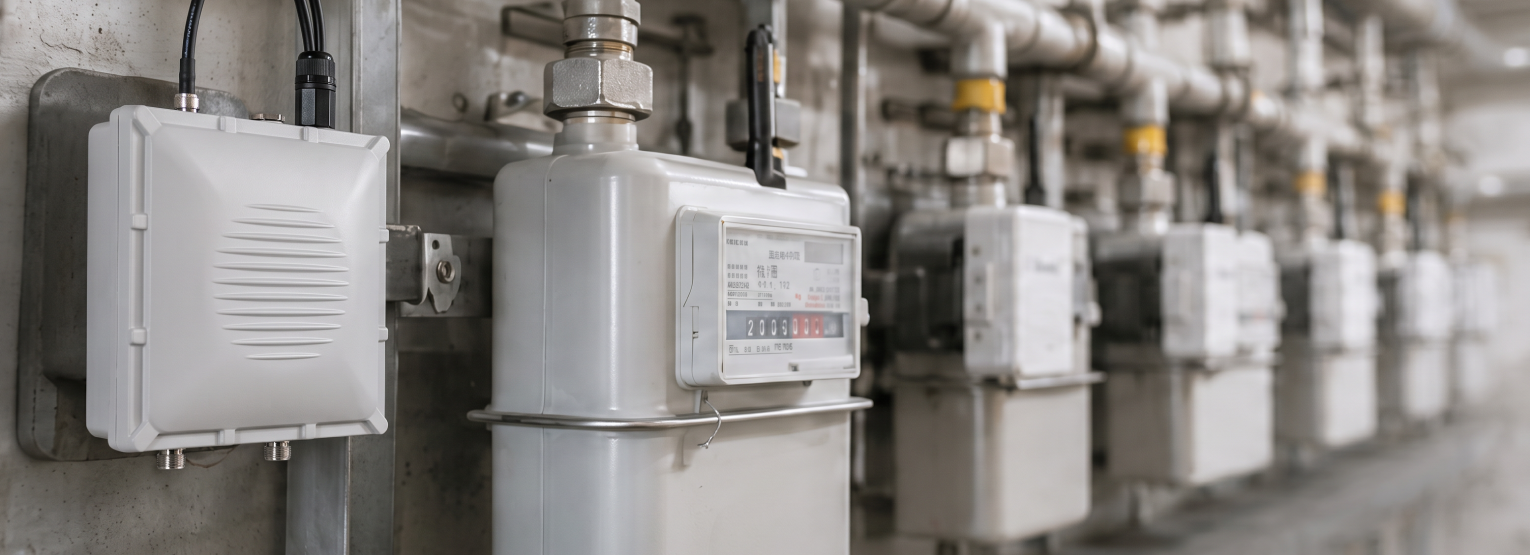
Smart gas meters. A smart gas meter is a metering device with a built-in data transmission function. Depending on the model, it may support a radio channel, cellular communication, a pulse output, built-in memory, events, and remote transmission of readings.
This option is convenient for new facilities, large-scale modernization, or projects where the provider is ready to replace the meter fleet. Its advantage is the use of a single device without a separate external sensor, but its limitations are the higher cost of replacement, the need for installation work, and a dependence on the availability of suitable models for specific market requirements.
Radio modules for gas meters. A radio module is a device that connects to a meter and transmits data to the metering system over a wireless network. This approach is especially useful if existing meters can still be used, but the collection of readings needs to be automated.
Radio modules can operate using LoRaWAN or NB-IoT technology. LoRaWAN is suitable for projects where the provider or integrator deploys its own network of base stations. NB-IoT is convenient when facilities are distributed across a territory and mobile operator coverage can be used. In both cases, it’s important to check device compatibility with the meter, connection quality, and autonomous operation requirements in advance.
Sensors for analog meters. In many projects, it’s not necessary to replace the entire fleet of analog meters immediately. A sensor can be connected to the meter to detect pulses or another readable event and then transmit the information to the radio module. This retrofit approach makes it possible to digitalize existing metering points without large-scale replacement of devices.
For gas meters, sensor compatibility with a specific model, mounting method, sealing conditions, cable length, housing protection, and the correct pulse coefficient are especially important. If these parameters are not checked in advance, the system may transmit data but provide incorrect readings or require maintenance too often.
1. Fewer inspections and lower data collection costs. Manual collection of readings requires time, personnel, routes, repeat visits, and data processing after the inspection. In addition, the inspector cannot always access the meter because the subscriber is not at home, the room is closed, access is restricted, or the facility is located far away.
Smart metering reduces dependence on these factors. Readings are transmitted automatically, and employees can focus not on mass inspections, but on problematic points, such as missing data, suspected interference, abnormal consumption, or technical faults.
2. More accurate and timely charges. The longer the delay between actual consumption and receipt of data, the higher the risk of inaccurate charges, corrections, and disputes. With regular transmission of readings, the resource provider receives data for billing faster and can work with a more up-to-date picture of consumption.
This is especially important for companies with a large subscriber base, seasonal consumption fluctuations, and distributed infrastructure. Data becomes a continuous flow of information for metering and analysis, rather than a fragmented result of inspections.
3. Fast detection of anomalies and interference. Smart metering helps see not only readings, but also events. Depending on the device and platform, the provider can receive information about magnetic influence, device removal, loss of connectivity, battery discharge, or a sharp change in consumption.
Such data helps identify suspicious situations faster, including possible leaks, unauthorized interference, incorrect meter operation, and abnormal consumption. While this does not replace an on-site technical inspection, it helps determine more accurately where to send a service team.
4. Manageable operation of the device fleet. After smart metering is implemented, it’s important for the provider not only to receive readings, but also to maintain the entire system: devices, network, base stations, SIM profiles, batteries, events, reports, and integrations. Therefore, the platform should show not only consumption, but also the technical condition of the infrastructure.
Jooby RDC Dashboard, for example, is designed to collect and process data on consumption of all resource types and device status. The system provides reports, user interfaces for 24/7 monitoring, event notifications, and information about the status of devices and the network
5. More data for planning and analytics. With reliable real-time gas consumption monitoring, the provider can analyze dynamics more accurately, compare periods, plan gas procurement, assess network load, and identify atypical scenarios. This is especially important for companies that want to move from metering that’s based on inspection results to more predictable resource management.
Smart metering data can be used in reporting, billing, analytics dashboards, dispatching systems, and integrations with the provider’s internal IT systems.
Below are real cases from the Jooby team’s extensive experience working in this sector.. These examples show the benefits of smart gas meters for resource providers, whether it’s reducing inspections, regular access to data, scaling to thousands of subscribers, or integration with existing IT systems.
Domplan: transition from manual metering to a digital model. Domplan, a utility provider from the city of Kranj in Slovenia, collected gas readings manually before implementing Jooby. This required regular employee visits and caused delays in receiving data.
The project used an NB-IoT-based retrofit solution: Jooby EPHIR RMS NB-IoT radio modules with smart sensors that detect pulses from gas meters and then transmit data to a centralized system for monitoring, visualization, and analysis. In total, 1,000 autonomous NB-IoT devices of different modifications were deployed.
The main benefit for the provider is regular remote access to data instead of fragmented manual collection, which helps energy management by increasing consumption transparency, detecting anomalies faster, and making network management more predictable.
Sombor Gas: automation of regular reading collection. Sombor Gas, a regional utility provider from the city of Sombor in Serbia, also started with manual metering, requiring employees to visit facilities and record meter readings. This process took a lot of time, was labor intensive, and did not ensure regular data updates.
For automation, the company used Jooby EPHIR RMS GMEL10 102 EU devices for remote meter reading collection. The project helped move data collection into a more manageable digital format, where the provider receives information without constant staff involvement, processes readings faster, and reduces the workload on service teams.
JSC Odesagaz: scaling to thousands of subscribers. In the project for JSC Odesagaz, Jooby radio modules were provided to 11,000 subscribers. The devices were installed on gas meters and connected to third-party integrator software, while a LoRaWAN base station was used to transmit data to the server.
For the provider, this became an example of a scalable implementation. The company gained access to accurate consumption data in the administrative panel, and the solution was successfully integrated not only with its own ecosystem, but also with the software of a third-party partner.
Before launching a project, the resource provider needs to decide which implementation model to choose: replace meters with smart ones, equip existing meters with radio modules, or use IoT gas sensors for analog metering devices.
If the facility is new or scheduled meter replacement is planned, smart gas meters can be considered. If the meter fleet is already installed and replacing it would be expensive, it’s more logical to use a retrofit solution using sensors and radio modules. If facilities are located compactly, for example, in a residential complex or district, a LoRaWAN network can be deployed. Alternatively, if the points are widely distributed and operator coverage is available, NB-IoT may be suitable.
Regardless of the above, the project should begin with an audit: checking meter models, installation conditions, connectivity availability, requirements for transmission frequency, battery life, platform, integrations, and maintenance.
For a successful project involving gas metering for utility companies, devices alone are not enough. The provider needs to determine in advance how data will enter billing, who is responsible for missing data, how alarms are processed, how often reports are generated, who sees technical statuses, and what actions are triggered by events.
Device autonomy also needs to be considered. The more often data is transmitted, the higher the load on the battery. Therefore, the transmission frequency should correspond to the real business task. For billing, regular scheduled readings may be sufficient, while emergency events require separate notification logic.
Another important issue is operation. After launch, device status, connection quality, batteries, events, and integration correctness need to be monitored. If this is not done, smart metering can turn into yet another system that has to be maintained manually.
Smart gas metering gives resource providers practical advantages. These include reducing the number of inspections, increasing data accuracy, accelerating billing, helping detect anomalies, and making network operation more manageable. Depending on the project, smart meters, radio modules, or sensors for analog meters can be used, while connectivity can be built on LoRaWAN, NB-IoT, or another suitable technology.
Offering more possibilities than simply remote transmission of readings, smart gas monitoring systems allow the resource provider to gain a foundation for more accurate, transparent, and predictable management of gas infrastructure.
Was it helpful?
 97
97


Stay on top of the latest industry news
Thank you, we have received your message. Our manager will contact you shortly.


Thank you, we have accepted your request. In the near future the responsible manager will contact you and clarify the details of the order.