04.03.2026
 2213
2213
2213
Which countries are prioritizing LoRaWAN at the national strategy level
2213
LoRaWAN has evolved from a “pilot-only technology” into a foundation for nationwide digital transformation initiatives in many countries. Today, it is increasingly embedded in LoRaWAN national strategy frameworks and long-term government IoT strategy roadmaps.
The reason is simple: municipalities and public utilities need connectivity that is inexpensive to operate, works reliably in basements and underground drainage and sewer systems, scales to tens of thousands of devices, and enables years of autonomous battery-powered operation.
For governments building national IoT infrastructure, these requirements are critical. As a result, LoRaWAN has become a core technology when implementing LPWAN for governments, smart city deployments, and large-scale smart infrastructure planning.
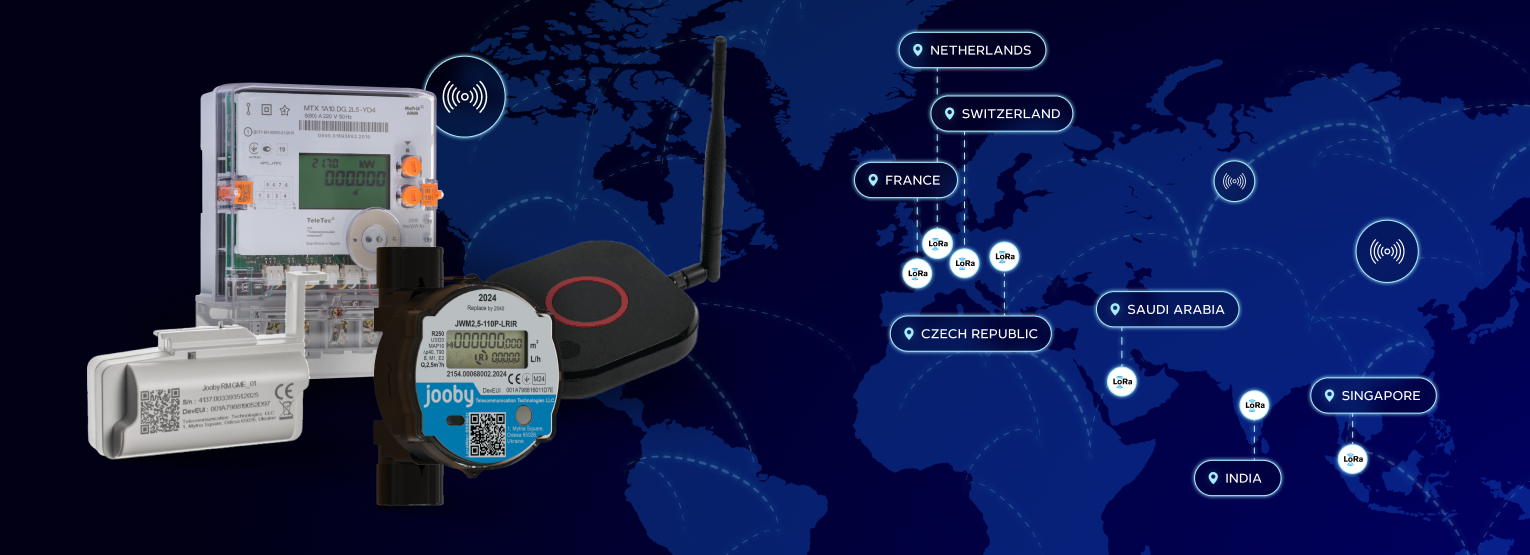
Below are examples of countries where this low-power protocol is already deployed within government LoRaWAN networks or nationwide programs.
Netherlands. KPN deployed nationwide LoRa coverage and has positioned it as the foundation for Smart City services. The country became one of the first with truly national public IoT networks, allowing cities to launch parking, lighting, and environmental monitoring projects without building their own infrastructure.
France. LoRaWAN is part of the country’s broader national IoT programs. Orange has officially confirmed long-term support and nationwide coverage. At the same time, the market provided an important lesson: The French engineering group Bouygues shut down its LoRaWAN network in favor of NB-IoT. For customers, this highlights the importance of aligning deployments with operator strategy over a 7–10 year horizon.
Switzerland. Swisscom operates a Low Power Network (LPN) based on LoRaWAN as a “utility-grade” service. The focus is on up to 10 years of battery life, bidirectional communication, and reliable operation in difficult locations such as basements, historic buildings, and distributed sites – a textbook example of resilient low power networks supporting critical infrastructure.
Czech Republic. The national operator České Radiokomunikace deployed a LoRaWAN network covering about 75% of the population. This provides a unified standard for regional and municipal projects and forms the backbone of utility metering networks, smart sensors, and city-scale IoT services.
Singapore. SPTel launched the first nationwide LoRaWAN sensor network under the Smart Nation initiative. The network directly supports public-sector projects: urban sensors, infrastructure management, and environmental monitoring. It functions as a nationwide urban IoT platforms layer and is a key element of the country’s public digital infrastructure.
India. The government’s Smart Cities Mission has become a strong driver of LoRaWAN deployment. Hundreds of cities and multiple verticals – water, lighting, environmental monitoring, parking – have created demand for scalable LPWAN connectivity that is fast and cost-effective to deploy.
Saudi Arabia. Within Vision 2030 and major megaprojects such as NEOM, IoT and LPWAN technologies are treated as essential parts of national modernization. Tens of millions of smart meters have already been installed. LoRaWAN is integrated into LPWAN smart infrastructure alongside 5G and NB-IoT, supporting large-scale smart energy systems and resource management.
Total Cost of Ownership (TCO). Municipal projects involve tens of thousands of devices. LoRaWAN performs best where traffic is minimal and where there is a need for devices to operate for 5–10 years without battery replacement. Even small savings per device scale into millions at the city level.
Operation in hard-to-reach locations. Water and heat meters, underground chambers, basements, and utility rooms are areas where traditional cellular networks often struggle. LoRaWAN was designed for exactly these conditions and works reliably without expensive signal amplifiers or reconstruction.
Fast Smart City rollout. Nationwide public IoT networks allow municipalities to launch services immediately without building infrastructure from scratch. This dramatically shortens deployment timelines and reduces capital expenditure.
Hybrid architecture. In practice, the most effective model combines public networks with private segments for critical facilities such as boiler rooms, pumping stations, or industrial zones. LoRaWAN easily supports this flexibility.
Open ecosystem. As an open standard governed by the LoRa Alliance, LoRaWAN reduces vendor lock-in, simplifies procurement, and supports competitive tenders – all important requirements for public-sector projects and IoT regulation compliance.
Perfect fit for smart metering. Governments need measurable and controllable assets. Large-scale metering makes LPWAN technologies essential. LoRaWAN is especially effective for water, heat, and gas metering, as well as distributed sensors – forming the backbone of national utility metering networks.
Turning strategy into real-world implementation requires practical infrastructure: gateways, data collection systems, and operational tools. The Jooby ecosystem offers ready-made components for municipal and utility deployments:
A typical roadmap for a city or utility looks like this: endpoint inventory – radio planning – pilot project (300–1,000 devices) – operational model – scaling to district and city level with KPIs for losses, outages, and metering accuracy.
The Netherlands, France, Switzerland, the Czech Republic, Singapore, India, and Saudi Arabia clearly illustrate the same trend: LoRaWAN is becoming an integral part of national IoT infrastructure.
Across these LoRaWAN adoption countries, the technology is increasingly being treated as a core layer of digital government and modernization policy.
Because of its low operating cost, scalability, reliability in challenging environments, and open ecosystem, LoRaWAN is no longer experimental – it is a mature foundation for government LoRaWAN networks, sustainable public digital infrastructure, and long-term smart city development.
Was it helpful?
 222
222


Stay on top of the latest industry news
Thank you, we have received your message. Our manager will contact you shortly.


Thank you, we have accepted your request. In the near future the responsible manager will contact you and clarify the details of the order.