27.08.2025
 2394
2394
2394
LoRaWAN for Street-Lighting Monitoring: real-time lighting control
2394
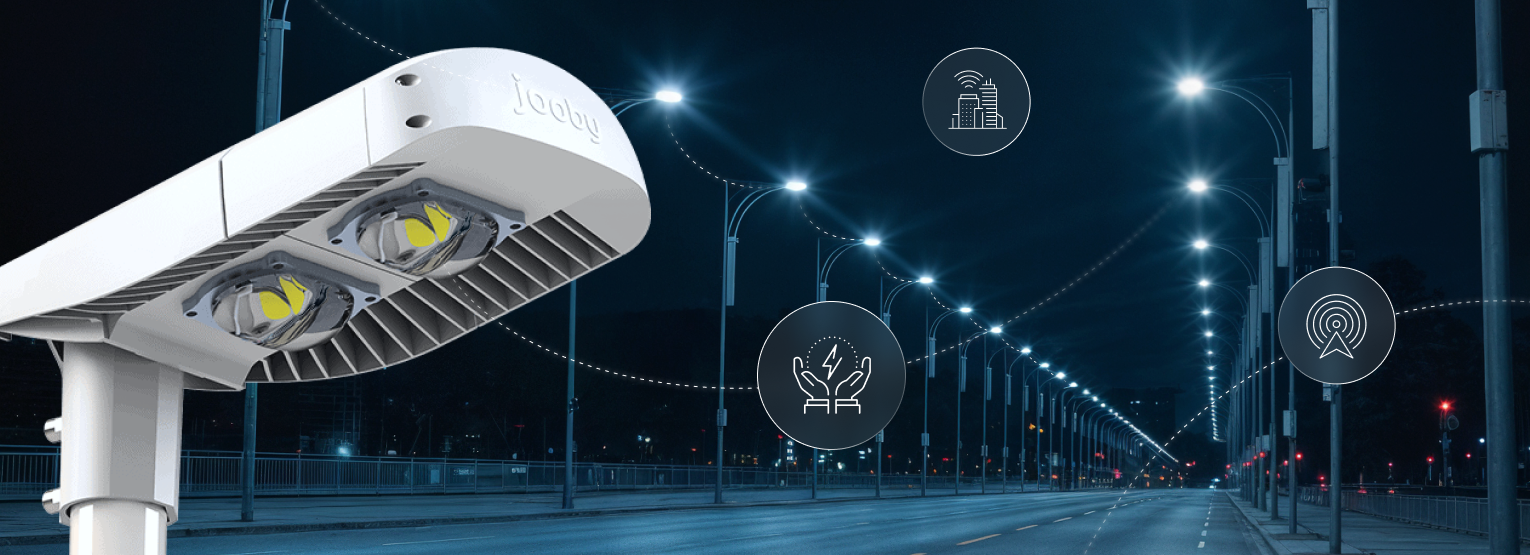
Urban lighting is no longer just a set of lamps — it’s a digital system that changes along with traffic, weather, and the usage patterns of public spaces. In this article, we describe the Jooby solution for smart lighting, which includes all components required to launch a project.
This innovative solution is presented as a unified street lighting IoT platform, tailored to modern lighting infrastructure and high-quality outdoor illumination within a smart lighting IoT environment.
Amid rising energy prices, tighter environmental regulations, and a shortage of skilled staff, smart lighting is not merely a tech trend but a practical tool for savings and risk management.
Migrating to a network of controllable luminaires that have remote dimming and provide “light-on-demand” reduces consumption without compromising on safety. In addition, predictive diagnostics cut unplanned field trips and total cost of ownership.
Using energy-efficient communication (for example, LoRaWAN) lowers operating expenses and enables block-by-block scaling without overloading the budget. This is all thanks to the use of wireless connectivity on a low-power network, delivering tangible energy efficiency and rapid energy savings.
Jooby offers an “out-of-the-box” solution that acts as a single contour: luminaires, controllers, and sensors all work on one network, while management takes place from the cloud supplemented by local telemetry — a practical approach to lighting network management and street light remote control.
All of these features make it possible to adapt lighting operation in real time and reduce OPEX. At the same time, street safety is increased and the urban environment improved through intelligent lighting management.
The foundation of the solution is a modular architecture in which each device “knows” how to communicate with others: controllers receive commands and execute dimming control profiles, sensors respond to motion and change the lighting scene, and the cloud platform collects and visualizes data — enabling truly adaptive street lighting without altering operational workflows.
Start with an engineering survey that includes an inventory of luminaires, poles, power lines, control cabinets, and potential locations for controllers and gateways. Based on the collected data, build a digital model of the network (by blocks and feeder groups) with a LoRaWAN coverage calculation and dimming scenarios by time of day, traffic, and seasonality.
Next, select a pilot — ideally, this will be a few streets with differing traffic profiles and pole types. In the pilot, install controllable luminaires on existing fixtures, along with motion and illuminance light pole sensors. The cloud lighting platform should then be configured with access roles for dispatchers and contractors.
Once savings and light quality are confirmed, scale the model area by area: modernize control cabinets in parallel, configure security policies (encryption, key management, audit), maintenance procedures, and SLAs for contractors.
The final steps are alignment with city systems, staff training, and the launch of regular KPI reporting for energy, incidents, restoration times, and public feedback.
The municipality gains controllable spending thanks to adaptive dimming and “light-on-demand.” Electricity consumption is reduced, night-time peaks are smoothed, and payments under network tariffs are lowered.
Another significant benefit is that operations become predictable: automatic diagnostic events (maintenance alerts, driver degradation, voltage spikes) shorten response times and increase availability, while fault detection helps pinpoint issues much earlier.
The budget benefits twice — from energy savings and fewer unplanned repairs — and ESG reporting is supported by accurate data. For residents, this means safer and more comfortable streets that have even color rendering, no “blind spots,” appropriate brightness at night, and fast troubleshooting.
Smart lighting is becoming a backbone subsystem of city IoT networks and a successful demonstration of LoRaWAN smart city solutions.
Controllers and sensors share the same channel and transport analytics so that data on traffic intensity and pedestrian flows automatically adjusts lighting levels on arterial roads and intersections.
But the benefits don’t only relate to outdoor lighting automation. Public works are able to connect container-fill sensors and transit-stop condition sensors to the same network, while environmental services add air-quality and noise sensors; all assets appear on a single map for faster reaction times — a cohesive, connected infrastructure.
Integration with safety systems makes it possible to raise brightness along emergency routes, while linking to the geoinformation system and the city portal opens public analytics for residents. This information could include where modernization took place, when a fault was cleared, and how savings changed over time.
Through standardized APIs, the lighting platform also connects to traffic-control systems, dispatching, and billing to create a unified approach to efficient street light remote control within broader LoRaWAN smart city solutions.
Modern smart lighting is not simply replacing fixtures with LEDs, but a managed digital system — an efficient street lighting IoT platform that delivers real-time lighting control. It also adapts city lighting to street life, cuts costs, and increases safety.
A properly structured project starts with a precise network model and a pilot, then scales together with procedures, cybersecurity, and integration into the city data platform.
Bringing lighting together with resource metering and street sensors in one wireless network turns “light” into a strategic asset. The municipality gets transparent KPIs, a predictable budget, and development flexibility, while citizens get comfortable, bright, and safe spaces.
The success of LoRaWAN in this area is an outstanding example of the use of technology to dramatically improve urban infrastructure and outdoor illumination while still managing to reduce spending — all achieved through lighting network management powered by wireless connectivity.
Was it helpful?
 552
552


Stay on top of the latest industry news
Thank you, we have received your message. Our manager will contact you shortly.


Our experts are always happy to help and promptly answer your questions. Please fill out the form to discuss your project and develop a tailored action plan.
Thank you, we have received your message. Our manager will contact you shortly.
Thank you, we have accepted your request. In the near future the responsible manager will contact you and clarify the details of the order.
Our experts are always happy to help and promptly answer your questions. Please fill out the form to discuss your project and develop a tailored action plan.
Thank you, we have received your message. Our manager will contact you shortly.