03.12.2025
 531
531
531
Social Housing and New Requirements for Resource Metering
531
Social housing has always been in the focus of municipalities and utility providers. High population density, limited budgets, and the need for transparent cost allocation all mean that this particular type of accommodation requires affordable, modern, and reliable solutions.
Under these conditions, traditional metering devices increasingly fail to meet expectations—both from property managers and residents.
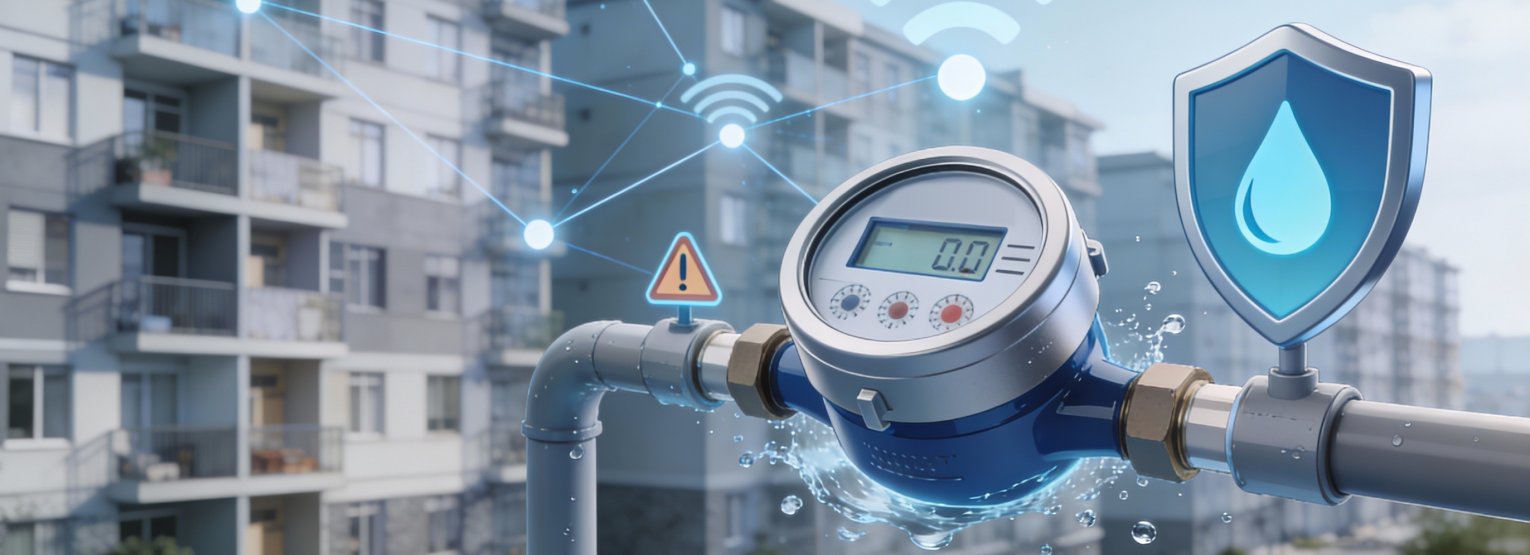
Against this background, the digitalization of utility infrastructure becomes a logical step forward. Smart water meters with remote data transmission make it possible to automate routine processes, reduce water losses, and increase trust in billing systems. Such energy and water metering systems are especially relevant for new social housing projects and for renovation programs targeting existing housing stock.
LoRaWAN technology has proven itself in large-scale data collection tasks. It provides long communication range, stable operation in dense urban environments, and minimal power consumption of devices. For social housing metering in particular, this means the provision of affordable housing utilities, where water meters can be installed without complex infrastructure or frequent maintenance.
Another key advantage of LoRaWAN smart meters is scalability. A single gateway can serve thousands of devices, something that’s particularly valuable for municipal housing programs and residential blocks with a large number of apartments. At the same time, the total cost of ownership remains predictable, and deployment of the scalable metering infrastructure does not require significant construction work.
Remote data collection using wireless metering solutions such as LoRaWAN eliminates the human factor. There’s no need for manual readings, on-site inspections, or verification of entered data. In addition, by adopting digital metering systems, utility providers and homeowners associations gain access to data in near real time, while residents gain confidence in fair resource allocation and accurate billing.
For developers and municipalities involved with social housing infrastructure modernization, this also becomes a way to increase the investment attractiveness of projects. Modern metering systems are integrated into the “smart building” concept and demonstrate a responsible approach to resource management already at the commissioning stage.
One of the key functions of modern water meters is leak detection. In social housing, failures in internal water networks may remain unnoticed for long periods, leading to significant water losses and property damage. Smart meters analyze abnormal consumption patterns and automatically signal potential issues.
The integration of leak detection using IoT-based housing management is especially important for older housing stock and for buildings with high tenant turnover. Early identification of faults helps reduce repair costs, lowers accident rates, and improves the overall safety of building operation.
For local authorities, reducing losses in housing utilities is vital. The implementation of LoRaWAN meters is a step toward systematic management of utility resources. Centralized utility monitoring and data collection simplifies consumption analysis, identification of inefficient areas, and planning of network modernization.
Homeowners associations and property management companies gain a control tool to meet regulatory requirements for metering without increasing staff size or workload. Automation of metering frees up time for resident engagement and service improvement, while increased utility transparency and billing reduces the number of potential disputes.
Social housing is always a long-term commitment. Therefore, when selecting equipment, it’s important to consider not only current needs but also long-term resource metering requirements and prospects. LoRaWAN sensors and radio modules are designed for long service life and stable battery-powered operation, making them an optimal choice for large-scale deployment within smart city housing infrastructure.
The use of open standards and compatible solutions for residential utility monitoring allows the system to be gradually expanded: adding new types of sensors, integrating with billing platforms, and connecting to city IT systems. As a result, smart water meters with leak detection become not just metering devices, but part of a sustainable and modern social housing ecosystem.
Was it helpful?
 123
123


Stay on top of the latest industry news
Thank you, we have received your message. Our manager will contact you shortly.


Our experts are always happy to help and promptly answer your questions. Please fill out the form to discuss your project and develop a tailored action plan.
Thank you, we have received your message. Our manager will contact you shortly.
Thank you, we have accepted your request. In the near future the responsible manager will contact you and clarify the details of the order.
Our experts are always happy to help and promptly answer your questions. Please fill out the form to discuss your project and develop a tailored action plan.
Thank you, we have received your message. Our manager will contact you shortly.