05.01.2026
 533
533
533
Urban automation trends: why LPWAN is about much more than meters
533
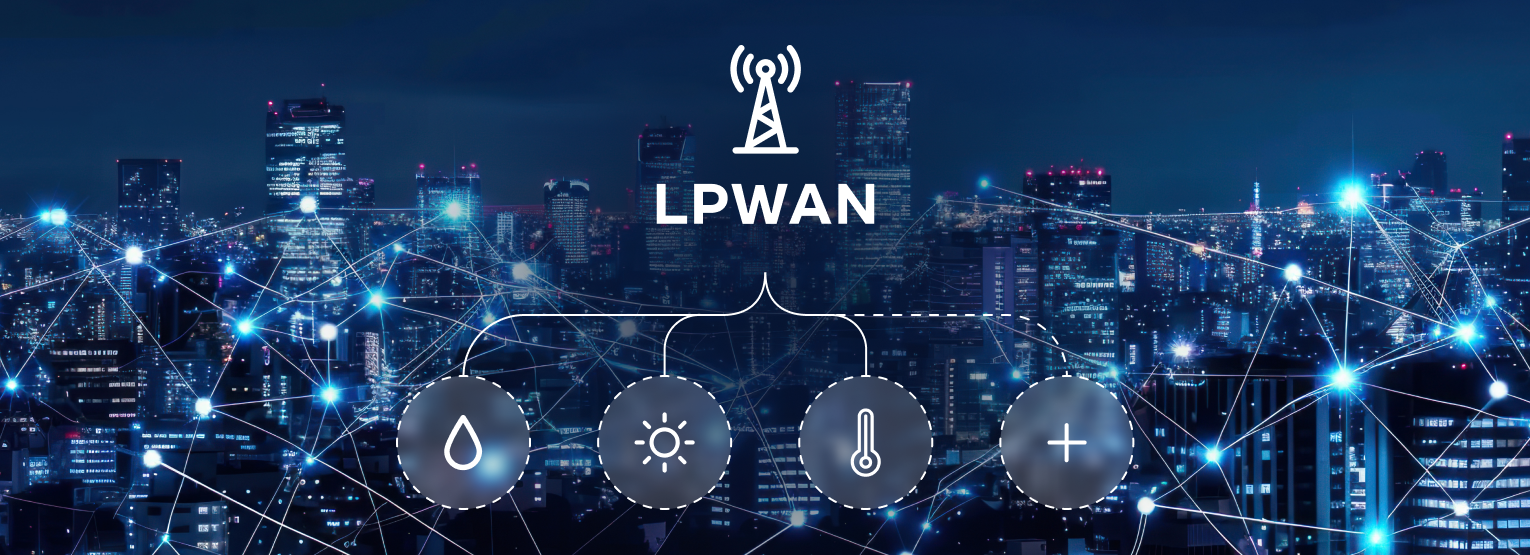
The digital transformation of city infrastructure has long moved beyond just remote meter reading. LPWAN networks (LoRaWAN, NB-IoT, LTE-M) have now become a universal transport layer for urban telemetry and control across smart city connectivity use cases: from adaptive lighting and water-pressure monitoring to container-fill tracking, air-quality measurements, and predictive maintenance of municipal assets.
The core value is not a single radio technology but the ability of low power wide area networks to collect data cheaply and at scale, guiding operational decisions and helping to establish verifiable KPIs across a digital city infrastructure.
Unlike other short-lived smart city technology trends, LPWAN has firmly established itself by solving the foundational task of collecting regular, energy-efficient data collection from distributed endpoints. By building on that data layer, cities gain qualitatively new capabilities. Hourly consumption profiles and event-driven telemetry streams are combined with geospatial data and operational processes. As a result, specialist teams can act proactively, ensuring that:
These improvements align with urban automation trends and the evolution of smart city IoT networks.
Water and district-heating networks. Pressure, temperature, flow, and valve-state sensors enable DMA zoning, tracking of the network’s “night breathing,” loss localization, and incident prevention. Controlled valves and variable-speed pumps are tuned by actual conditions rather than by fixed schedules, reducing OPEX and extending pipeline life.
Street lighting. Controllers and motion sensors enable adaptive dimming—“light on demand”—which lowers electricity consumption and light pollution without compromising safety. Driver and phase-voltage telemetry supports predictive maintenance and reduces field callouts, illustrating the effective use of smart lighting systems within wireless IoT for cities.
Waste and city services. Fill-level sensors allow route planning that includes only necessary stops. The same networks support monitoring of bus stops, parking, city assets, and sports/playgrounds—one unified map replaces manual rounds, providing a significant step toward waste collection optimization and smart parking solutions.
Environment and safety. Low-cost battery nodes measure noise, particulate matter, nitrogen emissions, stormwater levels, and the state of dampers and ventilation in underpasses. LPWAN provides consistent coverage where cellular is expensive or unstable, such as in basements, manholes, metal cabinets, and industrial areas—leveraging long range wireless networks.
Municipal buildings and social infrastructure. The monitoring of indoor climate, consumption, door openings, ventilation, and boiler rooms improves building energy efficiency and reduces complaints—especially in schools, clinics, and multifamily housing—supporting real-time utility monitoring.
The LPWAN approach reshapes cost structure. Capital expenditures scale in phases—from a pilot zone to citywide—without wholesale infrastructure overhauls. Operating costs fall by eliminating mass manual rounds, cutting emergency callouts, optimizing energy and water procurement, shortening MTTR, and “stretching” capital replacements through predictive analytics.
Beyond direct savings, the organization obtains clean time series for non-financial reporting—both ESG (environmental, social, and governance) and CSRD (EU sustainability reporting): hourly CO₂e, the share of non-revenue losses, and energy per unit of service. This supports data-driven governance and sustainable development agendas.
Impact comes not from hardware alone but from data discipline and integration. Metrological series are enriched with network health indicators (RSSI/SNR, successful-uplink ratios, delivery latency, battery status), helping to distinguish consumption anomalies from radio-link issues.
Load profiles and event flags (leak, backflow, enclosure tamper, overheating, voltage sag) automatically feed BI, SCADA, and GIS views, where alerts, geo-tagged work orders, and control scenarios are generated (e.g. change a PRV setpoint, shift pump starts, reduce lighting brightness on a segment). This is how city IoT platforms operationalize sensor networks and anomaly detection.
Modern LPWAN networks provide end-to-end cryptography (separate network/app keys, AES-128), dynamic session keys (OTAA), TLS between gateways and backend, segmentation, RBAC/MFA, and immutable audit logs. These practices simplify audits, reduce regulatory risk, and strengthen public trust in digital metering and city services—key factors driving utility automation across city-wide IoT infrastructure.
A unified LPWAN ecosystem minimizes integration breaks: radio modules, gateways, and the management platform operate with aligned profiles, and APIs are open to billing, ERP/SCADA, GIS, and analytics. This accelerates the move from pilot to production and ensures reproducibility across districts and cities, supporting LoRaWAN network optimization and robust AMI systems.
A practical deployment roadmap
Pilot + baseline. Launch with 200–300 nodes and 1–2 gateways in a representative area (water/lighting/environment). Establish baseline KPIs: successful-uplink share, data completeness/timeliness, reductions in leakage/electricity use, and response time—these will create the foundations for usage forecasting and meter telemetry.
Standardization. Define standard transmission profiles, installation maps, metric catalogs, SLAs for delivery/processing, and cybersecurity policies—enabling reliable cloud data pipelines and IoT dashboards.
Scaling. Extend coverage, add device classes, introduce “risk panels,” predictive models, and MRV/ESG reporting—building toward digital twins and sustainable resource optimization.
Pilot + baseline. Launch with 200–300 nodes and 1–2 gateways in a representative area (water/lighting/environment). Establish baseline KPIs: successful-uplink share, data completeness/timeliness, reductions in leakage/electricity use, and response time—these will create the foundations for usage forecasting and meter telemetry.
Standardization. Define standard transmission profiles, installation maps, metric catalogs, SLAs for delivery/processing, and cybersecurity policies—enabling reliable cloud data pipelines and IoT dashboards.
Scaling. Extend coverage, add device classes, introduce “risk panels,” predictive models, and MRV/ESG reporting—building toward digital twins and sustainable resource optimization.
What to look for when selecting a platform
LPWAN is the “nervous system” of urban IoT automation, connecting diverse assets into a controllable loop. With low connection costs, long device battery life, and proven integrations, cities gain measurable savings, modern citizen-friendly services, and transparent reports for regulators and investors.
The technology used in IoT for urban infrastructure now covers far more than meter reading: it enables sustainable infrastructure operations where every decision is data-backed and every kilowatt-hour, cubic meter, and gigacalorie becomes predictable and manageable.
Was it helpful?
 90
90


Stay on top of the latest industry news
Thank you, we have received your message. Our manager will contact you shortly.


Our experts are always happy to help and promptly answer your questions. Please fill out the form to discuss your project and develop a tailored action plan.
Thank you, we have received your message. Our manager will contact you shortly.
Thank you, we have accepted your request. In the near future the responsible manager will contact you and clarify the details of the order.
Our experts are always happy to help and promptly answer your questions. Please fill out the form to discuss your project and develop a tailored action plan.
Thank you, we have received your message. Our manager will contact you shortly.