25.02.2026
 556
556
556
Service for Residents: Mobile Notifications from LoRaWAN/NB-IoT Meters
556
The digitalization of housing and utilities has long gone beyond being used simply to take remote meter readings. Today, residents and homeowners care that meters not only operate automatically, but that information is transparent, timely, and easy to understand. When data about water, heat, or electricity arrives on a smartphone as easily as a notification from a bank or delivery service, trust in the service provider noticeably increases.
This explains why systems based on LoRaWAN and NB-IoT are increasingly becoming not just telemetry tools for dispatchers, but fully-fledged services for people. LoRaWAN smart meters are able to communicate with residents, warning about overconsumption, reminding about verification, and reporting emergencies. The use of smart utility monitoring benefits both management companies and municipalities — call center workload decreases, response times improve, and resource losses are reduced.
Historically, automated meter reading projects were focused on internal tasks, such as collecting readings, issuing bills, and reducing manual inspections. But as IoT-based utility management networks expanded, it became clear that data could be used more deeply. A meter turns into a source of events — not just numbers once a month, but a continuous stream of signals.
LoRaWAN and NB-IoT technologies are ideal for this due to their low power consumption, coverage in basements and utility shafts, and reliable transmission of small data packets. This means devices can operate for years without battery replacement and regularly send status updates. Then, the software layer comes into play, with its mobile notifications, personal dashboards, and automated scenarios.
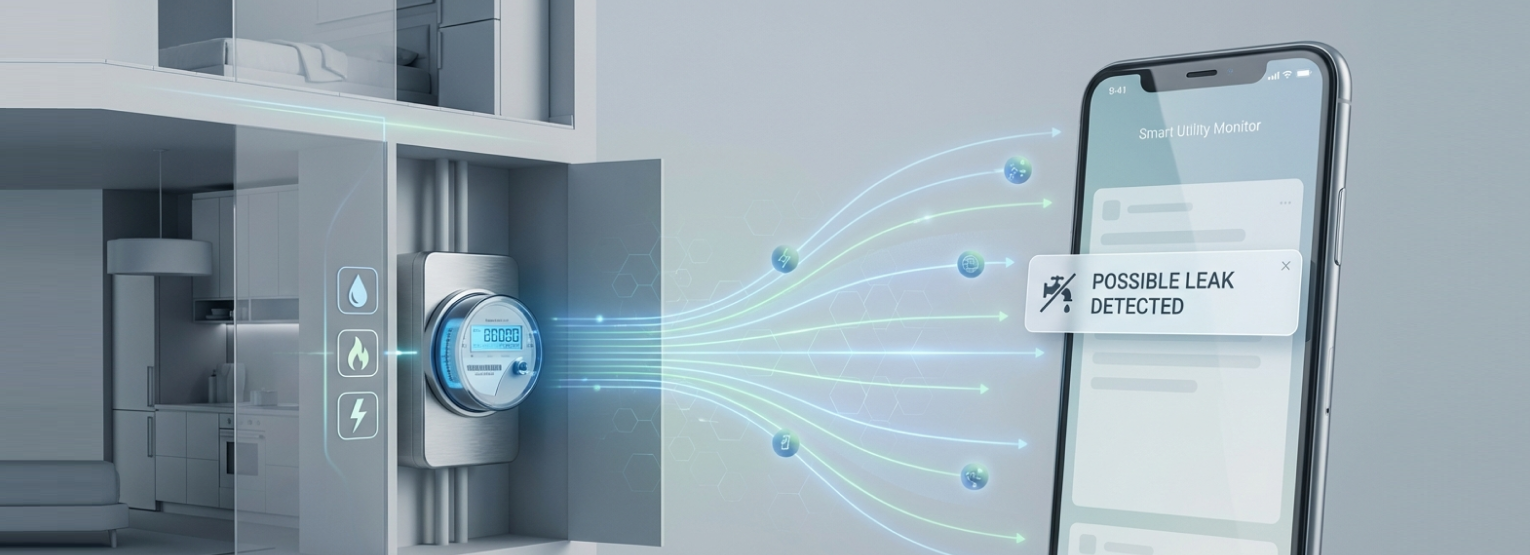
For residents, utility data notifications mean control and predictability. They can see daily consumption as well as high-consumption alerts, receive remote meter alerts about possible water leaks or sharp spikes in heating, and learn about scheduled maintenance in advance. Instead of surprises on utility bills, by using resident engagement tools they get a clear picture of expenses.
For resource providers, data-driven utility communication is a risk reduction tool. Rapid alerts about abnormal situations help prevent accidents, reduce commercial and technical losses, and cut down on field crew visits. For municipalities, smart city metering provides transparent analytics across buildings and neighborhoods, while for developers it becomes an additional competitive advantage when selling housing.
The scenario is simple. A meter or sensor detects an event: exceeding a consumption threshold, tampering attempts, pressure drops, or battery discharge. Through a LoRaWAN or NB-IoT radio module, the data is sent to a server, where the platform processes it in real time.
The system then generates a notification: a push message, SMS, or message in a mobile app. At the same time, the information is sent to a dispatcher or billing system. Thus, one infrastructure using a centralized monitoring platform serves several roles simultaneously — residents, service teams, and management. The better the integration between hardware and software, the higher the value of the entire ecosystem.
Industry experience shows that utility providers most often request event-based notification scenarios that help quickly detect losses and reduce risks. These include alerts about potential leaks or continuous nighttime water flow, sharp spikes in heat or electricity consumption, tampering attempts, reverse flow, and low battery levels.
The “alert before billing” model is also becoming increasingly common, where residents are notified in advance when consumption exceeds a defined threshold. This approach to energy and water efficiency tracking helps in reducing utility complaints, increases transparency, and at the same time lowers the workload on service teams.
Reliable connectivity in basements and densely built urban areas is achieved through proper radio planning and the right choice of technology. For LoRaWAN, correct placement of gateways and antennas, preliminary signal measurements, and network densification in challenging locations are essential.
NB-IoT, operating in licensed spectrum through mobile network operators, is inherently designed for deep indoor coverage, but field testing and proper device selection remain critical. With an optimized transmission profile and the use of power-saving modes, real-world projects demonstrate device lifetimes of 5–10 years or more, making large-scale deployments economically viable.
Reducing total cost of ownership when scaling to thousands of buildings requires a combination of technical and organizational measures, including leveraging existing operator infrastructure where appropriate, standardizing device configurations, centrally managing device fleets, and minimizing on-site visits through remote diagnostics.
In practice, pilot projects most often face challenges such as underestimated integration with billing and dispatch systems, insufficient attention to cybersecurity, and the lack of proper radio surveys.
A comprehensive approach — from architectural design to a well-thought-out service model — is what distinguishes modern solutions from “just meters”, where data becomes not only a basis for real-time billing updates, but also a tool for consumption management, loss reduction, and building trust between provider and resident.
Project economics are built not only on reducing manual labor. Notifications, including leak detection alerts, help detect problems and unauthorized connections early, which means recovering losses. In addition, the number of support requests decreases, with many issues being resolved automatically, without operator involvement.
For homeowners’ associations and management companies, real-time meter data is also a way to build trust with residents. When people see transparent statistics and timely notifications, they are less likely to dispute charges. As a result, accounts receivable decrease and processes become more predictable.
The reliability of equipment and radio modules plays a key role in digital utility services, since replacing devices in a distributed network is always costly. Open integration interfaces with billing systems and mobile applications are also critical. The system must scale without requiring a complete architectural redesign.
It’s equally important to think through the user experience. Notifications via a resident utility app should be useful rather than intrusive, with clear wording, understandable thresholds, and customization options. The service then becomes a helpful assistant rather than a source of information noise.
Mobile push notifications for utilities from LoRaWAN and NB-IoT smart meters transform telemetry into a full-fledged service for residents. This is a step from simple data collection toward consumption management and trust between provider and customer. For developers, municipalities, and homeowners’ associations, such solutions are becoming not an option but the new standard.
Investments in modern IoT metering solutions and infrastructure pay off faster when hardware, connectivity, and services work as a single system. And it’s precisely this comprehensive approach — from sensor to application — that makes it possible to build truly smart and convenient housing and utilities systems of the future.
Was it helpful?
 66
66


Stay on top of the latest industry news
Thank you, we have received your message. Our manager will contact you shortly.


Our experts are always happy to help and promptly answer your questions. Please fill out the form to discuss your project and develop a tailored action plan.
Thank you, we have received your message. Our manager will contact you shortly.
Thank you, we have accepted your request. In the near future the responsible manager will contact you and clarify the details of the order.
Our experts are always happy to help and promptly answer your questions. Please fill out the form to discuss your project and develop a tailored action plan.
Thank you, we have received your message. Our manager will contact you shortly.