18.11.2025
 188
188
188
Construction Stage: How to Integrate LoRaWAN/NB-IoT Meters and Gateways Into Project Documentation
188
Modern buildings are increasingly being designed with future digitalization in mind, including wireless meter integration. IoT rollout planning now demands that while engineering systems remain the foundation of any facility, they are expected to be both reliable and able to operate within a unified intelligent infrastructure.
Against this backdrop, integrating LoRaWAN and NB-IoT meters, as well as network gateways, into project documentation and custom design packages at an early stage is no longer just a recommendation—it’s a prerequisite for cost-efficient long-term operation.
The construction phase of a building is when the foundations for proper installation, stable connectivity, and smooth integration with billing systems are laid. That’s because implementing smart meter infrastructure design after the main construction stage will result in costs rising significantly, with walls having to be opened, equipment relocated, antenna outputs added, and power lines re-routed. Utility project approvals will rely on avoiding such complications, and it’s essential to understand the requirements of LPWAN networks and how to design an object so that digital metering works flawlessly for many years.
The first step in integrating smart meters is to identify which utilities need to be monitored—water, heat, gas, electricity—and the expected volume of data. LoRaWAN infrastructure planning also has to take into account that different resources require different meter types and communication modules, so their compatibility must be ensured early.
LoRaWAN and NB-IoT differ in bandwidth and network architecture, which influences the required number and placement of gateways, data transmission frequency, and device energy consumption.
During the design stage, it’s important not only to select a communication technology but also to determine usage scenarios and specifications for LoRaWAN devices, such as whether data must be transmitted hourly or in real time, whether the system will integrate with a municipal platform, and how utility providers will validate readings. These factors define network density, the number of collection points, and the configuration of the equipment.
The communication section of the project should include a radio coverage model. LoRaWAN typically relies on dedicated gateways, and large facilities require coverage calculations that account for walls, floors, and potential shielding surfaces. In residential complexes, LoRaWAN gateway installation will often see them placed in technical rooms or on rooftops, where signal loss is minimized and coverage is optimal.
Although NB-IoT uses the operator’s mobile network, designers must still use pre-deployment surveys to evaluate signal stability in basements, heat substations, and utility entrances. Installation diagrams for IoT gateways should be followed closely. Modules should not be placed in sealed metal enclosures that drastically reduce signal strength.
Proper planning using network coverage planning guides helps avoid the need for repeaters or equipment relocation after the building is completed.
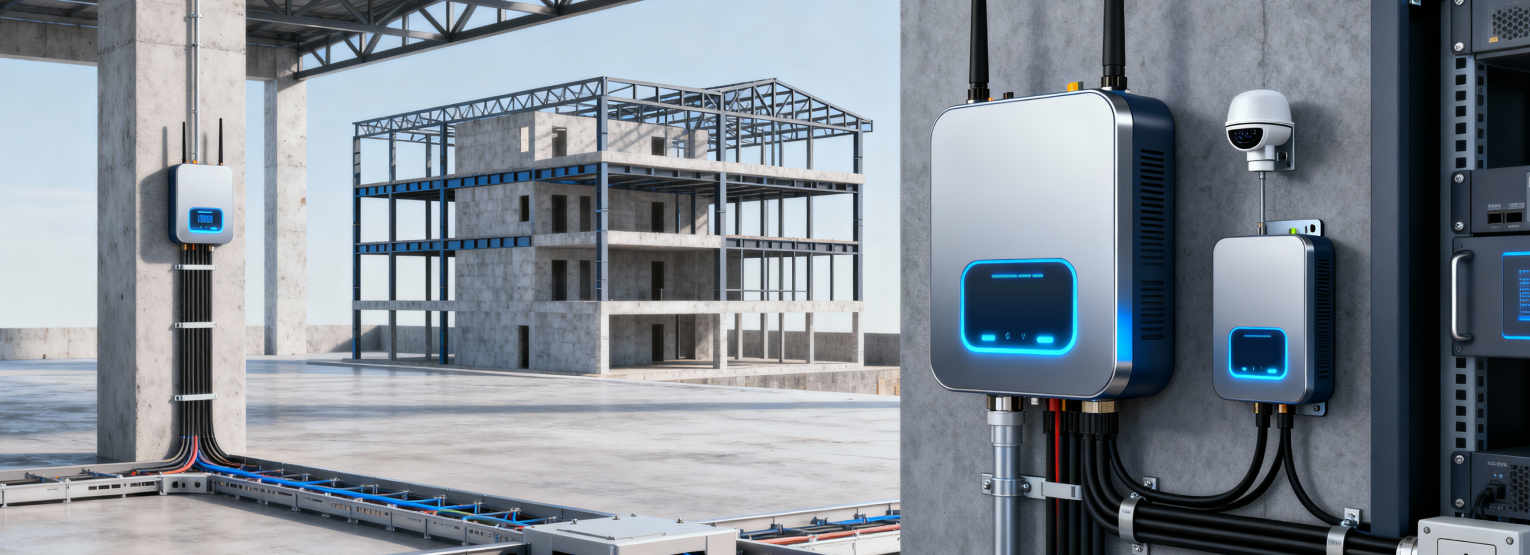
This stage defines how meters and radio modules will be physically incorporated into utility nodes. It’s essential to ensure convenient access for service work and battery replacement, as well as to plan secure placement for gateways with backup power. In buildings with a large number of devices, dedicated installation cabinets or niches are useful, providing space for power lines, Ethernet, or fiber optics if supported by the gateway.
The project should also reflect ventilation requirements, distance from heat-generating components, and moisture protection. Although many LPWAN devices are designed for harsh environments, proper installation conditions remain critical. They directly influence equipment lifespan and the stability of data transmission.
Using construction documentation workflows, the primary objective is to record every element of the intelligent infrastructure as clearly as traditional engineering systems.
LoRaWAN and NB-IoT project documentation will include technical specifications regarding meter types, radio protocols, installation requirements, permissible signal levels, and expected battery replacement cycles. Cable routes for gateways, backup communication channels, and server-side requirements—if local data processing is planned—must also be described.
In addition, integration interfaces should be outlined in advance, detailing communication protocols, data formats, authentication methods. This simplifies coordination between developers, utility providers, and telecom operators while preventing cases where equipment from different manufacturers is incompatible or requires costly upgrades after the building is commissioned.
Incorporating LPWAN meters at the construction stage helps developers significantly reduce future operational costs. Automated metering provides consumption transparency, simplifies billing, and minimizes the risk of uncollected payments. With a successful remote metering project design and implementation, municipalities gain access to accurate statistics and can detect leaks or inefficiencies without conducting additional inspections.
For homeowners’ associations and management companies, predictable expenditure is particularly valuable. When equipment is integrated into municipal infrastructure planning early on, installation is quicker, and its maintenance cheaper. There are also no hidden costs for modifying communications or temporarily disconnecting residents. As a result, the building receives modern digital infrastructure with minimal investments, and all stakeholders benefit from reliable tools for monitoring and control.
Was it helpful?
 38
38


Stay on top of the latest industry news
Thank you, we have received your message. Our manager will contact you shortly.


Our experts are always happy to help and promptly answer your questions. Please fill out the form to discuss your project and develop a tailored action plan.
Thank you, we have received your message. Our manager will contact you shortly.
Thank you, we have accepted your request. In the near future the responsible manager will contact you and clarify the details of the order.
Our experts are always happy to help and promptly answer your questions. Please fill out the form to discuss your project and develop a tailored action plan.
Thank you, we have received your message. Our manager will contact you shortly.