25.12.2025
 366
366
366
Campuses, Schools, Hospitals: How a Unified LoRaWAN/NB-IoT Metering System Transforms Infrastructure
366
Modern campuses, educational institutions, and medical centers are expanding rapidly, not only in size, but also in the complexity of their internal engineering networks.
Water supply, heating, electricity, ventilation, and security all require regular monitoring, quick response, and transparent reporting. However, traditional metering methods involving manual reading rounds or localized wired solutions no longer match the scale and pace of such facilities.
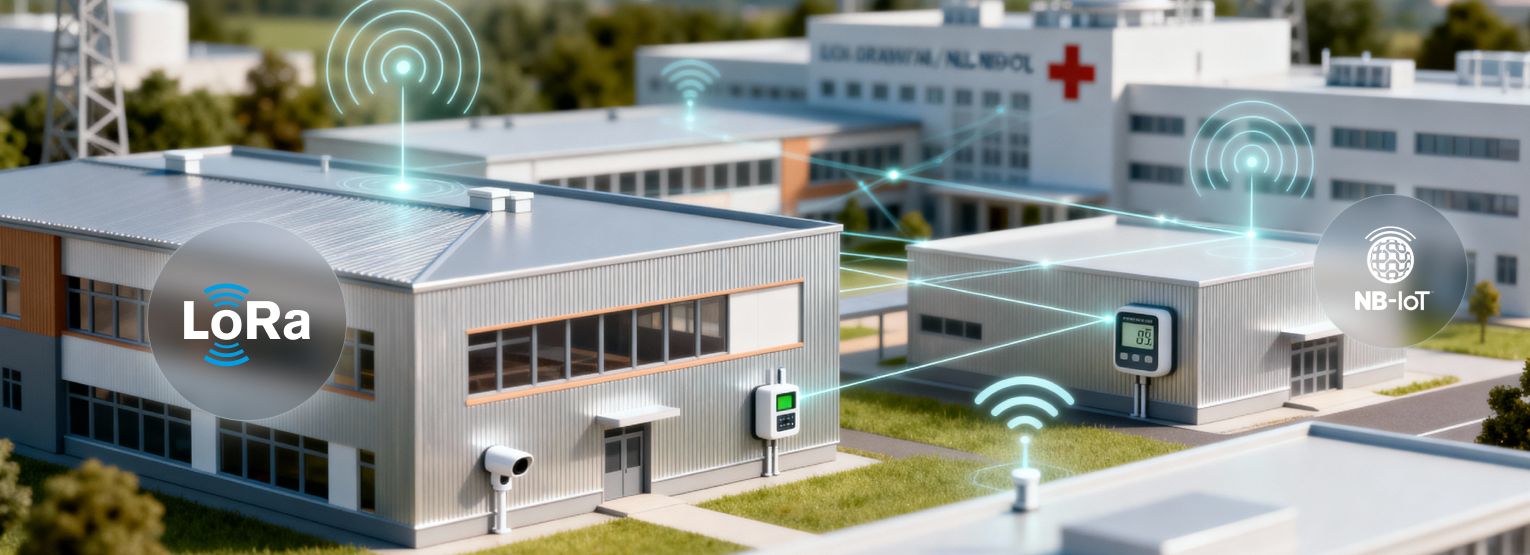
Wireless LPWAN technologies — LoRaWAN and NB-IoT — are stepping in to replace outdated approaches. That’s because wireless meter integration enables a unified digital environment for monitoring hundreds or thousands of devices, provides access to data without staff involvement, and allows flexible integration of equipment from different manufacturers.
For large complexes, remote data collection for utilities represents not just technological modernization but a transition to a new model of sustainable energy management.
Campuses and public-sector institutions share a key characteristic: a distributed, often heterogeneous engineering infrastructure. A single site may include dozens of buildings, each with its own consumption nodes and technical rooms, so achieving operational efficiency in institutions is not feasible. Manual data collection from hospital water and electricity meters, for example, leads to delays, inaccuracies, and the inability to detect anomalies at early stages.
Moreover, maintenance teams are forced to rely on fragmented information, making it difficult to plan repairs and optimize resource usage. With rising costs of energy and water, the absence of up-to-date data turns into direct financial losses. Instead, a unified digital metering system offers energy and water optimization, with a solution that synchronizes processes and makes the entire LoRaWAN/NB IoT infrastructure manageable.
LoRaWAN and NB-IoT are designed for long-range device communication with minimal power consumption. Their key advantage lies in the ability to support sensors and meters located at significant distances or in environments with complex building structures. This is particularly relevant for campuses, hospitals, and schools, where the signal must reliably penetrate multiple floors, basements, and technical corridors. In such projects, Jooby radio modules and sensors operating on LoRaWAN and NB-IoT standards are integrated directly into metering devices and engineering systems, ensuring stable wireless data transmission even under challenging radio conditions.
LoRaWAN and NB-IoT gateways are used to collect and aggregate data, receiving information from hundreds or thousands of devices and forwarding it to cloud-based or local monitoring systems. The use of Jooby gateways enables network coverage to be tailored to the specific architecture of a facility — from a single building to a distributed area — and allows the network to scale without replacing existing equipment.
Wireless networks eliminate the need for cabling, significantly accelerating infrastructure upgrades. Devices equipped with radio modules can operate on batteries for up to ten years, while centralized data collection via gateways provides a comprehensive view of resource consumption in near real-time. All of this makes large-scale monitoring deployment efficient, cost-effective, and low-maintenance.
Today, LoRaWAN/NB-IoT network integration supports smart water meters, heat, gas, and electricity meters, as well as leak detectors, temperature and humidity sensors, air-quality sensors, and equipment-status monitors. With a unified data transmission protocol, all devices in IoT metering systems, such as those used for school energy management, interact through a single infrastructure, forming an integrated monitoring ecosystem.
Collected information is delivered to a cloud platform, where it can be analyzed, visualized, forecasted, and used to generate reports. Remote metering for institutions will alert staff to abnormal events — whether it’s a water leak in a school basement or a sudden surge in energy use in a hospital wing. As a result, a connected utility infrastructure provides maintenance teams with a powerful tool for rapid response without constant physical inspections.
For utility providers and municipalities, a unified LoRaWAN metering system ensures transparency in billing. All data is transmitted securely via automated billing systems, eliminating errors, human factors, and disputes over consumption. For condominium associations and facility management companies, a multi-building metering system with real-time consumption tracking provides a way to reduce operational expenses through the early detection of issues.
Analytics adds further value: with centralized utility monitoring, managers can identify inefficient consumption zones, compare performance across buildings, and plan equipment upgrades based on real data. Over several years, it is precisely such strategic decisions that deliver the greatest financial return and improve comfort for facility users.
For large institutions, adopting LoRaWAN/NB-IoT is not merely a technical upgrade but a strategic shift toward predictive resource management and utility cost reduction. It creates a foundation for future services, such as automatic consumption control, intelligent thermal balancing, environmental monitoring, and enhanced safety.
The earlier facilities transition to a unified digital platform, the easier it becomes to scale new solutions and integrate additional sensors. As a result, predictive maintenance for campuses, schools, and hospitals is achieved using a controlled and efficient infrastructure capable of adapting to growing demands and increasing complexity.
Was it helpful?
 56
56


Stay on top of the latest industry news
Thank you, we have received your message. Our manager will contact you shortly.


Our experts are always happy to help and promptly answer your questions. Please fill out the form to discuss your project and develop a tailored action plan.
Thank you, we have received your message. Our manager will contact you shortly.
Thank you, we have accepted your request. In the near future the responsible manager will contact you and clarify the details of the order.
Our experts are always happy to help and promptly answer your questions. Please fill out the form to discuss your project and develop a tailored action plan.
Thank you, we have received your message. Our manager will contact you shortly.